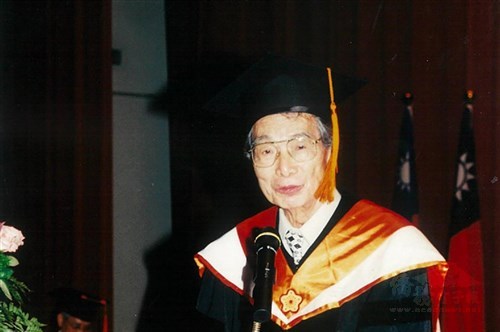
Taipei, Dec. 27 (CNA) Fung Yuan-Cheng, a bioengineer widely considered the "father of biomechanics," died Dec. 15 at 100 years old, according to an obituary released by the University of California, San Diego Dec. 20.
Born in 1919, Fung obtained his bachelor's and master's degree in aeronautics at National Central University in China. He went on to receive his Ph.D. in the same field at the California Institute of Technology, and served as an assistant professor and researcher at the school for 20 years.
In 1966, Fung co-founded the bioengineering program at the University of California, San Diego, and recruited Chien Shu, a famed physiologist and bioengineer, to teach at the school.
Chien, who is now president of the Biomedical Engineering Society, once said that Fung applied the principles of fluid mechanics to biomedical engineering, and adopted a more precise and realistic way of thinking about human health.
Many of Fung's papers were landmark achievements that built the foundation of biomechanics, Chien added.
Fung received many awards and honors in his life, including being elected in 1968 an academician at Academia Sinica, Taiwan's top research institute, and received an honorary doctorate degree from Taiwan's National Central University in 2002.
He was also awarded the National Medal of Science by then-U.S. President Bill Clinton in 2000, the first bioengineer to earn the distinction, and was a member of the U.S.' National Academy of Engineering, National Academy of Medicine and the National Academy of Sciences.
In 2008, Taiwan's National Central University named an asteroid discovered by the school's Lulin Observatory "Fungyuancheng," in honor of his scientific achievements and rigorous scholarship.
In Fung's biography, he wrote that he wanted to pursue biomedical engineering because his mother developed glaucoma, a disease which causes vision loss.