


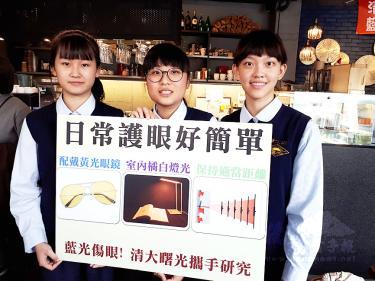
Research from students at Shu Guang Girls’ Senior High School in Hsinchu, featured at the Optic and Photonics Taiwan International Conference (OPTIC), found that yellow-tinted lenses or using different text colors could help protect the eyes while looking at computer screens.
National Tsing Hua University materials science and engineering professor Jou Jwo-huei, who has collaborated with the high school for five years, led the team.
The average time spent in front of a computer, cellphone or tablet is growing and leading to more young people being diagnosed with eye problems, Jou said on Monday.
The trend, and how to counter its effects, became the research topic for the students, he said.
Students Chang Chia-ning and Lin Chih-yu said they used a blue light quantification spectroscope developed by Jou to identify the maximum exposure limit of the human retina to light when wearing different colored glasses.
They said their research shows that wearing yellow-tinted glasses could extend the time spent in front of a computer screen by 8.27 times with only a 10 percent loss in clarity, while blue-tinted glasses would only increase the time by 1.1 times while losing 50 percent clarity.
Students Hsieh Chi-en, Yeh Yu-hsuan and Chang Tzu-yu said their research showed that the clarity of the typeface did not change whether it was white with a black background, black on white or orange on black.
However, orange on black caused an increase in melatonin, providing more than 20.2 times the protection for eyes, they said.
Students Chang Wen and Jen Yung-wei researched photonics by experimenting on snow peas, and found that a suitable amount of light would benefit plants by 35 percent, compared with environments with no light.
Students Shu Chih-yu, Huang Kai-lin, Tseng Chia-hsuan and Wei Yu-fang said that exposure to light for yeast cultures, which are usually kept in the dark, would result in 4.2 times growth, compared with yeast cultures with no exposure to light.
Shu Guang principal Yao Li-ying said nearsightedness was common at the school, and that more than 91 percent of high-school students and 88 percent of junior-high school students wear glasses.
The students’ research could lead to ways to protect the eyes while giving students a competitive edge, she added.