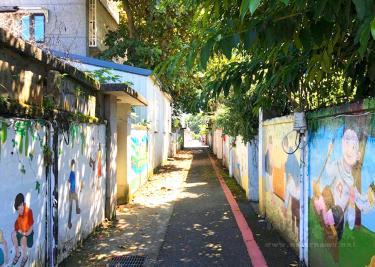
Hualien is seeking cultural heritage status for a military dependents’ village that is nearly 80 years old, the city government said on Saturday.
Better known as juan cun, the villages are residential compounds that were set up to house soldiers and family members brought to Taiwan with Chiang Kai-shek’s Nationalist Army in 1949.
There are 10 dependents’ villages within the city, but only Jie Shou Village still has all of its original architecture, the city government said.
The village also has a background rooted in the Japanese colonial era, and preserves elements of the societal transition that occurred following World War II, it said.
The houses in Jie Shou were built in 1941 by the Japanese colonial administration as a public housing facility, as there was a housing shortage, the city government said, adding that it contained 27 Japanese-style buildings with two units each, totaling 54 units.
Less than five years after the village was built for Japanese, it was occupied by Nationalist soldiers and their families arriving from China, it said.
In 1969, the village had new residents once again when the air force relocated and the village became home to military doctors and nurses, National Yunlin University of Science and Technology assistant professor Hsu Hui-min said.
The village retained its original character, as residents left it largely untouched, he added.
“From experience, there is a long road ahead before acquiring cultural heritage status for the village, which would include funding for the village’s restoration,” he said.
Government officials and public representatives would need to fight to secure that funding, he added.
As 34 of the village’s 54 units still have people living in them, he suggested finding a few who were interested in renovating first, so that their units could serve as models to present to the central government.
Renovations could focus on how to integrate modern and historical elements, he said.
Those concerned with preserving the village should gather all of the research material they can to help the public understand its history, Hualien Mayor Wei Chia-hsien said, adding that if it can be preserved, the village would serve as an important part of the city’s unique cultural history.