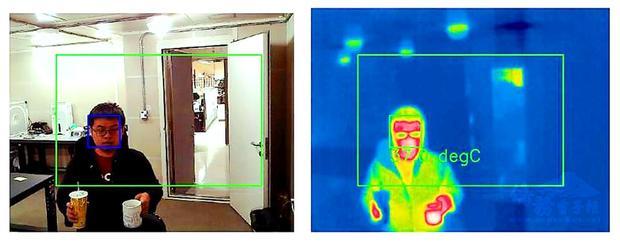
The National Health Research Institutes on Monday unveiled a new type of infrared thermal imaging camera that excludes nonhuman objects, such as hot coffee and cold drinks, from temperature readings, allowing disease prevention efforts to be more precise.
Equipped with multiple sensors, the system can simultaneously detect the temperatures of three to six people — even when they are moving and wearing a mask, cap or glasses — from a distance of 1m to 3m, said Liao Lun-de, head of the team that developed the device.
The camera uses artificial intelligence to detect the contour of a human face before it takes a temperature reading, so food and drinks carried by subjects would not trigger the system, Liao said.
In an experiment in which 200 anonymous participants in an open space passed by the camera separately, the temperatures recorded by the system were close to those of a forehead thermometer, he said.
If the system is deployed in an office building, people can swipe their identification cards before entering the detection area so the system can automatically build a database of individual temperatures, Liao said, adding that ear and forehead thermometers would require the additional step of creating and maintaining a handwritten log.
The team is working on enabling the system to use facial recognition, which could save even more time, he said.
When it detects an abnormal temperature, the system issues an alert, takes a picture and notifies disease prevention personnel via mobile phone and computer, reducing staff requirements and making data tracing easier, Liao said.
Many countries, particularly those covered by the government’s New Southbound Policy, have expressed an interest in the system, he said.