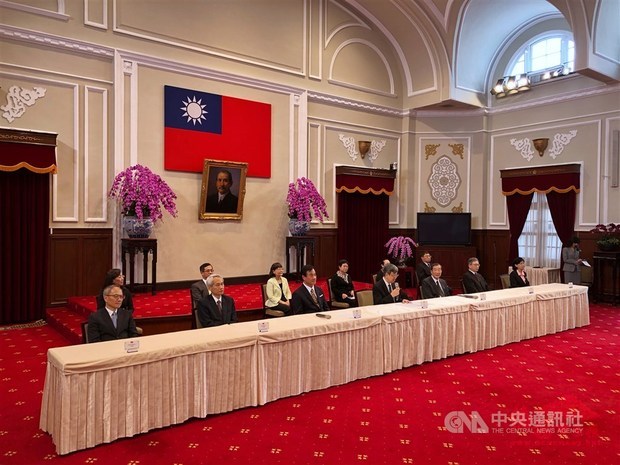
Taipei, May 29 (CNA) President Tsai Ing-wen on Friday submitted a list of 11 nominees to run the Examination Yuan when the streamlined version of the branch of government responsible for national exams and management of civil service personnel opens in September.
Before the list was sent to the Legislature for confirmation, Tsai met with the 11 nominees at the Presidential Office.
Among them, former Education Minister Huang Jong-tsun and Chou Hung-hsien, the current Minister of Civil Service under the Examination Yuan, have been nominated to be the next president and vice president of the body.
Former Vice President Chen Chien-jen, who headed the team that come up with the list from 60 candidates, said Tsai picked Huang for his experience in government and Chou for his familiarity with the Examination Yuan after four years in his ministerial post.
Tsai also expressed the hope the nine other nominees, who will serve as Examination Yuan ministers without portfolio, will help Huang, Chou and the body's two ministries to push for reforms while working with their counterparts in the Cabinet as a team, Chen said.
Two of the nine nominees, Yang Ya-hwei and Chen Tsi-yang, are existing ministers without portfolio, who took up their posts in 2014 and 2017, respectively.
Several other nominees were former university presidents or vice presidents, including former Southern Taiwan University of Science and Technology Vice President Wu Hsin-hsing, former Chang Jung Christian University President Chen Chin-seng, former Kaohsiung Medical University Vice President Wang Hsiu-hung, and former National Taipei University of Technology President Yao Leeh-ter, according to the Presidential Office.
The other nominees were Chou Lien-siang, a professor in National Taiwan University's Institute of Ecology and Evolutionary Biology; Ho Yi-chen, director of National Chengchi University's Department of Public Finance; and current Council of Indigenous People deputy chief Iwan Nawi.
The Presidential Office expects the Legislature to complete a review and approve the nomination by the end of June, before the new term begins on Sept. 1.
The new term of the Examination Yuan will be different after the amendments to the Organic Act of the Examination Yuan came into effect in early January, which shortened the terms of members from six to four years and cut the number of ministers without portfolio from between 17 and 19 to between seven and nine.