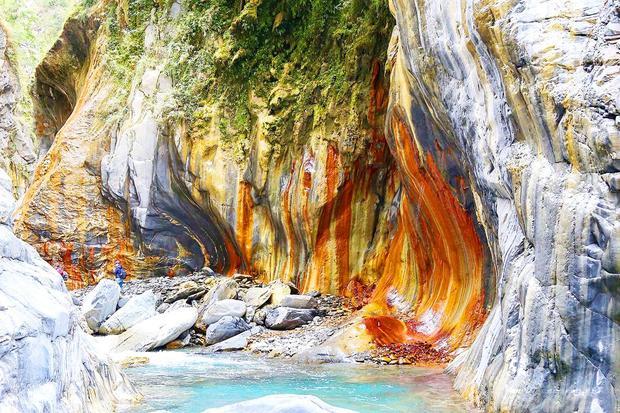
A registration system to limit visitors to the Hayou River, a popular destination in the mountains of Pingtung County, is to be imposed to reduce the environmental impact of tourism, the Pingtung County Government said
Hayouxi Hot Spring with its colorful cliff formations has attracted ever more visitors in the past few years despite its remote location.
The county government in a press release on Friday said it has designed Wutai Township a “Natural Environment and Cultural Scenic Area,” including the river as well as the Aboriginal Labuwan, Adiri and Kabalelradhane communities, covering 14.35km2, featuring hiking trails, mountain lakes and waterfalls.
Most tourists visit the area by scooter or car, but after new rules go into effect in November, visitors would need to register in advance, and hiking would only be allowed for guided tours, a county government official said, adding that those who enter the area without registration would be fined between NT$3,000 and NT$30,000, based on stipulations of the Act for the Development of Tourism.
Visitors must register online one to two weeks in advance, and guided tours would be offered for between NT$1,400 for two to four hours and NT$2,500 for day tours, with a maximum of 21 people per group, the county government said.
Wutai Township officials said that the number of visitors to Hayou River would be limited to 500 participants per day, and fees would be used for environmental protection in the area and to support the local Rukai Aboriginal communities.
Wutai Towship Mayor Kalrimadraw said he has been pushing for the designation of the area for five years, and has sought advice from and collaboration with the county government, the Ministry of Transportation and Communications, the Ministry of the Interior, and the Ministry of National Defense.
“We are the first Aboriginal area in the nation to be designated a ‘Natural Environment and Cultural Scenic Area.’ The new regulations will reduce the impact of tourism on the local environment and allow us to manage natural resources for sustainable development,” he said.
In other developments, the Forest Bureau’s Chiayi County Office has announced a daily limit of 500 visitors to the area around the abandoned Japanese-era “Mian-yue” branch line of the Alishan Forest Railway, as the sight has also attracted more visitors in the past few years.
Bureau officials said the quota would be strictly enforced starting on Sept. 1, to protect the area’s forests, and those breaching the regulation would be fined according to the law.
Officials said they would periodically reassess the maximum capacity of the area for hikers and camping, and the abandoned railway would undergo regular maintenance and cleaning, while environmentally friendly washrooms were installed along the trails in the past few months.
Visitors to natural preserve areas and mountain forests should try to reduce their environmental impact, and not leave any trash, Taiwan Thousand Miles Trail Association director Hsu Ming-chien said, adding that people might also collect trash they find along the trails.
The Forest Bureau and hiking associations are also planning to hold mountain cleanup events around the nation, starting in the coming months, the bureau said, adding that visitors should observe the fundamental rule: “Take nothing but pictures. Leave nothing but footprints.”