Los Angeles, Sept. 10 (CNA) Starting with a humble beverage shop, a Taiwanese-American boba tea entrepreneur managed to transform his business into a multimillion-dollar packaging giant that is publicly listed on Nasdaq.
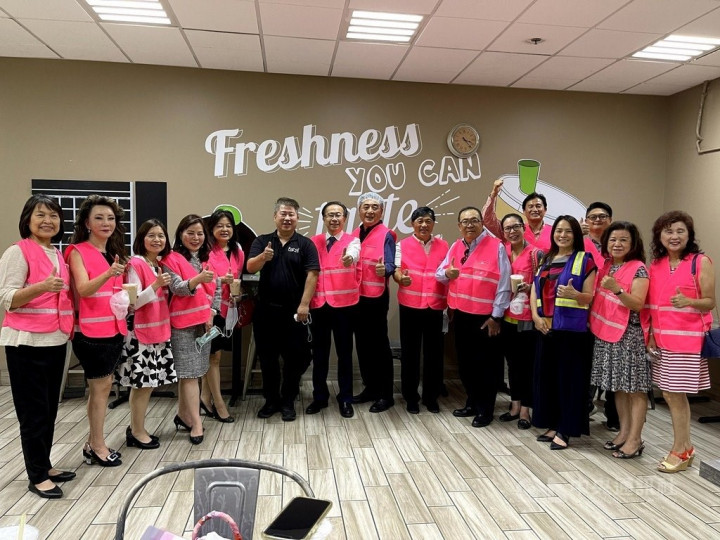
On Sept. 8, Taiwanese-American entrepreneur Alan Yu shared his success story as he hosted a delegation made up of members from the Taipei Economic and Cultural Office in Los Angeles (TECOLA), the Taiwanese-American Chamber of Commerce of Greater Los Angeles (TACCLA) and media representatives.
The meet was held at Yu's facility located in Chino, California. The roughly 50,000-sq-ft facility serves as the principal executive and administrative headquarters of his companies: Karat Packaging, Inc. and Lollicup USA, Inc., as well as a manufacturing plant for select products.
Karat is currently a publicly listed company valued at approximately US$368 million.
However, Yu's empire came from humble beginnings. His first foray into the food and beverage industry began in 2000 when he decided to open his first boba tea shop in San Gabriel, California with his partner Marvin Cheng.
Soon, Lollicup USA Inc. was founded, focusing initially on the establishment, franchising and licensing of boba tea stores all across the U.S.
According to Yu, he was the person who coined "boba tea," the English term used to describe the internationally popular Taiwanese beverage.
Yu said that instead of using "pearls," the term commonly used in Taiwan to describe the jewel-like tapioca balls, he decided on "boba," an older Mandarin slang used to describe the voluptuous figure of a woman, to associate the snack with the supersizing of day-to-day items commonly practiced in the U.S.
The operation quickly went from a single store in 2000 to more than 60 stores in 2006. To guarantee quality control in all of their stores, the company expanded its focus in 2004 to include the distribution of supplies for the entire boba industry in the U.S.
Later, in 2014, the company began distributing and manufacturing products under a new brand, Karat, as a result of a growing demand for their packaging products in the U.S. food service industry.
Karat Packaging Inc. was eventually incorporated in September 2018 as the holding company for Lollicup.
In response to being asked about the key to his success, Yu said that it is always important to keep risk diversification in mind during the growth process of a company. Yu also said dedication, adaptability and perseverance in problem-solving were factors that enabled the company's growth.
Echoing Yu's statement, Lollicup and Karat's Chief Operation Officer, Joanne Wang , used examples of how the company spread its focus in the last 20 years, all the while coming face to face with unforeseen obstacles such as the September 11 attacks, the 2018 financial crisis, and the most recent COVID-19 pandemic.
"There are a lot of people out there in the business of boba tea products," Wang said, "but we are able to achieve what others could not, such as decreasing volume to lower logistics expenses, and selecting the right kind of plastic to minimize breaking during transport."
Liu Lun-cheng , head of the Economic Division at TECOLA who was also in attendance, said Yu's ability to transform a small-scale beverage shop into a NASDAQ-listed public company fully encompassed and represented the hardworking spirit of the Taiwanese people.
TACCLA's president, Lisa Liu , noted that it was an impressive feat for a Taiwanese-American founded company to penetrate the mainstream U.S. market, getting clients such as popular food chains like TGI Fridays.
Today, Lollicup has a geographical reach across six U.S. states, consisting of distribution centers, supply stores, manufacturing plants and warehouses in Hawaii, Washington, California, Texas, South Carolina and New Jersey.