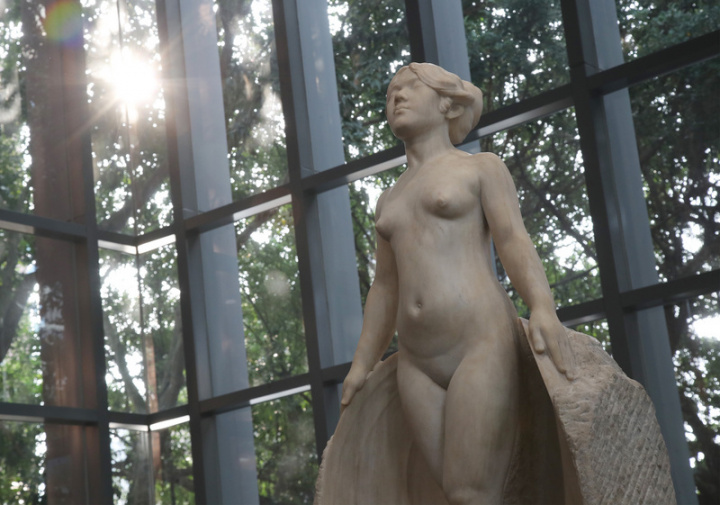
Taipei, Dec. 16 (CNA) A long-lost nude sculpture by late Taiwanese sculptor Huang Tu-shui (黃土水) will be the central exhibit at an art exhibition to be held at the Museum of National Taipei University of Education (MoNTUE) from Saturday through April 2022.
The exhibition, titled "Lumiere: The Enlightenment and Self-Awakening of Taiwanese Culture," will feature the newly-found sculpture, Water of Immortality (formerly translated as Sweet Dew), along with paintings and writing by more than 20 Taiwanese artists and literary figures from the Japanese colonial period.
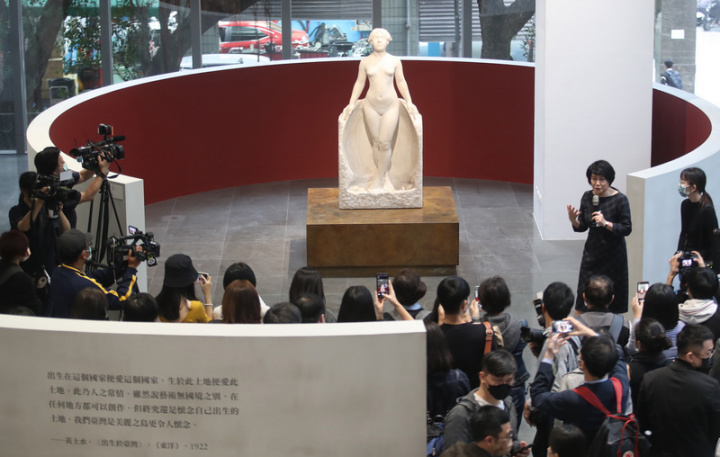
During a press conference on Thursday before the official opening of the exhibition on Dec. 18, Lin Mun-lee (林曼麗), the exhibition curator who discovered Huang's sculpture early this year, expressed her happiness and excitement about the event which she said is long overdue and highly anticipated by many, especially people in the world of art.
This year marks the centenary of the sculpture's completion, as well as the founding of the Taiwan Cultural Association, which launched the New Cultural Movement and ushered in a golden age for Taiwanese art, Lin added.
"We are fortunate to be able to include Water of Immortality, which is the last piece of lost art history, in the exhibition," Lin said.
The sculpture, which stands at the back of the gallery beside a wall of windows, is bathed in rich sunlight on this warm Thursday afternoon.
It portrays a young woman, with a calm yet confident countenance, standing upright with her head tilted slightly backwards and both hands holding either side of a large shell behind her.
"I have been watching her since the day she was placed in the gallery, and I find her more beautiful as the days go by," Lin said, "She's finally having a rebirth after more than 50 years in darkness," referring to the fact that the sculpture was kept in a wooden case for the last half century.
Chou Wan-yao (周婉窈), head of the exhibition's research team, explained the title of the event, saying that the word lumière, French for light, best captures the spirit of that era, when people were searching for light which symbolizes a better, more progressive future.
"'Water of Immortality' is the central symbol of light, representing Huang's anticipation for Taiwan's society at that time," Chou said.
The exhibition also features artworks that were recently found or displayed for the first time ever, including late Taiwanese painter Ran In-ting's (藍蔭鼎) "A Noodle Stand at Night" and Chen Chin's (陳進) "Embroidering the Skirt."
Artworks from iconic Taiwanese painters, including Chen Cheng-po (陳澄波), Kuo Po-chuan (郭柏川), Liao Chi-chun (廖繼春), Li Mei-shu (李梅樹), Chen Chih-chi (陳植棋) and Kuo Hsueh-hu (郭雪湖), are also displayed throughout the exhibition's four sections.
The exhibition runs from Dec. 18, 2021 through April 24, 2022.