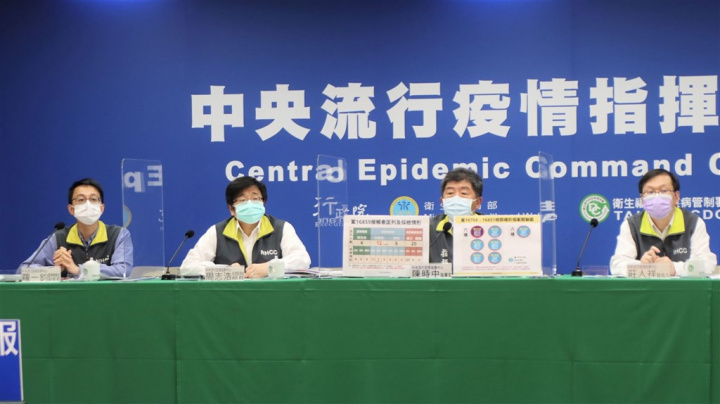
Taipei, Dec. 17 (CNA) All contacts of a COVID-19 patient linked to a cluster infection at a quarantine hotel in Taoyuan have so far tested negative for the disease, the Central Epidemic Command Center (CECC) said Friday.
The individual was considered a major concern in the cluster because he had entered the community after leaving quarantine before testing positive for COVID-19, Health and Welfare Minister Chen Shih-chung (陳時中) said at the daily CECC press briefing Friday.
According to the CECC, the Taiwanese man, who returned from China on Nov. 20, had tested negative for COVID-19 after arriving in Taiwan as well as prior to the end of his quarantine, but another test he took seven days after leaving the hotel where he had spent his quarantine came back positive.
Chen said 16 contacts in the community and 37 workers at the hotel have all tested negative for COVID-19.
Subsequent tests have also been carried out on 418 people who had either stayed or are still doing quarantine at the Taoyuan hotel, he explained. So far, 400 of them have tested negative for the disease while the CECC is still waiting for the results of 15 others.
Three have tested positive for COVID-19, of whom two never entered the community and have already been counted as part of the cluster, the health minister said, while the third has been deemed a separate case.
The third case is a woman who returned from Cambodia on Nov. 21 and had stayed on the fifth floor of the same Taoyuan hotel.
Although having entered the community after leaving quarantine, Chen said two subsequent COVID-19 tests then showed a positive and a negative result, suggesting that the case could be a false positive test result as the woman had recovered from the disease once in Cambodia.
Chen said the case posed a minimal threat to the community as test results showed the woman had a low viral load of the disease.
According to the CECC, seven people have been identified as being part of the Taoyuan hotel cluster infection, and genome sequencing showed that they were all infected with the same Delta strain of the COVID-19 virus.
Also on Friday, the CECC announced that seven previous cases deemed to be "imported" had been reclassified as domestically-transmitted infections. Six of them were part of the Taoyuan hotel cluster while the seventh case had stayed in another quarantine hotel in Taipei.
The seventh case, a woman, was one of two Taiwanese nationals who recently tested positive for COVID-19 after staying in adjacent rooms at the Taipei hotel. The woman tested positive Tuesday, two days after leaving quarantine, and a man tested positive while still in quarantine Wednesday. The woman's case was subsequently reclassified from an imported COVID-19 case to a domestically-transmitted one.
At the press event, Chen confirmed that genome sequencing had showed that both were infected with the same Delta strain of the COVID-19 virus and that one had infected another, noting that the man was the likely source of infection.
According to the Taipei City government on Thursday, the woman's positive test had a CT level of 12, indicating a recent infection, while the man had a relatively high CT level, which suggests he could have been infected a while ago.
All four members of her family have so far tested negative for COVID-19, he said, while the results of other contacts in the community and hotel had all came back negative for the disease.
In a separate press event earlier in the day, Taipei Deputy Mayor Tsai Ping-kun (蔡炳坤) said although there were no interactions between the man and woman during hotel quarantine, they likely got infected from the airflow circulation in the corridor as they had opened the doors to their room around the same time to pick up their delivered meals.
Tsai said the city will not rule out requesting quarantine hotels to separate meal collection times, pending discussions with relevant experts on the matter.
During the CECC briefing, Chen responded to reporters that it was unlikely the two had gotten infected in that manner, and said he believed that environmental contamination was the more likely cause.
Regarding whether there will be changes to the CECC's "7+7" quarantine plan, he said there was no need for any adjustment.
Under the 7+7 plan, which is intended to be in place from Dec. 14-Feb. 14, arrivals can spend the first seven days of quarantine at a hotel or government facility before finishing the rest of the quarantine period at a personal residence.
To be eligible, travelers must provide proof that they have been fully vaccinated at least 14 days before arriving in Taiwan with a vaccine recognized by the World Health Organization or the Taiwanese government.