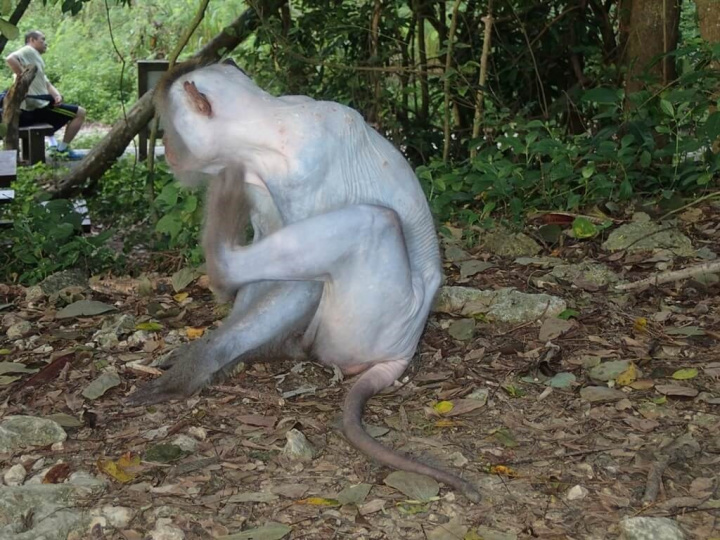
Kaohsiung, Jan. 30 (CNA) Researchers have pinned the blame for an outbreak of baldness among Formosan macaques in Kaohsiung's Shoushan National Nature Park on the twin stresses of high population density and less generous tourists.
The academics from the National Pingtung University of Science and Technology (NPUST) were originally called in by park authorities in 2015 over concerns that the hair loss, which first appeared in 2013, was caused by an unknown infectious disease.
But in findings released last year, the NPUST researchers instead pointed to high levels of stress for the appearance of alopecia in the park's primate population.
Chen Chen-chih (陳貞志), an NPUST professor who headed up the study, told CNA recently that his team took skin samples from randomly selected monkeys at Shoushan for fecal glucocorticoid metabolite analysis, which can be used to detect stress levels.
Test results showed that monkeys suffering from hair loss had higher levels of glucocorticoid hormones, indicating that they were more stressed out than their hirsute counterparts.
Chen's team attributed this to the high density of Formosan macaques living in the Kaohsiung mountain, itself a consequence of the fact that people have been feeding the monkeys there for decades.
The average density of Formosan macaques in Taiwan is around 10 to 20 monkeys per square kilometer. However, at Shoushan, the population density was 200 monkeys per square kilometer, according to the study.
But with Kaohsiung and park authorities having greater success in encouraging visitors to stop feeding the animals, monkeys originally drawn to the area for its abundance of food are now going hungry.
This has led to more stress and less hair for some of the park's inhabitants, according to Chen.
Chen said the ultimate solution to the hair-loss problem among monkeys would only be achieved if their population continued to decrease.
However, he said it was debatable whether humans should play an active role in artificially decreasing the number of monkeys in Kaohsiung, or if nature should be left to run its course - a process that could take decades.
The NPUST study was previously published at Scientific Reports, an online peer-reviewed journal, in May 2021.