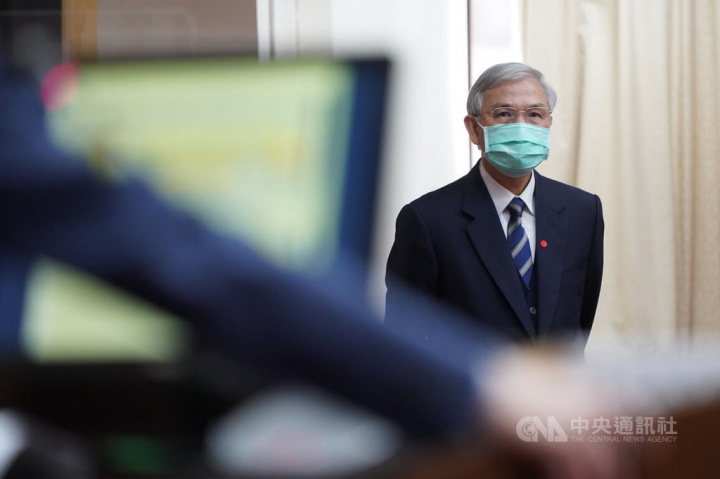
Taipei, March 10 (CNA) Taiwan's Central Bank Governor Yang Chin-long (楊金龍) said Thursday that the country is facing rising imported inflation pressure but its economic fundamentals remain solid.
At a legislative hearing, Yang said that while product prices on the domestic market have remained stable compared with other countries, Taiwan will later feel the effects of increasing prices of energy and staple commodities on the international market, which has resulted from the ongoing Russia-Ukraine war.
The growing imported inflationary pressure in Taiwan is being caused mainly by a demand-supply gap, he said, explaining that demand for products and services has been rising as the COVID-19 pandemic eases globally but blockages at major ports worldwide have caused product supply delays.
Taiwan, however, is unlikely to fall into stagflation -- economic stagnation accompanied by rising inflation -- he told lawmakers in the legislative Finance Committee during the hearing.
"Import-induced inflationary pressure is indeed increasing in Taiwan, but stagflation is unlikely, as the country's economic fundamentals remain sound," Yang said.
On the question of whether the central bank would resort to credit control to rein in housing prices, Yang said that approach was a possibility, as it was quite effective in 2010 when it was adopted in some areas of Taipei and New Taipei.
There would be no good reason for the government to intervene, however, as long as Taiwan's stock and housing markets remain underpinned by a solid economy, he said, adding that the domestic economy has been performing well since 2018.
The central bank will discuss the possibility of introducing some gradual measures that would allow a "soft landing" of the housing market, Yang added.
Meanwhile, in response to lawmakers' concerns that the United States may name Taiwan as a currency manipulator this year, Yang said the central bank will try to avoid that.
He said a country is named as currency manipulator when it has a current account surplus that exceeds 3 percent of its GDP, it has a bilateral trade surplus of over US$15 billion with the U.S., and its net purchase of the U.S. currency is more than 2 percent of its GDP for at least eight months a year.
While the first two conditions apply to Taiwan, the third one does not, Yang said, adding that the central bank will continue to communicate with the U.S. to avoid being labeled as a currency manipulator.