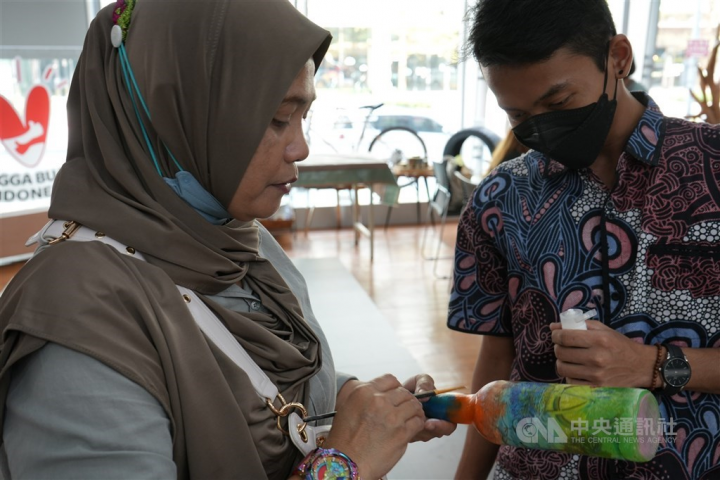
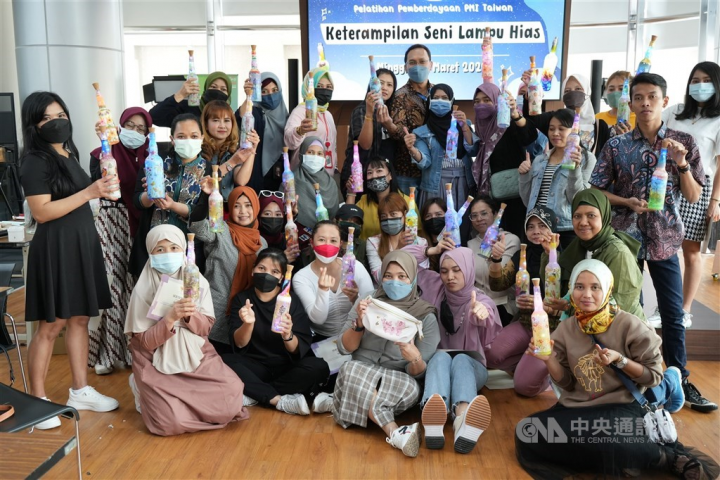
Taipei, March 21 (CNA) The Indonesian representative office in Taiwan organized a free handicraft lesson on Sunday to teach Indonesian migrant workers how to make homemade bottle lamps so that they could acquire entrepreneurship skills in preparation for their return home.
The lesson was held at the Indonesia Exhibition Center at the Indonesian Economic and Trade Office (IETO) in Taipei and was attended by close to 40 participants, most of whom were Indonesian migrant caregivers.
The participants were all smiles and filled with a sense of accomplishment when they decorated their lamps made of recycled glass bottles, using colorful paint, vivid decoupage designs, and delicate LED lights.
Dwi Tantri, an Indonesian community leader and caregiver based in Keelung, who was the instructor of the class, told CNA the event aimed to teach Indonesian migrant workers a skill that they can use to start a small business when they return to Indonesia.
According to Tantri, a beautifully handmade bottle lamp can sell for around NT$500, approximately 252,536 Indonesian Rupiahs in Indonesia.
NT$500 is a considerable amount for them because the average daily salary of an Indonesian migrant caregivers in Taiwan is only NT$567, according to Tantri.
The ability to start a small business in Indonesia after returning from Taiwan means that the workers will not have to leave their families again in the future to work in another country, Tantri said.
"We should be staying with our families where we are happy and at the same time be able to make an income," said Tantri, who has a husband and six sons in Indonesia.
Having already worked in Taiwan for over a decade, Tantri said she will be returning to Indonesia this year and will be looking forward to forming partnerships with other former migrant workers to start businesses.
Also speaking with CNA, migrants taking the lesson expressed their gratitude towards IETO for helping them learn new skills.
Winarsih, a 47-year-old caregiver from Taipei, said she was thrilled about the lesson and plans to sell handicrafts when she returns to Indonesia, while fellow compatriot Ratna Juwita Sari said she found the lesson beneficial and hopes to attend future training sessions.
Meanwhile, Siti Fatimah, a 28-year-old caregiver from New Taipei, said even though she doesn't have concrete plans to open a business in the future, she had always wanted to learn how to make bottle lamps.
"I wanted to learn so I can also teach my family and friends. If they like it then we might think about starting a business," Siti said.
Noerman Adhiguna, an analyst with IETO's labor department, told CNA they plan to continue to hold various lessons for handicrafts, culinary, makeup and beauty, and other-related training programs free of charge with the aim of teaching up to 500 Indonesian migrant workers this year.
However, the lessons will be organized depending on the situation of the COVID-19 pandemic at the time, Noerman said.
IETO has been organizing and co-organizing training activities for Indonesian migrant workers for many years, but large and frequent gatherings have been limited due to the coronavirus, Noerman said.