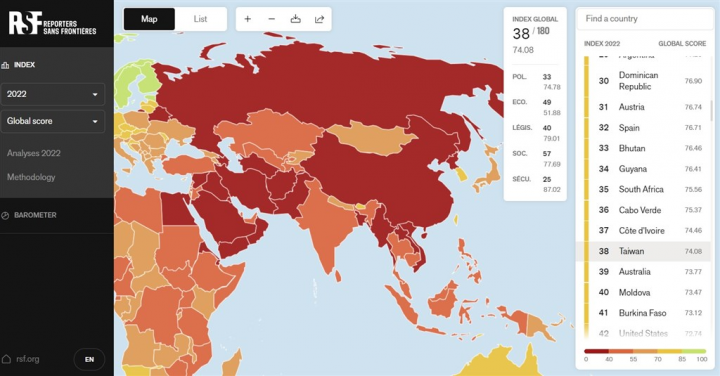
Taipei, May 3 (CNA) Despite Taiwan moving up five places to No. 38 in the latest World Press Freedom Index by Reporters Without Borders (RSF) released Tuesday, the organization said more needed to be done to address the "toxic" working environment for journalists in the country.
Taiwan's ranking placed it fourth in the Asia-Pacific region, behind New Zealand (11th), East Timor (17th), and Bhutan (33th), but ahead of Australia (39th) and South Korea (43th).
Taiwan was among the 40 countries listed in the index as having a "satisfactory" media environment.
Meanwhile, the index's top three spots went to Norway, Denmark, and Sweden, in that order, with the three Nordic countries considered to have a "good" media environment.
Commenting on the latest World Press Freedom Index, Cédric Alviani, head of RSF's East Asia Bureau, said the change in Taiwan's ranking did not reflect the country's improvement but was rather the result of a modified way of compiling the index.
"This year, Taiwan is moving up five ranks, does not reflect any significant improvement in terms of press freedom," Alviani told CNA during a telephone interview Tuesday. "So the movement is purely due to the new system we used to make the index."
This change of criteria and methodology enabled the index to better reflect the current press freedom situation of every country, Alviani noted.
Issues impairing press freedom in Taiwan
While Taiwan has taken a favorable spot in the index, the country's press freedom situation has been "impaired" by some "serious problems," Alviani said.
The political polarization of the media in Taiwan and the sensational approach that Taiwanese media takes to report certain news has posed an "obstacle" to the public getting factual and objective information, Alviani added.
He noted that RSF had for the past year repeatedly called for Taiwan's government to take some measures to address these problems, such as providing some serious funding for public broadcasters without compromising such entities' editorial independence.
"So far, nothing really ambitious has been taken. [The government has] only been mostly speaking or supporting some small-scale initiatives. But it's not enough," Alviani said.
He also said the working environment for journalists in Taiwan was "quite toxic" and that such a situation continued to impact Taiwan's press freedom.
Many young journalists have chosen to change jobs after a few years of work because they were underpaid and overworked, and because it was not possible for them to do quality reporting as they had expected to do, Alviani said, citing RSF's past interviews and discussions with Taiwanese journalists.
"I believe that every journalism student has dreams of winning a Pulitzer Prize and making a great career as a journalist. The current environment in Taiwan does not allow it ... for the vast majority of the people [in the industry]," Alviani said, adding that there should be bipartisan efforts to tackle the problem.
Other East Asian countries
In East Asia, which includes Taiwan, China, South Korea, North Korea, Japan, and Mongolia, the press freedom situation is "getting worse," according to Alviani.
In particular, the ranking of Hong Kong in the latest index showed "one of the biggest downfalls ever in our index over the past 20 years," Alviani said.
Hong Kong ranked 148th in the 2022 press freedom index, slipping 68 spots from No. 80 in the previous ranking.
Last year, Hong Kong authorities began targeting news organizations and journalists on charges related to the national security law, leading to the closure of major independent news outlets such as Apple Daily and Stand News, Alviani said.
"One could be afraid that in a few years, let's say before the end of the mandate [of the Sino-British Joint Declaration], freedom of the press in Hong Kong would be no better than freedom of the press in the rest of the country," he said, referring to China, which finished at 175th in the 2022 index.