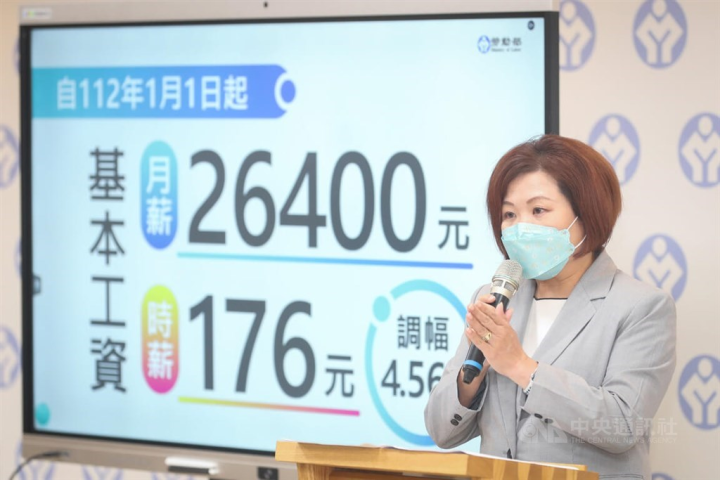
Taipei, Sept. 1 (CNA) A 4.55 percent hike in the minimum monthly wage next year agreed by the Ministry of Labor's (MOL) Minimum Wage Review Committee Thursday is intended to both offset inflationary pressure on workers and minimize the cost to businesses, many of which have barely recovered from the impact of the COVID-19 pandemic, Labor Minister Hsu Ming-chun (許銘春) said that day.
The committee decided to increase the minimum monthly and hourly wage by 4.55 percent and 4.76 percent, respectively, effective Jan. 1, 2023.
If the proposal is approved by the Cabinet, the increase will raise the minimum monthly wage from the current NT$25,250 (US$828) to NT$26,400, and the minimum hourly wage from NT$168 to NT$176, according to the committee.
However, the hike failed to meet the 11 percent increase demanded by labor union leaders, while some business leaders also voiced frustration, saying they had expected the rise to be below 3 percent.
Speaking in defense of the committee's decision, Hsu said the 4.55 percent hike was a compromise between members of the committee who represent labor unions and business associations.
The hike was calculated based on an assessment of inflation as measured by the Consumer Price Index growth and economic growth this year, which are forecast to be 2.92 percent and 3.76 percent respectively, Hsu said.
It was a result of adding 2.92 percent and half the economic growth rate, to secure "a share of the fruits of economic growth" for labor and management, while taking into account the pandemic-hit economy, she said.
At the meeting, labor representatives said inflation has eaten into wage increases, while business representatives argued that inflation also pushed up production costs and caused declining revenue, with some businesses still struggling to rebound from the pandemic, she noted.
The pay raise will benefit 1.75 million local workers, including 484,300 migrant workers -- most of whom work in industries, the construction sector and nursing institutions covered by the Labor Standards Act, as well as 574,600 local workers paid by the hour, according to the ministry.
The committee's decision marked the seventh year in a row President Tsai Ing-wen's (蔡英文) administration has raised the minimum wage.
As compared to the level before Tsai came to office in 2016, the minimum monthly wage has increased by 31.9 percent from NT$20,008, and the minimum hourly wage by 46.7 percent from NT$120.
However, the minimum monthly wage is still below the campaign pledge Tsai made in 2016 to raise the minimum wage rate to NT$30,000.
Hsu said the government has moved toward that goal over the years but also needs to avoid causing major disruption to businesses and the job market amid challenges faced in the post-pandemic era.