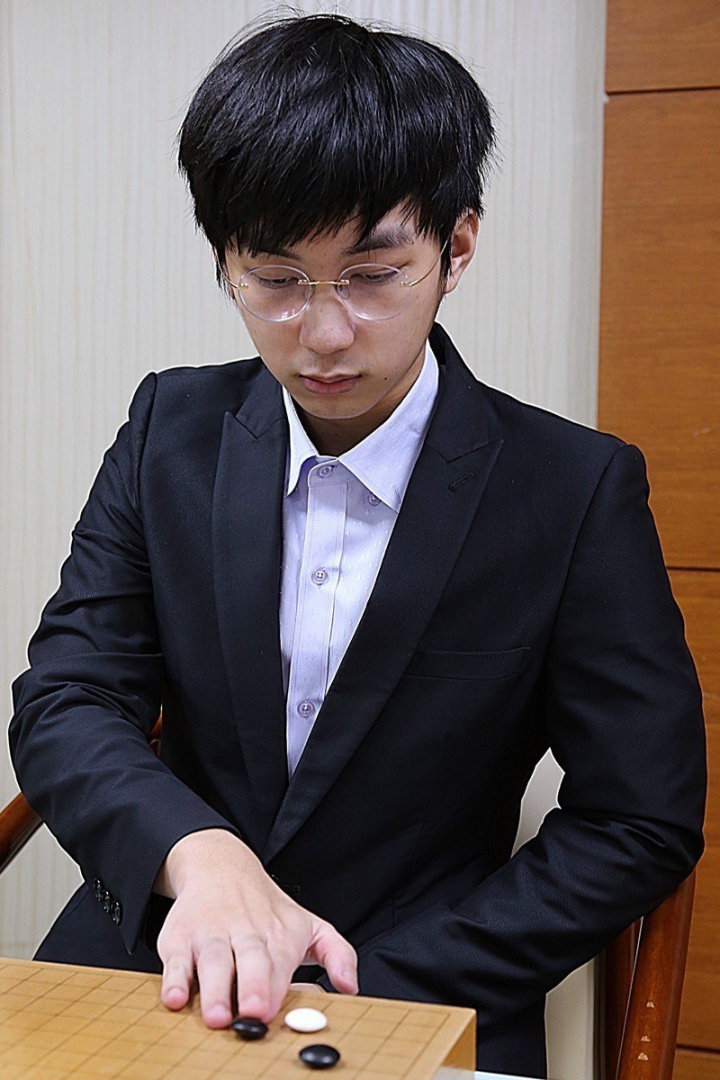
His 24 career titles in Taiwan have laid the foundation for him to challenge the world's top players, and Hsu told CNA in a recent interview that his focus now is on winning international titles.
He could not hide his excitement when talking about the Hangzhou Asian Games, which have been postponed to September 2023 due to COVID-19.
"Compared with other sports, Go players have far fewer chances to represent our countries," Hsu said, and identified his biggest goal in 2023 as preparing himself for a strong outing in Hangzhou.
In the professional world of Go, there are at most a handful of top-flight international events every year, and Taiwanese are generally given only one slot in each tournament, mitigating the odds of any Taiwanese winning at the world's highest levels.
Given that the world's top players are generally from China and South Korea, the Hangzhou Asian Games, which will stage an individual men's Go tournament at an Asian Games for the first time, could end up as the pinnacle of the sport and an ideal venue for a Taiwanese breakthrough.
"I'd love to win a medal at the Asian Games and show how competitive Taiwan's Go players are," Hsu said.
So what are realistic expectations for this young Go phenom?
Taiwanese Go veteran Chou Chun-hsun (周俊勳), himself a 9-dan player and the only Go player representing Taiwan ever to win a top international event, the LG Cup in 2007, thinks Hsu has what it takes to win at the game's highest levels because he does everything well.
"I would say Hao-hung's playing style is 'comprehensive,'" Chou said. "Unlike some pros who are good at certain aspects of the game, Hao-hung can adjust to different situations, making it hard for his opponents to beat him by focusing on a specific weakness."
Chou believed Hsu will eventually break through and win a title if he can consistently reach the quarterfinals of a top international event at least once a year.
Hsu made it to quarterfinals of the Ing Cup, known as the Go Olympics because it is only held once every four years, in 2020 and of the 2020-2021 Chunlan Cup, but he was eliminated from the 2022 Samsung Fire Cup in the round of 16.
Chou sees Hsu as a treasure of Taiwan's Go community not only because of his talent and diligence, but also because Hsu is on a mission.
"Hao-hung is not satisfied with the prize money he has won. As Taiwan's No. 1 Go player, he realizes he is representing Taiwan. Carrying the whole nation on his back will enable him to take it to another level," Chou said.
If anything, Hsu was groomed for the big stage.
Hsu's way to Go
Long before he was known as Taiwan's best Go player, Hsu said he was just a 5-year-old kid from Hsinchu who went hiking in the mountains with his parents on weekends.
But after taking up the game at age 5, the 2001-born Hsu soon displayed extraordinary talent, reaching an amateur 1-dan ranking as a first grader and then launching a professional career at the age of 11 in January 2013 after passing Taiwan's pro examination in 2012.
Then, in January 2015, Hsu stopped attending junior high to train intensively with the Elite Team at the HaiFong Go Association.
Looking back at how far he has come, Hsu admitted to thinking about the many memories common to others his age that he will never share.
"Sometimes I do wonder what it would be like if I hadn't chosen Go," Hsu told CNA. "Maybe my life would be a bit richer if I had those different experiences."
Despite that pang of regret, however, Hsu said he would make the same choices again if he could go back in time, not just because of his winnings and sense of achievement, but because he relishes playing one stone after another in pursuit of a "Eureka!" moment.
"I really enjoy figuring out those cool moves that no one has thought of and let me outsmart a rival. It's so fun to figure out those kinds of moves," Hsu said.
As smooth as his career has generally been, Hsu nearly quit the game in 2017 after blowing a huge lead in his final preliminary match at the prestigious Go Grandmaster Tournament in Taiwan and getting knocked out of the tournament.
Yet the loss unexpectedly relieved him of the heavy stress that had weighed him down and helped him notch his first major professional title that same year in the CMC Grandmaster Tournament.
His tournament wins would increase to five in 2021 and eight in 2022.
Playing Go in an AI era
According to Chou, a key factor in Hsu's rise has been the use of AI in his training with the HaiFong Go Association, a tool Chou did not have access to when he was rising up the Go ranks.
For older players, Chou described the use of AI in Go as "if Albert Einstein were still alive today and was told by an alien that his theory of relativity was totally wrong."
They would have to forget nearly everything they were taught and "relearn" how to play Go if they embraced AI, he said.
But younger players such as Hsu see AI as a tool that allows them to develop their own styles without having to kowtow to the system, given that it is impossible for a human being to make the same calculations that AI does.
"As far as I'm concerned, playing Go in an AI era is to learn how far human beings can go while embracing our limits and errors as flesh and blood," Hsu said.
Keeping it going
There is no telling what the future holds for Hsu or if he will become the second player to win a top-flight international title for Taiwan.
But just like Shinto Hikaru of the famous Japanese manga "Hikaru no Go" (meaning "Hikaru's Go" in Japanese), who finds traces of the Go spirit Fujiwara no Sai nowhere but in the stones he plays and therefore decides to keep playing the game, Hsu and Taiwan need to keep "Going" to get to where they want to be.