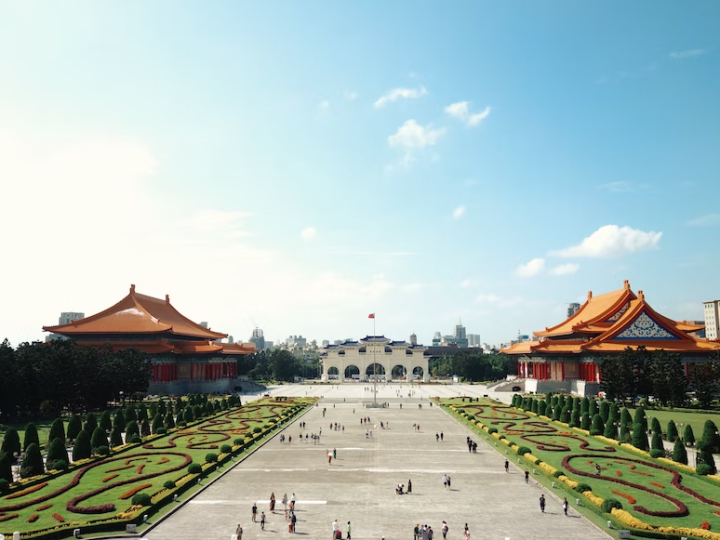
Yet another year has gone by with no progress made on revamping the Chiang Kai-shek Memorial Hall, a symbol of Taiwan's authoritarian past that began with the 228 Incident in 1947.
Wiping out the legacy of authoritarianism was mandated by the Act on Promoting Transitional Justice enacted in 2017 in accordance with a President Tsai Ing-wen (蔡英文) 2016 campaign pledge, which many hoped would help further expose the truth behind Taiwan's dark history.
For the survivors and families of victims politically persecuted during the 228 Incident, however, the issue goes deeper.
"Chiang Kai-shek (蔣中正) was the prime culprit of the 228 Incident. He has massive amounts of blood on his hands," Wang Wen-hong (王文宏), chairman of the Taiwan Association for 228 Incident Victim Care, told CNA in a recent interview.
Despite Chiang's record of brutality, however, a huge statue of him stands in the chamber of the Chiang Kai-shek Memorial Hall for people to warship and admire, Wang said, which he described as "condescending."
Local crackdown
Soon after the Kuomintang (KMT) Republic of China government took over Taiwan from colonial ruler Japan at the end of World War II in 1945, tensions between locals and the regime ran high because of corruption and an economic policy that squeezed Taiwan to support the civil war in China.
The breaking point came on Feb. 27, 1947, when an anti-contraband officer pistol-whipped Lin Chiang-mai (林江邁), a cigarette vendor, in Taipei, leading to the death of a bystander.
Mass protests broke out in Taipei the following day and quickly spread to the rest of Taiwan over the next week.
Governor-General Chen Yi (陳儀) ordered the use of force to put down the protests and imposed martial law on some cities, but on March 2 he agreed to set up the 228 Incident Settlement Committee, as requested by local leaders, to investigate the Feb. 27 incident and discuss their demands for political reform.
On March 6, however, hundreds of people heading to a meeting of the 228 Incident Settlement Committee in Kaohsiung were targeted by a shooting spree ordered by the Kaohsiung Fortress Headquarters chief Peng Meng-chi (彭孟緝).
The event marked the start of a three-month crackdown against civilian protests, including arrests of individuals at their homes, that has come to be known as the 228 Incident.
A 1992 government report on the tragedy said that between 18,000 to 28,000 may have been killed during the months-long campaign.
Living history
Wang's father Wang Ping-shui (王平水), then a local representative in Kaohsiung, was among those killed at Kaohsiung City Hall on March 6, according to historical records. His son was 32 days old at the time.
Over the next two decades, Wang grew up under an authoritarian KMT regime that did not teach children about the 228 Incident and scared people into remaining quiet about the past. As a result, he did not learn how his father died until forced by his mother to go to Brazil at the age of 18 and live with his older brother.
In a high school essay on his father, Wang said he wrote "my father was killed by bad guys in the 228 Incident" based on what he heard from older relatives without knowing what exactly the 228 Incident was.
The essay terrified his mother, Wang recalled.
"She quickly threw a banquet for my teachers to apologize for my 'innocence' and bought a boat ticket to send me to Brazil," he said. "She was worried the essay would get me into trouble if I were conscripted into the army."
In Brazil, Wang learned that his brother, 14 years older than him, and their grandfather found their father's body among a pile of corpses in a cattle trailer after a long search on the chilly, rainy evening of March 10 and bribed KMT soldiers to bring the body home.
"The cattle trailer in which my father's body was found was used to transport the bodies to the dump. My brother saw at least five trailers. I believe many of the victims were never found by their families," Wang said.
That oral history and other estimates of the number of people who disappeared in 1947 underpin his belief that the 228 Incident's death toll has been underestimated.
Transitional justice
Wang spent five decades, mostly in the U.S. and Brazil, studying and working in the electrical engineering field. He later returned home after the term "transitional justice" was first codified into law under the Tsai administration in August 2016.
Wang praised Tsai for her efforts to deliver on some of her promises on transitional justice in the first few years of her administration, but worried that those efforts would "peter out to nothing" in her last year in office.
He argued that transitional justice would not be complete without dealing with the symbolic legacies of Taiwan's authoritarian past, including the Chiang Kai-shek Memorial Hall and Cihu Mausoleum in Taoyuan's Daxi District where Chiang Kai-shek and his son, late President Chiang Ching-kuo (蔣經國), are interred, he said.
Chiang Kai-shek was named in no uncertain terms as the "primary culprit" with ultimate responsibility for the 228 Incident in a 2006 government report published during a previous Democratic Progressive Party (DPP) administration.
But that did not satisfy the demands for justice for his past practices among victims and their family members, such as Wang.
Historical archives indicate that Chiang Kai-shek, who was in China's Nanjing at the time, ordered Chen to respond to the uprisings with a brutal crackdown, and sent troops from China to help quell the protest, according to Kenneth Wang (王克雄), whose father Wang Yu-lin (王育霖) was arrested on March 14 at home and later executed.
The 21st Division 438th Regiment, one of the groups involved in the crackdown, reported the use of about 200,000 bullets, 1,200 hand grenades and 700 rounds of ammunition from the time it reached Taiwan on March 8 to March 31, Kenneth Wang said, citing historical records.
He agreed with Wang Wen-hong that as long as symbols of authoritarian worship of Chiang Kai-shek and Chiang Ching-kuo remain, not only for what happened in the 228 Incident but during the martial law period from 1949 to 1987, transitional justice would not be served.
Kenneth Wang said those who opposed the removal of these symbols are unwilling to face up to history and admit the mistakes made in the past.
But eliminating those symbols could still be a tall order. When the ad hoc Transitional Justice Commission was formed, there were around 966 statues of Chiang Kai-shek or Chiang Ching-kuo in public spaces and 580 places named after either of the two late presidents nationwide, according to government data.
When the commission was dissolved in May 2022, 80 percent of those symbols remained in place, the data showed.
Kenneth Wang is hoping Tsai will keep her promises on transitional justice and the KMT will have the courage to admit what it did so it can apologize with sincerity.
"Only by doing so can the historical trauma be healed and forgiveness and social reconciliation come about," he said.