Taipei, April 13 (CNA) A local research team has discovered that microplastics pollution in urban rivers in Taiwan is highly related to population density, urbanization and land use.
Microplastics, the plastic fragments or manmade fibers with particle size smaller than 5 millimeters, mostly come from daily life, roads, the manufacturing industry and natural fragmentation, explained Alexander Kunz, a research scholar at Academia Sinica's Research Center for Environmental Changes, at a press conference in Taipei on Wednesday.
However, microplastics have already contaminated the air, soil, deep sea and even Mount Everest's peak, while the pollutants are detected in animals and humans as well, said Kunz, who worked with academics at National Taiwan University and National Cheng Kung University.
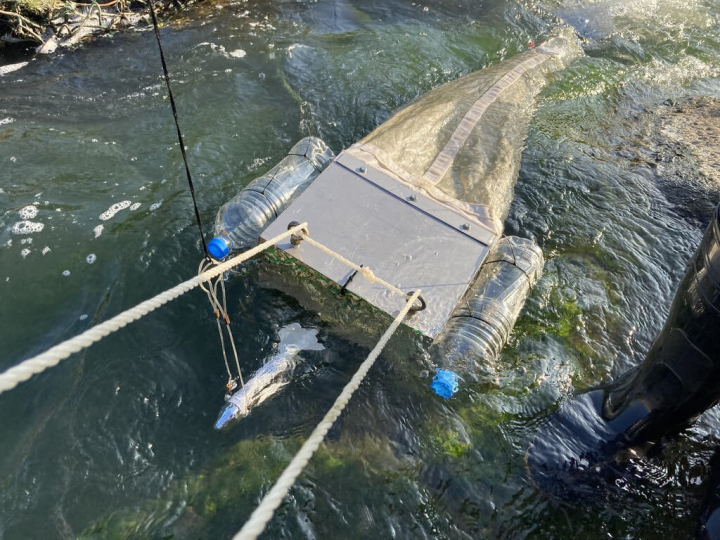
The researchers examined water samples collected at rural and urban locations along the Tamsui River in Greater Taipei in 2018 and along the Wu River in Taichung in 2021 to find sources of a sudden increase in microplastics along urban rivers.
The research team's findings showed that the level of microplastics found in the rivers were positively correlated with population density and the research has been published in the March 15 edition of the Environmental Pollution journal, according to a statement released by the center in March.
The study found that while sampling in the upper course of the Wu River, microplastics were barely found, however, when the team entered the suburban area of Taichung, an increase was seen in the microplastics concentration.
The highest microplastics concentration was found in water samples taken at the location where the Dali River joins the Wu River in Taichung's Wuri District, an industrial area in the southern part of the city, according to the research team's findings.
At a separate press conference held online by Science Media Center Taiwan on Tuesday, academics and experts shared their research findings on the distribution of microplastics in irrigation channels in Taoyuan, on beaches in the southern tip of Taiwan in Pingtung County and in sea currents off eastern Taiwan, which also showed that microplastics concentration is closely linked to population density.
The microplastics dispersion is also affected by seasons, as a higher density of microplastics is detected in rainy seasons in May, October and November, said Jiang Jheng-jie (江政傑), an assistant professor of environment engineering at Chung Yuan Christian University.
Jiang, Chen Te-hao (陳德豪), deputy director of National Museum of Marine Biology and Aquarium, and Shiu Ruei-feng (許瑞峯), an assistant professor at the Institute of Marine Environment and Ecology of National Taiwan Ocean University, urged the government to establish standards and methods to monitor microplastics in rivers, irrigation systems and other water bodies across Taiwan, in order to come up with solutions to these problems.