Taipei, April 17 (CNA) Two Taiwanese defense scholars have mixed views on China's rocket launch on Sunday, with one saying that it is a pure weather satellite, while another said Beijing could be using the launch to test a new bombardment system.
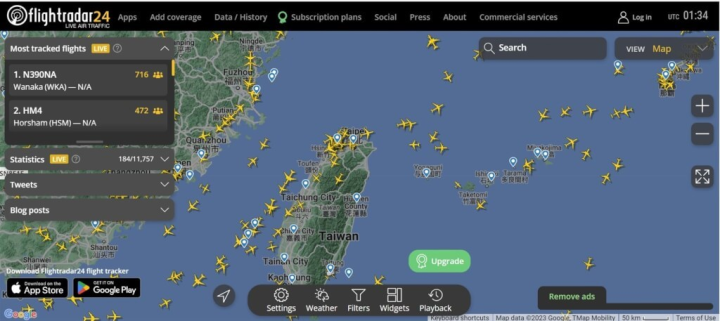
On Sunday morning, China launched a weather satellite as civilian flights altered their routes to avoid a Beijing-imposed no-fly zone to the north of Taiwan, which it had put in place because of the possibility of falling rocket debris.
The China Aerospace Science and Technology Corporation, China's main contractor for its space program, said the weather satellite Fengyun 3G was successfully launched from the northwestern province of Gansu at 9:36 a.m. local time.
The low-earth orbit satellite then entered its set orbit, the contractor said, describing the launch as a "complete success."
Taiwan's defense ministry, meanwhile, said some debris from the rocket launch had fallen into the "warning zone" off the island's northern coast, but did not affect Taiwan's territorial safety.
Asked to comment on the significance of the launch, Shu Hsiao-huang (舒孝煌), an analyst at Taiwan's government-funded Institute for National Defense and Security Research (INDSR), told CNA that according to information released by the Chinese government, the weather satellite is designed to track rainfall to prevent natural disasters.
Shu's colleague at the INDSR, Shen Ming-shih (沈明室), acting deputy CEO for research at the INDSR and its director of the Division of National Security Research, however, warned that the launch on Sunday could be a preparation on the People's Liberation Army's (PLA) part to test a new bombardment system.
According to Shen, media reports indicate that China has tested a system that appears to incorporate a glide body into a Fractional Orbital Bombardment System (FOBS), a nuclear-weapons delivery system that places warheads into low-earth orbit prior to de-orbiting them onto their targets.
China has denied that it has been developing FOBS, a Cold War technology, but if reports of the test are accurate and successful, that will give China a new ability to bombard the United States from outer space with nuclear weapons, Shen and other experts have warned.
Sunday's rocket launch, though a weather satellite launch in nature, could be used by the PLA to collect required rocket parameters in preparations for the FOBS delivery system under development, Shen suspected.
If that is the case, China might try to retrieve the rocket's debris with government vessels, he said, urging Taiwan's military to closely monitor PLA ships' movements following Sunday's launch.
Shu, meanwhile, said Sunday's launch was supposedly a routine practice. However, due to strained cross-Taiwan Strait relations, China may have intentionally used the regular weather satellite launch as a means to disrupt civilian flights north of Taiwan, he noted.
The scholar warned that Beijing could conduct similar launches more often near Taiwan in the future as a further harassment targeting Taipei and the latter needs to come up with responsive measures as soon as possible.
China had initially notified Taiwan of a three-day no-fly zone to the north of Taipei from April 16-18, but revised the zone's duration to 27 minutes on Sunday morning after a protest by Taiwan's Ministry of Transportation and Communications (MOTC), the ministry said in a statement on Wednesday.
The no-fly zone was expected to have affected about 33 flights to and from Northeast Asia and North America, according to the MOTC.