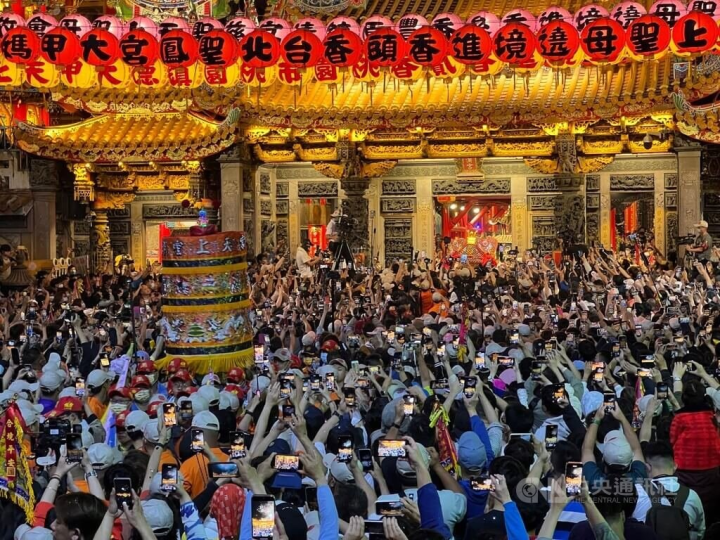
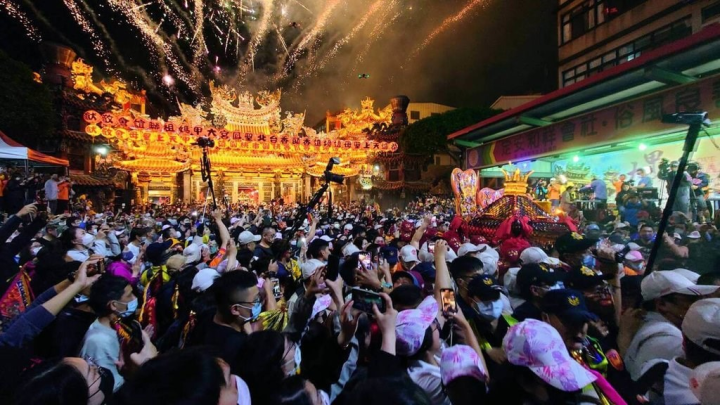
Taipei, April 21 (CNA) The annual pilgrimage of the sea goddess Mazu began late Friday evening at Dajia Jenn Lann Temple in Taichung and is scheduled to visit more than 170 temples in central and southern Taiwan over nine days.
The largest Mazu pilgrimage or religious event in Taiwan, the Dajia Mazu Pilgrimage typically attracts a turnout of more than 1 million and generates billions of New Taiwan dollars' worth of business for Dajia Jenn Lann Temple, which organizes the event, private-sector sponsors and local shops, according to industry observers.
A palanquin carrying three effigies of Mazu set out from the temple at 11:05 p.m.
According to the itinerary made public by the temple, the pilgrimage will stop at more than 170 temples in Taichung, Changhua, Yunlin and Chiayi, spanning a distance of about 340 km.
The origins of the pilgrimage can be traced back to 1730 in the Qing Dynasty at the Dajia residence of trailblazer Lin Yung-hsing (林永興). Lin had relocated the incense holder from Chao Tian Temple on Meizhou Island, Fujian, to his family altar, which was later expanded into a temple that served as the precursor to Dajia Jenn Lann Temple.
Every 12 years, Da Jia Jenn Lann Temple held worship tours attended by members of the local gentry, who would travel across the Taiwan Strait to Chao Tian Temple in Fujian to offer incense to Mazu.
However, after the First Sino-Japanese War in 1894-1895, sea transport between Taiwan and Fujian ground to a halt, prompting the Dajia Jenn Lann Temple to turn to Beigang Chao Tian Temple in Yunlin to worship the sea goddess.
In 1988, Dajia Jenn Lann Temple relocated the ritual to Hsin Kang Feng Tian Temple in Chiayi where it has remained ever since.
Every year, large crowds of Mazu's followers flock to the streets along which the palanquin is scheduled to travel to pray for good fortune, some even lying prostrate on the ground to let the palanquin pass above them.
Those who observe this custom believe it allows them to bathe in Mazu's blessings.
Eric Chu (朱立倫), chairman of the opposition Kuomintang (KMT), visited the Da Jia Jenn Lann Temple on Friday afternoon to offer incense to Mazu.
He told reporters at the temple that he prayed to Mazu to ask for her help to unite all forces behind the KMT and rid the party of its enemies, to allow the KMT to pick the best presidential candidate for the election on Jan. 13, 2024.
While New Taipei Mayor Hou Yu-ih (侯友宜) is seen as the KMT's favorite for presidential nomination, Hon Hai Precision Industry Co. founder Terry Gou (郭台銘) has also been tipped as a possible choice.
The party has said that it would field its presidential candidate through direct nomination rather than through a primary, and has set a June 18 deadline for the nomination.
Meanwhile, the Changhua County Police Department has said it will deploy 3,234 officers on April 23, April 28 and April 29 to areas that Mazu's palanquin is scheduled to pass by.
The county is seen as a high-risk area for disorderly activity during the pilgrimage.
A scuffle between Bamboo Union founding member Chang An-le (張安樂), alias the White Wolf, Chang's associates, and police broke out in the county during last year's pilgrimage near the Minsheng Underpass.