"Let me ask you a question," an eerie voice says in English behind an unnerving Japanese theater mask, one whose simplicity only adds to the ominousness of the disguise. "Do you believe that anybody has the capacity to become a murderer?"
That unsettling monologue, dubbed in American English, was delivered by "Noh," a fictional serial killer from the Taiwanese detective fiction series "Copycat Killer."
Filled with seemingly never-ending plot twists, the period piece catapulted on to streaming giant Netflix's top 10 list for non-English television programs soon after its release on March 31, and rose to second on the list in the first two weeks of April, just behind South Korea's "The Glory."
As of April 22, the show remained on the list, but had fallen to fifth in the rankings.
Aside from being the first Taiwanese Netflix production to make the streaming platform's top 10 non-English rankings, "Copycat Killer" had amassed 17.74 million hours of worldwide viewership as of April 3.
It was one of the few Taiwanese productions to become available in Europe and the Middle East and also the first Taiwanese show on Netflix available in seven languages upon its release.
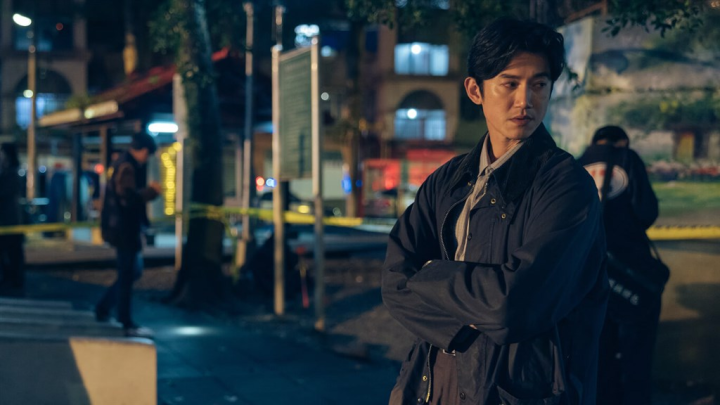
Set in the late '90s, the Taiwanese crime drama follows stoic prosecutor Kuo Hsiao-chi, whose stubbornness has alienated him from a number of police officers and his own peers.
Kuo finds himself intertwined in the mystery and games of the enigmatic Noh, who targets women as his victims and soon begins to taunt the keepers of the law and initiates a game of cat and mouse.
The drama and gruesome events that unfold between the protagonist and his antagonistic counterpart eventually become nationwide news, subjecting the entire country to the whims of the serial killer.
Worldwide popularity
"Copycat Killer," a namesake screen adaptation of Japanese writer Miyuki Miyabe's 2001 crime-mystery novel, has established countless milestones for Taiwan's small screen.
The well-received revelations of the show's twists, its unsettling serial killer and its stubborn detective protagonist also placed it on the top 10 viewership lists of the streaming service in countries such as Qatar, United Arab Emirates, Kuwait and Bahrain.
On the popularity of the detective drama, producer Phil Tang (湯昇榮) said that both he and his company, Greener Grass Production, were gratified by the achievement.
"After all, we brought it from Taiwan and Asia to different parts of the world," Tang said, "tackling the challenges of language, demographics, worldviews, cultural differences and genre."
All-out adaptation
To adapt Miyabe's novel and translate it for the Mandarin screen, Tang said Netflix hired United States teleplaywright Neal Baer, known for his work on American shows "ER" and "Law & Order: SVU," as a story consultant to ensure the quality of "Copycat Killer's" script.
Tang said the rights to the story were acquired by one of the show's producers years ago.
After Greener Grass' success with its 2020 crime drama "The Victims' Game," Tang said the company decided it was ready to undertake the adaptation, going as far as giving screenwriters two years to work on the teleplay that preceded a full year of post-production before releasing the show.
Strategic syndication
Speaking with CNA, Tang attributed the international success of "Copycat Killer" to the syndication strategy devised by Greener Grass and Netflix prior to the show's release.
Tang said they decided to have the show become the first Taiwanese production to be released simultaneously in its original Mandarin form, as well as in English, Japanese, Thai, Indonesian, Spanish and Brazilian Portuguese to cater to viewers in countries who prefer dubbing to having to read subtitles.
The series has also been subtitled in over 30 languages.
Tang said his company had planned to tackle the international market as early as 2015 upon realizing the dependency of Taiwanese productions on the mainland China market.
That was why when it came to promoting "The Victims' Game" that the company proactively sought out media outlets in countries such as the United States, Thailand and Malaysia, as well as in the city of Hong Kong, to promote its production.
The advertising strategy eventually proved to be a smart one, as "The Victim's Game" would go on to rank among the top 10 viewership rankings on Netflix in Hong Kong, Singapore and Vietnam that year.
Cannot only rely on Netflix
While "Copycat Killer" and "The Victim's Game" both proved successful thanks in part to the exposure provided by Netflix, Tang said Taiwanese productions should not be completely dependent on streaming services.
He said only a handful of productions are picked by those services, meaning that Taiwan still needs an export infrastructure to connect domestically made productions with the rest of the world.
"We (Taiwan) should also broaden our imagination when it comes to penetrating the global market," Tang said. "Taiwan should treat our entertainment industry as we would tech companies such as TSMC and Asus."
He said the entertainment industry is an important strategy in Taiwan's efforts at globalization.
"Just look at BTS (a Korean boyband) and the influence Korean shows have abroad, which serve as testaments to the impact of Korea's soft power," Tang said.