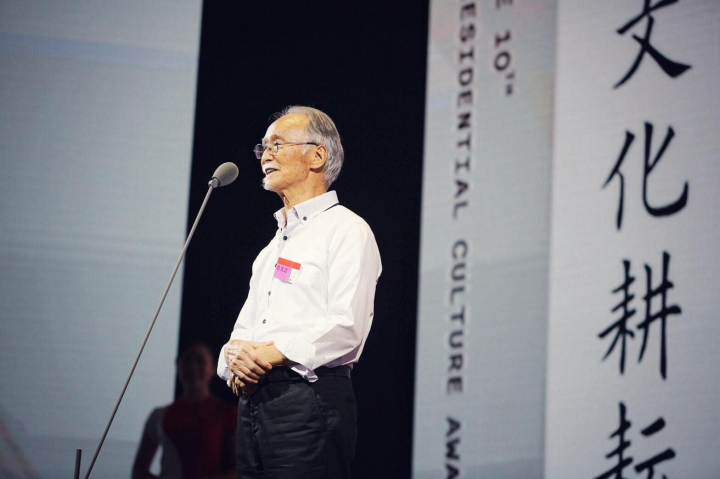
Taipei, April 24 (CNA) There has been a huge outpouring of sympathy and condolences following the death of famed Taiwanese sculptor Ju Ming (朱銘), who was found dead on Saturday at the age of 85.
Ju, whose death was reported Sunday, is one of Taiwan's most internationally well-known artists. Over the past 20 years, he had won numerous international awards, including the Fukuoka Asian Culture Prize in 2007 and is well-known for his Tai Chi series of sculptures.
President Tsai Ing-wen (蔡英文) expressed her deepest condolences upon learning of the death of Ju, who was found dead in his home in Taipei in what prosecutors said was an apparent suicide after prolonged illnesses, Presidential Office spokesperson Olivia Lin (林聿禪) said on Sunday evening.
Premier Chen Chien-jen (陳建仁) said in the same day in a post on Facebook that he was shocked and saddened to hear that the sculptor, considered a "national treasure," had passed away.
Chen recalled that when he served as vice president in 2019, he presented the Presidential Culture Award in the arts and culture category to Ju.
The Taipei-based General Association of Chinese Culture noted through Facebook that Ju won one of the 10th Presidential Culture Awards hosted by the association in 2019.
The sculptor dedicated his life to Taiwan's culture, the association said, while thanking Ju for "the splendid landscape you carved for Taiwan."
Ju's works won numerous awards during his lifetime. His Juming Museum is an internationally-renowned outdoor sculpture museum in New Taipei.
Culture Minister Shih Che (史哲) also expressed his deep sorrow and condolences in a press release issued Sunday, saying that Ju's works are full of vitality that helps connect Taiwan with the world.
Noting that Ju's creations can be seen in major cities around the world, Shih said his artistic achievements have been recognized by all walks of life, and he is a world-class Taiwanese artist.
Meanwhile, Ju's death also led to widespread outpourings of sympathy in Taiwan's political circles.
The ruling Democratic Progressive Party (DPP) issued a statement Sunday evening stating that Ju is an outstanding artist in Taiwan's contemporary art circle. Through his works of art, Ju successfully promoted local culture and Taiwan's values, the DPP said.
Eric Chu (朱立倫), chairman of the main opposition Kuomintang, described Ju's passing as the loss of a national treasure. He voiced his gratitude to Ju for his dedication to culture and art throughout his life, while expressing his condolences to Ju's family.
Responding to the news of Ju's death, Taipei Mayor Chiang Wan-an (蔣萬安) said that from the perspective of Taiwan as a whole and the Taipei city government, it is imperative to deal with the issue of long-term care amid an aging population and low birth rate in the country.
Ju appeared to have taken his life because he was reported to have suffered from high blood pressure and other chronic diseases for a long time in his later years and he also had been suffering from depression recently.
Ju was born in 1938 in Miaoli County, northern Taiwan. At the age of 15, he began studying wood carving and painting while working on restorations of a Mazu temple as an apprentice of a Buddhist statue craftsman, according to a statement issued by the nonprofit organization Juming Culture and Education Foundation.
He later applied his carving and sculpting skills to a range of media, including bronze, styrofoam, ceramics, and stainless steel, all along developing innovative techniques and artistic approaches.
Ju rose to fame in the 1970s. In 1977, Ju had his first show outside of Taiwan at the Tokyo Central Art Museum in Japan. The exhibition showcased 28 wooden sculptures under the theme of Tai Chi and won high praise from Japanese critics.
From 1980 onwards, Ju continually gained international acclaim and exhibited his works abroad, including in New York, London, Paris and Beijing.
In 1999, Juming Museum officially opened, planting the seeds of art in the soil of Taiwan.
Those in need of counseling or assistance can call the 1925 or 1995 hotlines for help.