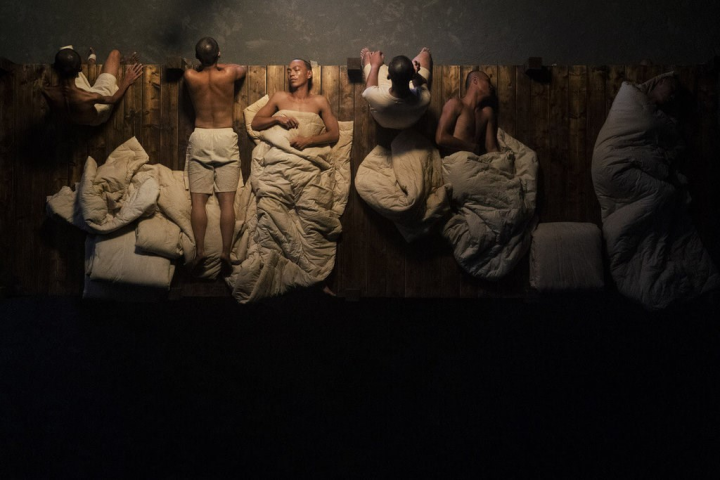
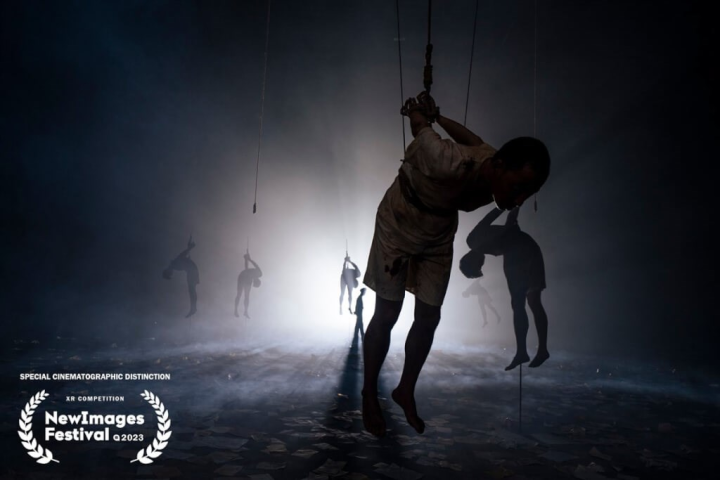
An exhibition exploring the inner worlds of political prisoners during the White Terror period in Taiwan is set to kick off in Taipei on Saturday, featuring a virtual reality movie that has won two international film awards.
Inspired by and named after the VR movie, "The Man Who Couldn't Leave," the exhibition seeks to provide a glimpse of the "inner worlds" of several political prisoners who were deprived of their freedom and separated from their families, Lin Mun-lee (林曼麗), the event's producer, said at a press conference in Taipei on Thursday.
The exhibition, which will run from May 6 to July 2 at the Museum of National Taipei University of Education (MONTUE), features copies of notes left behind by political prisoners from the White Terror era from 1949-1992 before their executions by the Kuomintang government.
It also displays letters exchanged between the political prisoners and their family members, among other documents, photos and objects preserved by their descendants.
In addition, sound recordings and music clips produced by Wang Yu-jun (王榆鈞) and woodcut artworks made by Lee Chia-hung (李佳泓) - both contemporary Taiwanese artists - are included in the exhibition to provide visitors with an "immersive" experience, Lin added.
The exhibition also displays footage used by director Singing Chen (陳芯宜) for her VR film, "The Man Who Couldn't Leave," to allow for a better understanding of how the 35-minute-long work was made.
The VR film, which has won awards at both the Venice Immersive in Italy and the NewImages Festival in France since its release in 2022, will also be shown at the MONTUE during the two-month exhibition.
Commissioned by the National Human Rights Museum (NHRM), Chen's film brings together the traumatic experiences of political prisoners jailed at a prison on outlying Green Island in the 1950s and discusses how those experiences continued to affect the prisoners or their families years after they were executed or released.
Speaking at the press conference, Chen said she was pleased that after touring more than 10 cities overseas, the VR film is finally being shown to a Taiwanese audience.
She cited Lin Chuan-kai (林傳凱), the exhibition's advisor, as saying that the values of transitional justice should lie in the efforts to understand the state of mind of people who were politically persecuted and what they have been through.
While admission to the MONTUE exhibition is free, those who wish to watch the VR film must purchase a ticket in advance.
The VR film will be screened at the MONTUE once every hour starting 10:10 a.m. until the museum closes at 6 p.m., from Tuesday to Sunday, with each session available for 10 people.
The film is also showing at the Taiwan Film and Audiovisual Institute from May 6 to July 2 and at the VR Film Lab in Kaohsiung from May 6-31.