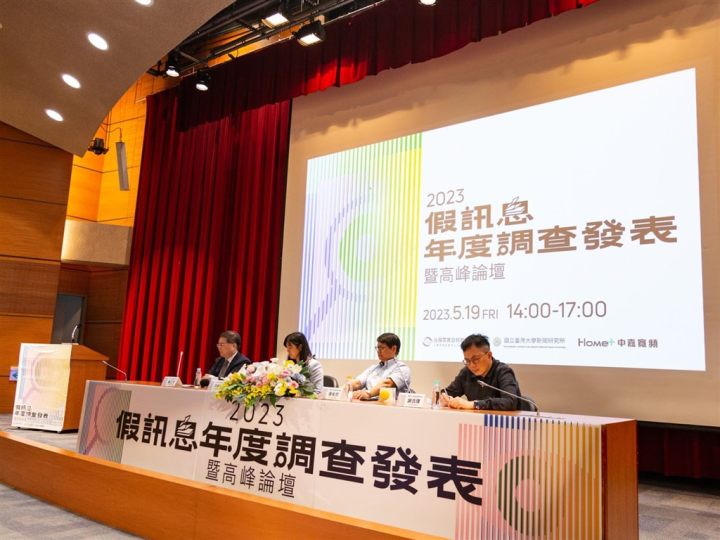
Taipei, May 19 (CNA) People's leanings toward certain political parties hamper efforts to debunk false information about politics, a report launched Friday by the Taiwan FactCheck Center (TFC) showed.
Strong supporters of the ruling Democratic Progressive Party (DPP) are more likely to buy into factchecking reports debunking false claims against the DPP, Chang Yu-tzung (張佑宗), a political science professor at National Taiwan University (NTU), said at the launch of TFC's annual report in Taipei.
Those people are, at the same time, less willing to accept reports rebutting disinformation against opposition parties, Chang said, citing his analysis in the report.
Meanwhile, staunch advocates for the main opposition Kuomintang (KMT) tend to embrace reports debunking disinformation that seeks to put the KMT in a bad light, but they remain skeptical even if claims tarnishing the DPP have been proven wrong, he said.
On the other hand, people from various backgrounds take note of factchecking of false information about health- and lifestyle-related issues, he said.
In other words, Chang said, whether or not factchecking reports of political disinformation is effective is often determined by individuals' preexisting political beliefs other than the quality of those reports.
He added that civil society groups providing factchecking functions should thus target independent and soft supporters of different parties when debunking false information about politics.
Chang later told CNA that journalists writing factchecking reports should try to keep a neutral tone and even refrain from preaching if they wish their debunking of false political claims to be effective.
Chang's analysis is based on the surveys he and his two NTU colleagues conducted either online or by telephone, with a total of 2,399 effective responses collected from April 1-17.
According to the TFC -- a non-profit and non-governmental factchecking group established in 2018 -- the annual report also seeks to understand Taiwanese perception of the spread of and response to disinformation.
The report's findings showed the people of Taiwan support government intervention in curbing the spread of disinformation on social media, even if such a law may infringe upon the freedom of expression, Hung Chen-ling (洪貞玲), director of NTU's Graduate Institute of Journalism, said.
Nearly 32 percent of survey respondents considered legislation to be "the best approach" to control the proliferation of disinformation, she said.
Some 63 percent of respondents said government intervention in curbing false information is needed even if such a move risks undermining the freedom of expression, she said.
In addition, as much as 90 percent of those surveyed said legislation requiring social media platforms to establish mechanisms to tackle disinformation is needed, she said.
However, Hung observed, relevant legislation is "very difficult" to be put through the Legislature as Taiwanese society highly values the freedom of expression. She mentioned the withdrawal of the draft digital intermediary service act last September as an example.
The draft bill, which the government said aims to increase the accountability and transparency of large online platforms, was shelved by the National Communications Commission following fears that it would undermine the freedom of expression.