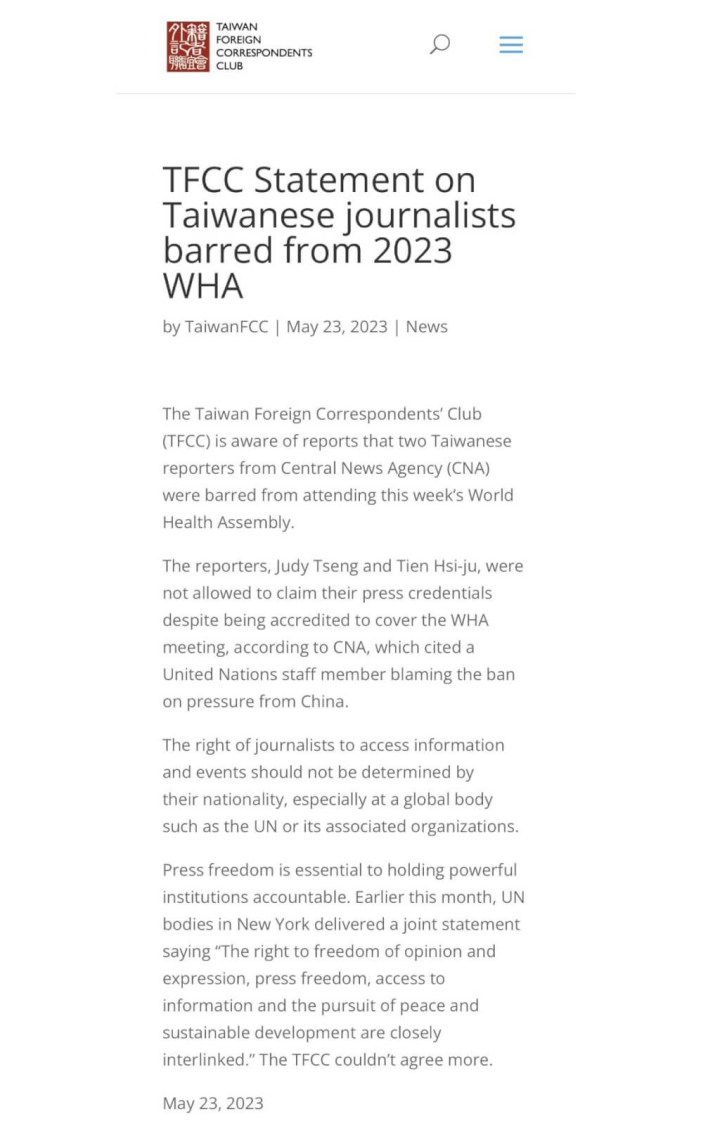
Taipei, May 23 (CNA) The Taiwan Foreign Correspondents' Club (TFCC) on Tuesday voiced support for two Taiwanese reporters from the Central News Agency (CNA) who were barred from covering this week's World Health Assembly.
"The right of journalists to access information and events should not be determined by their nationality, especially at a global body such as the UN or its associated organizations," the TFCC said in a statement.
"Press freedom is essential to holding powerful institutions accountable," according to the TFCC, which includes around 100 members from foreign news media based in Taipei.
United Nations bodies in New York delivered a joint statement earlier this month saying "The right to freedom of opinion and expression, press freedom, access to information and the pursuit of peace and sustainable development are closely interlinked," the TFCC noted, adding that it "couldn't agree more."
The CNA reporters, both Republic of China (Taiwan) passport holders, tried to claim their press credentials for the WHA meeting, which is being held May 21-30, at a U.N. office in Geneva on Monday morning.
Upon arriving to claim their credentials, the two reporters -- Judy Tseng (曾婷瑄) and Tien Hsi-ju (田習如) -- were told by a U.N. staff member at the office that they would not be allowed to cover the event due to pressure from China.
The only way they could enter with Taiwan passports was if they also had China-issued Mainland Travel Permits for Taiwan Residents, according to the U.N. worker, a permit the two CNA reporters replied they did not have.
Tseng and Tien explained to the U.N. worker that they were not part of any official delegation from Taiwan, but were instead journalists, and should therefore be allowed inside to cover the event, but they were not permitted to enter the venue.
The WHA is the decision-making body of the World Health Organization (WHO), which as a U.N.-affiliated agency does not recognize Taiwan as a member.
The two CNA reporters submitted documents for media accreditation on the United Nations website weeks before the WHA meeting. Since there is no option for "Taiwan" or "The Republic of China" in the dropdown list for country, the reporters selected "Thailand" but specified in the notes section that they are journalists from "Taiwan (Republic of China)" and uploaded copies of their Taiwan passports.
"An incident like this, as well as the fact that Taiwan passport holders are not even allowed to enter the UN headquarters in New York as visitors, goes to show the degree to which the UN and its affiliated organizations have been infiltrated by the Chinese communist regime and how subservient they have become to the whims of Chinese officials," a CNA spokesperson said in a statement Tuesday.
"Central News Agency reporters and their colleagues in Taiwan demand that the United Nations respect the right of journalists to do their job irrespective of their nationalities," the spokesperson said.
"The World Health Organization should mend its way by opening the proceedings of the current World Health Assembly to reporters from Taiwan," according to the CNA statement.
Monday's incident was not the first time Taiwanese reporters, including CNA reporters, have been barred from covering U.N. events. Taiwanese reporters have been banned from covering WHA meetings for the past seven years, as well as the International Civil Aviation Organization (ICAO) Assembly since 2016.
Taiwan, formally called the Republic of China, was expelled from the WHO in 1972, after losing its United Nations seat to the People's Republic of China due to the issue of "China's representation."
Since then, Taiwan has not been able to attend the WHA due to objections by China, except from 2009 to 2016, when cross-Taiwan Strait relations were warmer under the then Kuomintang government.
Meanwhile, Taiwan's Ministry of Foreign Affairs (MOFA) on Tuesday criticized the U.N. office in Geneva for "failing to act impartially" and for rejecting Taiwanese reporters' applications to cover the WHA meeting.
MOFA also "strongly condemned" Beijing, saying that it claims to care for the Taiwanese people but engages in actions that hurt the Taiwanese people.
The ministry urged the United Nations to recognize the basic rights of Taiwanese journalists to cover U.N. conferences and events, and to resist "unreasonable political pressure from specific countries."