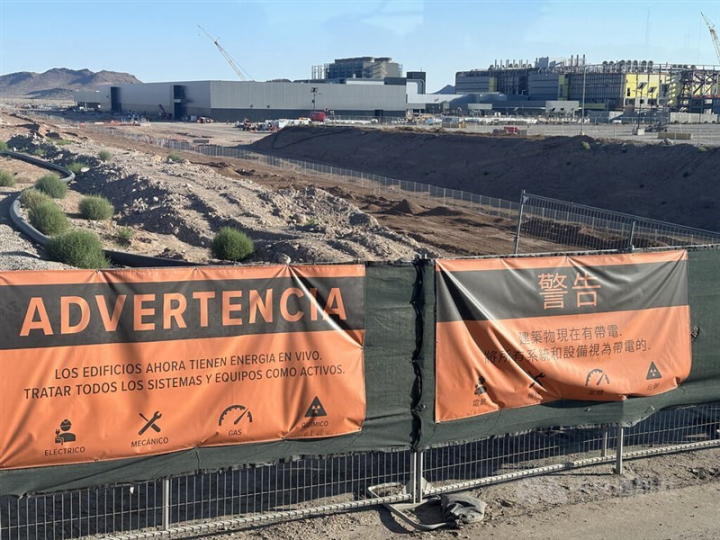
The Greater Phoenix Economic Council (GPEC), a major business group in the American city, on Friday promised Taiwan Semiconductor Manufacturing Co. (TSMC) that it will gain access to sufficient water supplies for its fabs now under construction in the drought-affected state of Arizona.
Speaking with CNA, Chris Camacho, president and CEO of the GPEC, said TSMC, the world's largest contract chipmaker, has obtained a large volume of water as the city had promised since the company kicked off its investments in Phoenix, and if it is planning to build more fabs in the city, his group will help the Taiwanese company gain sufficient water in the future.
On its website, the GPEC said it has fueled the regional economy in the past 33 years by helping 950 companies, creating more than 174,000 jobs and US$36 billion in capital investments.
The GPEC has been named one of the top economic development organizations in the United State by the U.S.-based non-profit International Economic Development Council (IEDC), which serves economic developers.
Concerns over water supplies in Arizona have been running deeper since a March 31 report in the U.S.-based financial weekly Barron's, which speculated that TSMC could face competition for water in the state from agricultural users and nearby Native American tribes.
In addition, the report said, U.S. rival Intel Corp.'s advanced fabs in Arizona are expected to add pressure on TSMC's water needs.
TSMC is investing US$40 billion to build two wafer fabs in Phoenix, with one scheduled to start mass production in 2024, using the company's advanced 4 nanometer process, and the other to begin commercial production in 2026, using the more advanced 3nm process, the latest technology the chipmaker has mass produced in Taiwan.
International news media has reported TSMC could build up to six fabs in Arizona.
Citing an estimate from Phoenix officials, Barron's said that TSMC could require up to 40,000 acre-feet of water a year if it builds six fabs in Arizona, enough for 160,000 homes.
Camacho admitted water has become a scarce resource to the western U.S., but Arizona has made great efforts in water resource planning in the past few decades to tackle this problem.
Through the state's water resource planning, water consumption in the greater Phoenix area and Arizona currently remains on the same level seen in 1957 despite economic and population growth as the state has been dedicated to pushing for water conservation, a transformation of its agriculture industry and water recycling in the manufacturing sector, Camacho said.
According to him, the manufacturing sector currently only accounted for 5 percent of the total water allocation in Arizona, so future investors are expected to gain sufficient water resources.
To his knowledge, Chamacho said, TSMC is highly interested in water recycling and about 90 percent of the company's water is recycled, which has drawn much attention from Phoenix.
After the Barron's report was published, TSMC tried to assuage fears over water supplies in Arizona, issuing a statement in early April reiterating its plans to construct a water recycling facility to meet the needs of its advanced wafer fabs in Phoenix, and also to build a comprehensive waste-water treatment system to reduce consumption and increase efficiency.
TSMC said it has been in close contact with officials in Phoenix since the initial planning stages for its Arizona fabs, to ensure sufficient water resources.
According to TSMC, Phoenix, which can draw on sources including the Colorado River, the Verde River, the Salt River, and underground aquifers, has been designated by the state of Arizona as having a 100-year supply of water.
Kirkland Capital Chairman Kirk Yang (楊應超), who is well known for covering the semiconductor industry, said while TSMC's water recycling efforts are expected to reduce the impact from Arizona's water supply issues to some extent, electricity supply, much of which is generated by water, could pose another challenge to the chipmaker, as Intel's advanced fabs in Arizona are expected to exacerbate the situation the Taiwanese company will face in both water and power demand competition.
On Friday, the government-sponsored trade promotion organization Taiwan External Trade Development Council (TAITRA) signed a memorandum of understanding with the GPEC to set up a partnership to push for economic development.
Camacho said so far 24 TSMC suppliers have followed the chipmaker to come to the U.S., and another 27 are in talks with the GPEC for their possible investments.
In addition to cooperation in semiconductors, Camacho said its group also eyes investments in aviation, medical equipment and bioscience, renewable resources and information/communications from Taiwan.
Camacho said the GPEC is hoping Taiwan and Phoenix will launch direct flights to forge closer bilateral business ties, adding that he will visit Taiwan in July to discuss the possibility of making that happen.