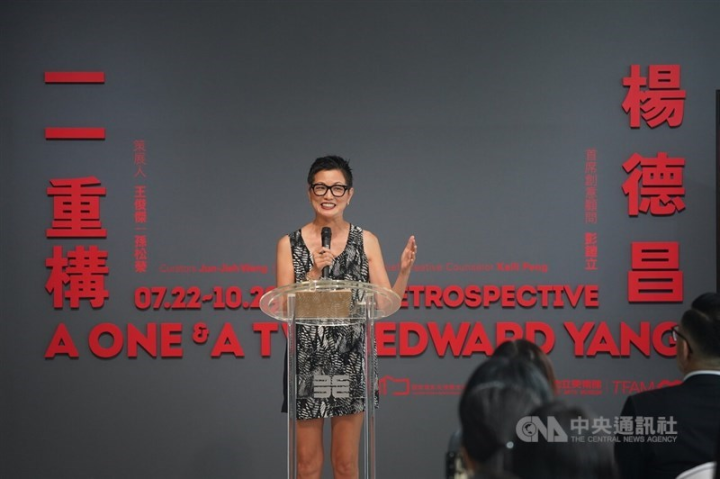
Taipei, July 22 (CNA) The Taipei Fine Arts Museum's (TFAM) new exhibition on renown filmmaker Edward Yang (楊德昌) gives a window into the director's creative process and a glimpse of his unfinished projects, head of the museum Wang Jun-jieh (王俊傑) said at an opening on Friday.
The exhibition, "A One & A Two: Edward Yang Retrospective," brings together hundreds of items -- scripts, notes, letters, journals, footage, props, among others -- left behind by the late filmmaker best known for his Best Director win at the Cannes Festival in France for his film "Yi Yi: A One and a Two…"
The exhibits came from more than 10,000 items entrusted by Yang's widow, pianist Peng Kaili (彭鎧立), to the national film institute, Taiwan Film and Audiovisual Institute (TFAI), in 2019.
The retrospective, the result of three years of study by the TFAI and curation by the museum, will allow movie enthusiasts to "rediscover Edward Yang" and delve into his life and creations, Wang said.
Inspired by German director Werner Herzog, Yang gave up his engineer job in the United States at the age of 30 and returned to Taiwan to embark on his filmmaking journey, according to Wang.
Yang's perfectionism and meticulousness made him complete only eight feature-length films, but he was a pioneer of the Taiwan New Cinema movement in the 1980s, Wang said, referring to a period that saw Taiwanese directors gain international recognition for the first time.
The items displayed at the exhibition, which runs from July 22 to Oct. 22, can be dated back to as early as Yang's childhood, showing his thinking in different stages of his life and how it molded his creations, Wang said.
Some of Yang's films dealt with complex interpersonal relationships in a fast-changing and urbanized society, such as his Taipei Trilogy, Wang said, namely "Yi Yi" and satirical works "A Confucian Confusion" and "Mahjong."
Yang was also apt to explore various social problems through the narrative of youngsters, such as his Golden Horse Awards best feature film winner "A Brighter Summer Day" and an uncompleted anime "The Wind," according to Wang.
The exhibition also showcases, for the first time, some of the unfinished projects Yang had taken on before his death from cancer in 2007 at the age of 59, including his plan to adapt "Lust, Caution" -- a novel by Chinese writer Eileen Chang (張愛玲) -- into a film.
Yang was always "passionate" about his life and creations and his "pure and brave" "pursuit of originality" in his works never yielded an inch to his illness, Peng, who servers as an advisor for the retrospective, recalled of her late husband.
The exhibition seeks to bring more young people into the universe of Yang and his works in visualized and innovative ways, Peng said, adding that she was looking forward to seeing a new wave of "Edward Yang fever" in Taiwan.
At the same time, Peng expressed hope the retrospective would tour internationally in the future, adding that museums from France, Japan and South Korea had expressed an interest in collaborations.
"I think he (Yang) must be very pleased to see from heaven what we've put together for the exhibition," Peng added.
As part of the Edward Yang Retrospective, the TFAI will screen all of the movies made by Yang at its base in New Taipei's Xinzhuang District in the next three months, starting Saturday.
The screenings, along with the exhibition at the museum, will lead viewers into "Edward Yang's cinematic world," TFAI Director Louis Lee (李智仁) said, noting that Yang's movies, with their images and characters, had decanted into the collective memory of the people of Taiwan.
In addition to Yang's works, the film institute will also be showing a dozen movies that had influenced the director, such as Herzog's "Aguirre, the Wrath of God," Russian director Andrei Tarkovsky's "Nostalghia," and French filmmaker Robert Bresson's "L'Argent."