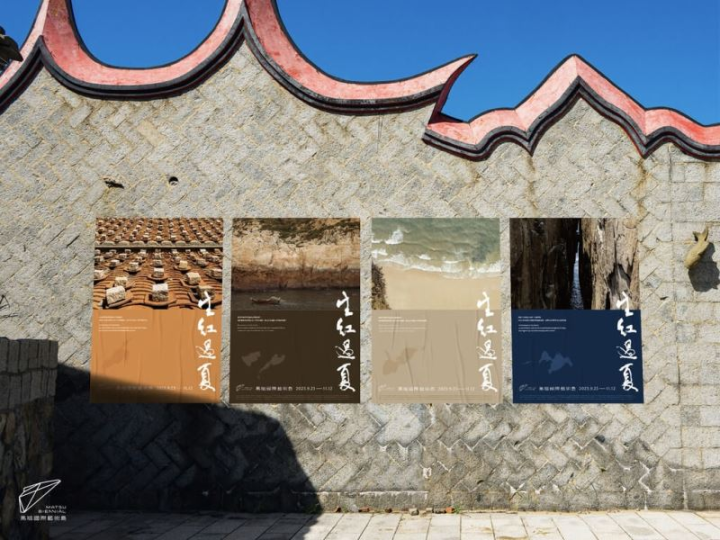
The second Matsu Biennial, co-organized by the Lienchiang County Government and the General Association of Chinese Culture (GACC), will take place from Sept. 23 through Nov. 12 in four townships across five islands of Matsu under the theme of "Ruby Red after Summer (Tshiang-ngoyngˋ-kuoˋ-ha^, 生紅過夏)."
Inspired by the fermentation process of Matsu's old wine, this year's theme "Getting Red (Tshiang-ngoyngˋ, 生紅)" represents the peachy red color of the filtered juice from the fresh batch of old wine, which is fermented in jars with sticky rice, koji, and well water; "After Summer (Kuoˋ-ha^, 過夏)" reflects the change in color from ruby red to amber and the wine’s much smoother taste after surviving the trial of summer through careful heating and preservation, when it achieves maturity as Matsu old wine.
GACC secretary-general Lee Hou-ching (李厚慶) stated in a press release that the Matsu Biennial, which is set out to be a ten-year project held every two years, is not only a decorative feature of the landscape but also a social fermentation, inheriting the island’s centuries-old summer tradition to vinify the 10-year Matsu wine.
The chief of Lienchiang County Wang Chung-ming (王忠銘) said that the main visual design of this year's exhibition innovatively integrated the calligraphic work of Matsu-born painter and calligrapher Chen Her-cheng (陳合成). Chen's work exhibits the vitality and rhythm of the Matsu Islands, allowing the audience to experience the vibrant art scene, Wang added.
Wang also said if the first Matsu Biennial was "tshiang-ngoyngˋ," the second edition is about making it "kuoˋ-ha^." It aims to put art in every household as part of the common life, a shared treasure of the people of Matsu.