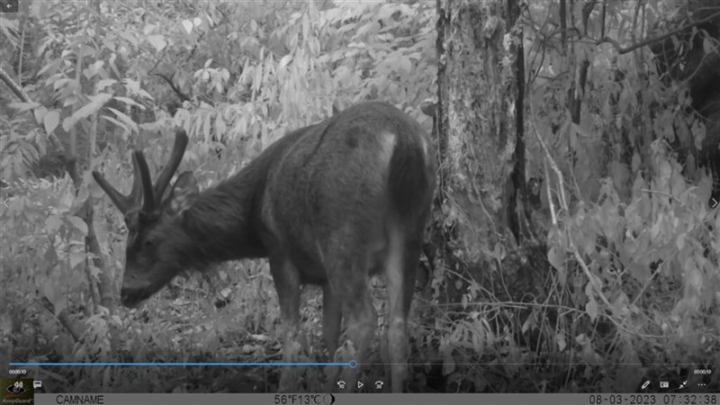
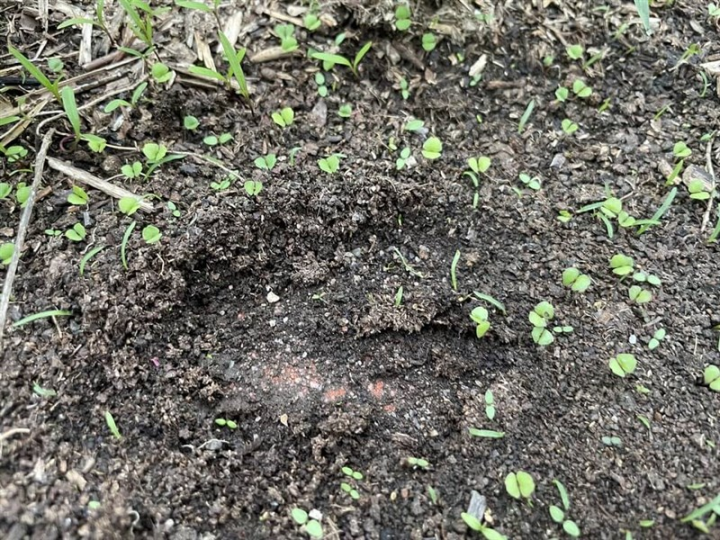
The habitat of the protected Formosan Sambar Deer has expanded in recent years and now includes lower altitude areas, with the species no longer commonly spotted in the mountainous areas it had long been forced to reside in due to human activity, the Endemic Species Research Institute said Thursday.
The Formosan Sambar Deer is Taiwan's largest herbivore and originally resided at an altitude of around 300 meters, however it was forced into mountainous areas -- generally higher than 2,000m-- due to hunting and destruction of its natural habitat, the institute said, adding there is now evidence that the deer are starting to move back toward lower altitude areas.
Tsai Chi-feng (蔡繼峰), assistant research fellow at the Endemic Species Research Institute, told CNA auto-trigger cameras have been set up since 2011 in Tengzhi Research Center at different altitudes -- the elevation ranges from 1,100-2,635m-- to try and capture the activity of the deer.
The institute's research has shown that the deer are now more commonly seen in areas below 1,600m and are rarely spotted in areas higher than 1,800m.
According to Tsai, although the deer appear to be moving to lower altitude areas, it is not clear as to whether the overall number of deer has increased.
He added that in Taiwan, low altitude refers to areas below 1000m, medium-low altitude is 1000-1500m, and 1500-2500m is mid altitude.
According to the institute, the introduction of the Wildlife Conservation Act in 1989, which banned hunting and poaching, and the establishment of the Central Mountain Range Conservation Corridor has helped the species flourish.