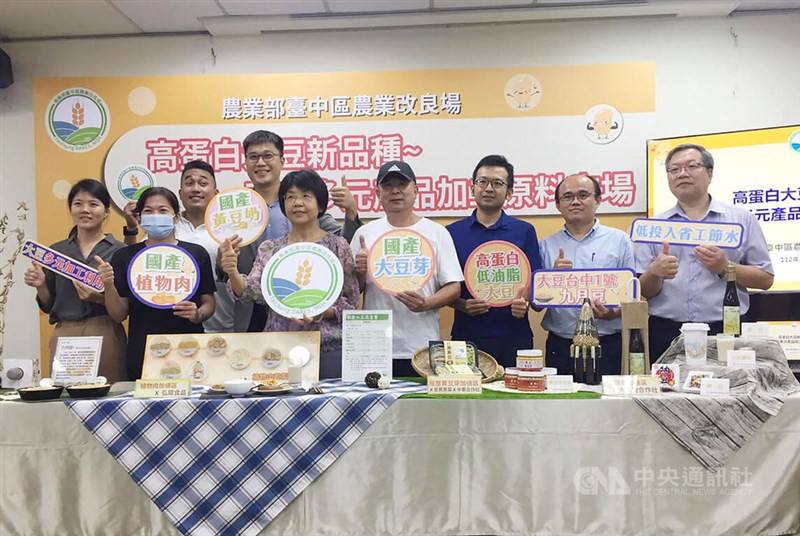
Taipei, Aug. 16 (CNA) Government agronomists on Tuesday unveiled a new variety of high-protein, weather-resistant soybean, which they said could help ease Taiwan's near-total reliance on imports of the food staple.
The "Taichung No. 1 - September bean" was presented at a press conference after seven years of development by the Taichung District Agricultural Research and Extension Station.
Chen Huan-pin (陳鐶斌), a researcher at the agency, said the bean was notable for its relatively high protein content and low levels of fat, as well as its small kernel size, which makes it ideal for processing.
According to the agency, the "Taichung No. 1 - September bean," is composed of around 40 percent protein by weight, compared to the typical 35 percent, and only 14.6 percent fat, compared to the usual 20 percent.
As a crop, it can be planted as late as mid-September in central Taiwan -- and harvested 100 days later -- thus reducing the chances of a typhoon wiping out a farmer's investment, the agency said.
The bean was also bred for improved resistance to soybean stem borers (a common pest) and drought, and has an average yield of around 2,400 kilograms per hectare, the office said.
This year, farmers partnering with the research station planted 350 hectares of the new soybean variety on a trial basis, it added.
At the press conference, the research office said its new soybean variety fit with the government's plans to expand domestic grain and bean production, and could also help farmers tap into the growing market for soy-based meat substitutes.
According to government data, Taiwan imported 2.75 million metric tons of soybeans in 2022, mainly from the United States and Brazil, compared to only 5,430 metric tons produced domestically.
Last year, the Ministry of Agriculture set a goal of locally growing 10 percent of all soybeans for human consumption in Taiwan within five years, equivalent to a five-fold jump from the current 1.9 percent.