Taiwan Semiconductor Manufacturing Co. (TSMC), the world's largest contract chipmaker, will give each of its non-manager employees in Taiwan a special bonus for Sports Day of NT$16,000 (US$497).
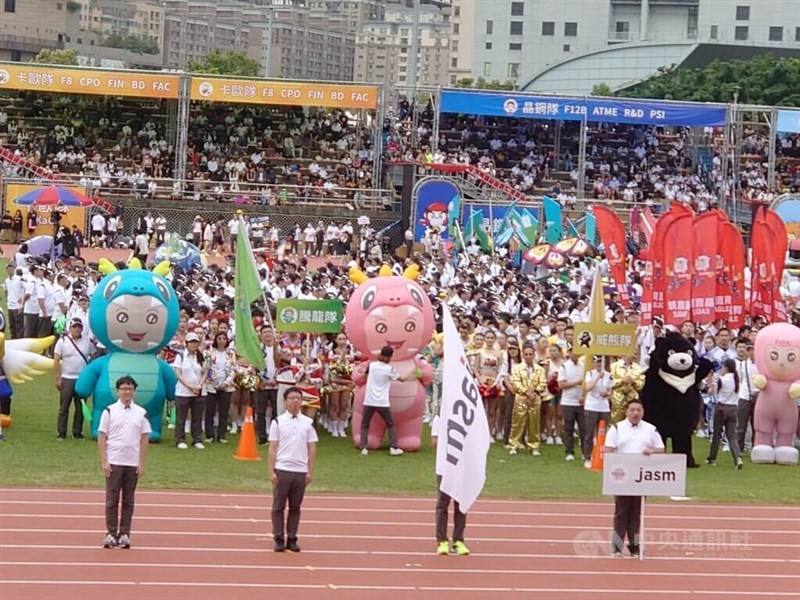
TSMC Chairman Mark Liu (劉德音) announced the bonus at the company's Sports Day event on Saturday.
He said that after suspending Sports Day for the past three years due to COVID-19, it resumed this year to allow TSMC's employees and their families to get together and demonstrate the athletic spirit of not becoming dizzy with success, nor being discouraged by failure.
The annual Sports Day event, which started in 1993, is something TSMC's employees look forward to because of the sizable bonus that usually comes with it.
When Liu announced this year's bonus, a loud ovation erupted among TSMC employees in Hsinchu County Stadium, where the event was held.
Though Sports Day was canceled the past three years due to the pandemic, TSMC still gave non-managerial employees special bonuses of NT$12,000 in 2020 and NT$16,000 in 2021 and 2022.
According to TSMC, more than 50,000 employees will be eligible for this year's payout, translating to a total financial commitment of more than NT$800 million in bonuses.
Liu said that although the semiconductor industry has faced headwinds amid weakening global demand over the past year, TSMC has still made advances, citing mass production of the 3 nanometer process, its newest technology in commercial production.
In addition, TSMC is developing the more advanced 2nm process with production planned for Hsinchu in 2025 as well as Kaohsiung, Liu said. TSMC has never disclosed when production of the 2nm process in Kaohsiung will begin.
The TSMC chairman also highlighted TSMC's efforts to go global by building wafer fabs in Arizona and in Japan's Kumamoto. The chipmaker also intends to set up a joint venture to build another fab in Dresden, Germany.
Liu cautioned, however, that competition in the market is on the rise, and TSMC is facing greater challenges, and he encouraged people in the company to learn and grow together to meet those challenges.
Liu's remarks echoed those of TSMC founder Morris Chang (張忠謀).
Speaking earlier at the event, Chang said that with geopolitical tensions on the rise, globalization principles in the semiconductor industry are no longer the norm. That means more countries will likely enter the market, leaving TSMC to face severe challenges.
Amid global demand weakness, TSMC saw its consolidated sales in the first nine months of 2023 fall 6.2 percent from a year earlier to about NT$1.54 trillion.
In the third quarter, a peak season for the semiconductor industry, TSMC's consolidated sales grew 13.7 percent from a quarter earlier to NT$546.73 billion. Analysts attributed the growth to the launch of the iPhone 15 series in September.
The new flagship iPhone 15 Pro and iPhone 15 Pro Max are powered by the latest A17 Pro GPU, the first Apple chip made using TSMC's 3nm technology. The new six-core GPU is about 20 percent faster than its predecessor, the A16 Bionic.
TSMC has scheduled an investor conference for Oct. 19 to detail its third quarter results and give guidance for the fourth quarter and for all of 2023.
At the July investor conference, TSMC lowered its sales forecast for 2023, saying revenue would fall 10 percent from a year earlier in U.S. dollar terms, a downgrade from an earlier estimate of a 4-6 percent fall made in April.
According to TSMC, although demand for AI-related gadgets appeared solid, global economic weakness still weighed on the semiconductor industry due to falling demand for consumer electronics gadgets.