Taipei, Oct. 18 (CNA) Coral reefs are disappearing and fish stocks have declined dramatically off Lambai island, commonly called Xiaoliuqiu, due to human contamination, Greenpeace warned Wednesday when presenting the results of a study it did in the area in August.
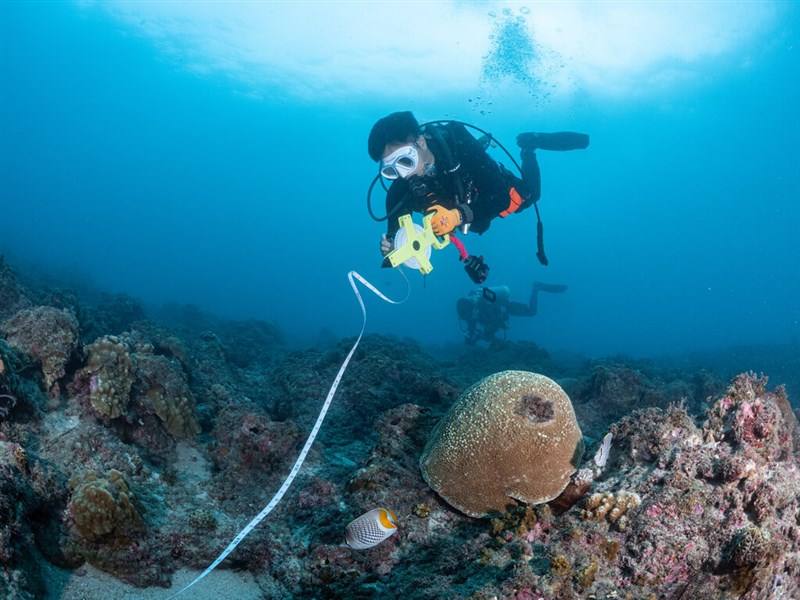
At a press conference, Greenpeace project director Chung Meng-hsun (鍾孟勳) said it sampled reef fish in August to understand the tourist island's ecological status, monitoring waters 10 meters under the surface across six tourist attraction sites around the island.
It found that the density of fish in Xiaoliuqiu's coastal waters was extremely low, hitting only 0.5 and 0.4 fish per square meter, for example, in Lobster Cave and Geban Bay.
At Vase Rock, Chung said, the number of fish was found to have plummeted to 0.6 fish per square meter, from 2.5 fish per square meter in 2010.
Even in Duozaiping, which had the highest density of fish of any of the six sites, there were still only 1.1 fish per square meter, Chung said.
Greenpeace's survey also found that the coral reefs in Vase Rock were "dysfunctional" and that those in Duozaiping, Lobster Cave, Shanfu and Wild Boar Ditch were "deteriorating." Only the coral coverage rate in Geban Bay was more stable, Chung said.
He noted that the coral systems across the sites all showed a tendency of "dominant species homogeneity," indicating that the ecosystems around the island had become increasingly imbalanced.
At the heart of the problem, Chung said, were the 2 million and 2.5 million visitors who in 2021 and 2022 visited Xiaoliuqiu, an island with an area of only 6.8 square kilometers, leading to the decline in coral reefs, fish and other marine creatures and resources.
Chung said the government should submit proposed regulations on marine conservation to the Legislative Yuan for review as soon as possible to preserve Xiaoliuqiu's precious marine resources and sustain the island's tourism sector.
Chen Hung-chun (陳汯葰), the head of Taiwan Loo-Koo Yu, an NGO focused on marine conservation, echoed Greenpeace's concern that the huge amount of tourists had brought pressure to the island's ecosystem.
Chen said the reef fish population had declined and was not as diverse, and the coral coverage rates were low in most of the waters around Xiaoliuqiu, and he worried that building fish stocks back up would not be easy.
While some younger fish existed, he said, they would not grow into adult fish in a short period of time but would also have trouble surviving under current conditions, leaving him less than optimistic that the environment around the island would be fully restored.
Also at the press conference, Fan Tung-yun (樊同雲), a researcher with the National Museum of Marine Biology and Aquarium, said coral reefs can help build up land and protect sea coasts and were important for both fish populations and tourism.
If the coverage of coral reefs were to fall below than 10 percent around Xiaoliuqiu, however, the coral reefs would become dysfunctional and would not provide a shelter for fish, Fan said.
He was also pessimistic about the current ecological status of Xiaoliuqiu, saying the area's biodiversity has deteriorated significantly because of both human contamination and climate change.
Fan suggested that government officials set up coastal protection areas to reduce the impact of humans on the island.