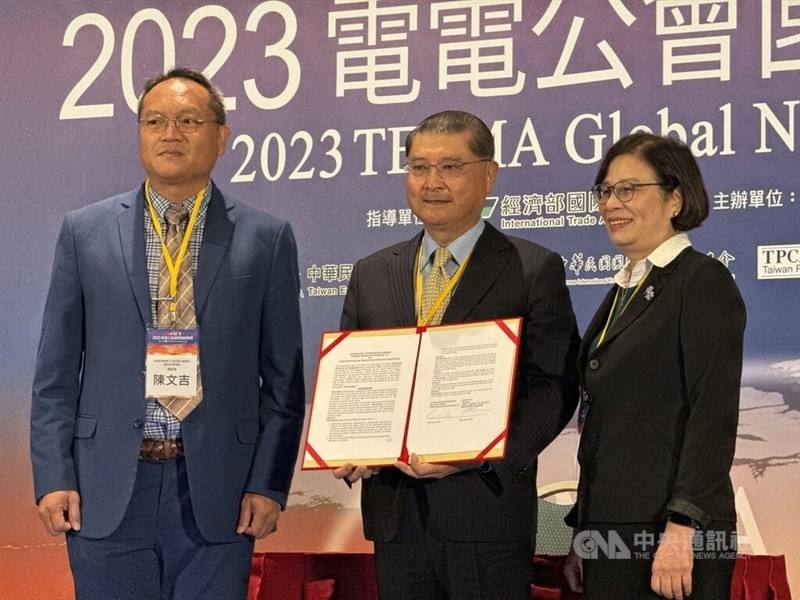
A Taiwanese electronics association and an auto parts industry group in Mexico signed a memorandum of understanding (MOU) on Friday, with the Taiwanese association saying Mexico could be a place of advantage for Taiwanese companies amid the recent global supply chain shuffle.
The MOU was inked between the Taiwan Electrical and Electronic Manufacturers' Association (TEEMA) and Mexico's National Auto Parts Industry (INA) during a virtual ceremony, by TEEMA Chairman Richard Lee (李詩欽) in Taipei and INA Executive President Francisco N. Gonzalez Diaz in Mexico.
It comes after a delegation from TEEMA, the Taiwan Printed Circuit Association, and the Taiwan External Trade Development Council visited Mexico in June.
In a statement, TEEMA said Mexico has become a hot destination as a result of recent supply chain restructuring, as it is not only part of the United States-Mexico-Canada Agreement (USMCA) -- the successor to the North American Free Trade Agreement -- but also closer to the U.S. market.
Taiwan's technological expertise and Mexico's strategic location, natural resources and long car manufacturing history will allow it and the INA to take full advantage of opportunities in the North American market, it added.
The signing ceremony was followed by a "Global Networking Forum" -- also hosted by TEEMA -- which discussed regional free trade agreements and "investing in the U.S. and Mexico."
Speaking at the signing ceremony and opening the forum in Taipei, Deputy Trade Representative of the Office of Trade Negotiation Jenni Yang (楊珍妮) said Taiwan should seek opportunities to build more partnerships in a world where once-globalized supply chains have been seriously affected and challenged by the pandemic and geopolitical tensions.
"As Taiwan is a relatively resource-poor country and not unaffected by the changes, we need to rely on reliable partners to upgrade our supply chains," Yang said.
This is why Taiwan is striving to join the Comprehensive and Progressive Agreement for Trans-Pacific Partnership and strengthening the country's economic cooperation with the U.S., Canada and Mexico, Yang added.
Taiwan's manufacturers of electronics have already upped their investment in those three countries, especially in states near the Mexican border, which proves that "nearshoring and de-risking are already happening," Yang said.
Also present at the event in Taipei was Martin Torres, head of the Mexican Trade Services Documentation and Cultural Office in Taiwan.
In his opening remarks, the representative welcomed a delegation from the Mexican state of Chihuahua attending the event to Taiwan.
Noting that many Taiwanese companies such as Inventech, Foxconn and Pegatron have had a presence in Chihuahua state since the turn of the Millennium, the representative said the presence of Taiwanese companies in Mexico is expected to grow further.
Torres also noted the "unprecedented" visits by governors from northern Mexican states to Taiwan in the past year and next year, with the governors of Chihuahua and Baja California due to visit next year.
American Institute in Taiwan Acting Director Jeremy Cornforth said in his opening remarks that "a significant increase in the focus on expanding in the United States among global investors" has also brought benefits to its neighbors in North America.
He noted that there has been an upsurge of mutual investments and cooperation following the establishment two years ago of the economic platform known as the Technology Trade and Investment Collaboration Framework between the U.S. and Taiwan.
"Total trade between the United States and Taiwan increased nearly 20 percent in 2022 alone, with Taiwan ranked as the United States' ninth largest goods trade partner, outpacing large markets such as India," he said.
Derry McDonell, acting director of the Canadian Trade Office in Taipei, said the USMCA -- known as CUMSA in Canada -- "grants Canadian companies access to over 450 million consumers, and 99 percent of Canadian exports to the U.S. and Mexico continue to benefit from duty-free treatment."
As many Taiwanese companies are taking advantage of the integrated North American market and have been active in the U.S. and Mexico, McDonell called for more Taiwanese investments in Canada as it "should be higher than it is given the real opportunities available in Canada."