A research team in Taiwan has overturned previous understandings of the risk of ADHD in the offspring of mothers with diabetes. Their findings have attracted significant attention both domestically and internationally, showcasing the potential of Taiwan's National Health Insurance data to contribute to global medical research. The team, led by Professor Edward Chia-Cheng Lai from the College of Medicine at National Cheng Kung University, in collaboration with the international academic research organization NeuroGEN (Neurological and mental health Global Epidemiology Network), and under long-term support from the National Science and Technology Council, published their research findings in the top biomedical journal Nature Medicine (https://www.nature.com/articles/s41591-024-02917-8#citeas).
ADHD is a common neurodevelopmental disorder in children, often diagnosed during school age, that impacts various aspects of life including learning and social interactions. The symptoms are usually chronic and can persist into adolescence or early adulthood. Factors believed to contribute to this condition include genetic heredity, environmental risks during pregnancy, and acquired factors. If the causal relationship between certain risk factors during pregnancy and ADHD in the offspring can be confirmed, early interventions and prevention could be initiated. Many studies have found that gestational diabetes may be linked to neurodevelopmental disorders in offspring; however, being limited by their observational designs, these studies did not fully account or adjust for familial genetics and environmental factors that could confound the results. Furthermore, verification of these associations has been challenging due to the limited sample size of pregnant women, a minority group.
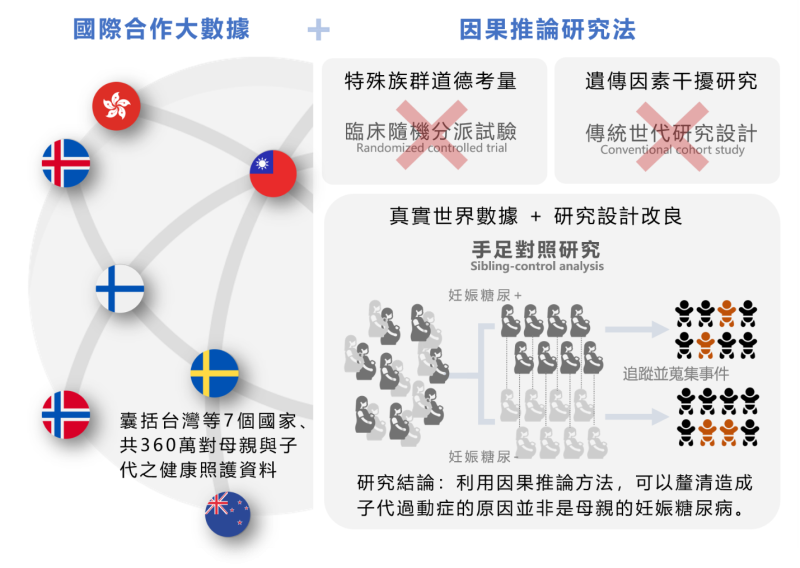
Key strategies for advancing epidemiological research include utilizing multi-country healthcare databases through international collaboration. Professor Lai's research team, in cooperation with the NeuroGEN research network, generated a large sample size using parent-child population studies based on research data from seven countries: Taiwan, New Zealand, Hong Kong, Finland, Iceland, Norway and Sweden, which included approximately 3.6 million pairs of mother and child health care records. The team utilized a sibling control study design to account for hard-to-measure factors such as familial genetic influences. Although studies based on traditional study designs suggested that gestational diabetes slightly increases the risk of children developing ADHD, this risk disappeared when genetic and environmental influences were taken into account, thus overturning the previous understanding of gestational diabetes and providing real-world evidence for clinical consideration.
Through international collaboration, the research team from National Cheng Kung University has demonstrated Taiwan's potential in big data analysis and the value of health care data. This supports medical advancement in the international community. Through the application of rigorous causal inference methods, this study was able to avoid misjudgment and effectively identified the true influencing factors, thus enabling the most accurate judgments and clinical decisions. This research method not only enhances the accuracy of results but also provides a more reliable basis for future clinical practice.