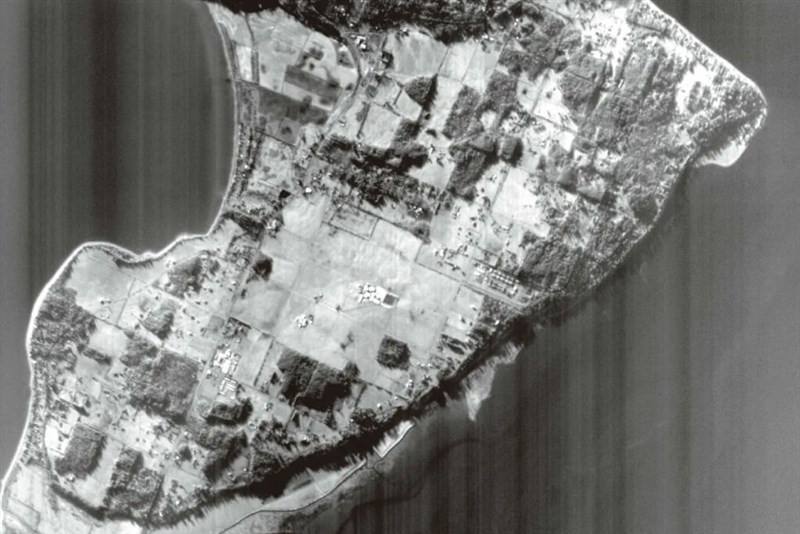
Taipei, Feb. 6 (CNA) The Taiwan Space Agency (TASA) announced Wednesday that the Taiwan-Japan co-developed small satellite "ONGLAISAT" had hit a key milestone by completing 50 imaging operations and successfully testing three key technologies.
After nearly three months of in-orbit operation, "ONGLAISAT" -- ONboard Globe-Looking And Imaging Satellite -- achieved its objectives after downloading and processing 50 images of the earth, TASA said in a news statement.
Three technologies were also successfully tested -- the Korsch off-axis optical system, Complementary Metal-Oxide Semiconductor (CMOS) Time Delay and Integration (TDI) image sensor, and JPEG 2000 onboard compression capability, TASA added.
Chan Chen-yu (詹鎮宇), who is running the "ONGLAISAT" project, said that small satellites -- CubeSats -- are a quicker and more affordable "pathfinder" to test emerging space technologies.
He added that the project was launched to test the feasibility of systems for use in future ultra-high-resolution optical remote sensing satellites.
Regarding the off-axis optical system aboard "ONGLAISAT," Chan said that while it presents greater design, manufacturing and assembly challenges, it has a more compact structure and improved optical performance.
With successful testing, he said the technology could be used on larger satellites, helping to improve image resolution.
Meanwhile, the CMOS TDI image sensor, which enhances sensitivity and image quality, is the first Taiwanese-developed TDI image sensor to be successfully tested in space mission, potentially helping the country develop its own satellites.
He added that the JPEG 2000 onboard compression capability enables more efficient use of satellite data storage and downlink bandwidth, "preventing bottlenecks" in data transmission.
The "ONGLAISAT" project is a collaboration project between TASA and the Intelligent Space Systems Laboratory at the University of Tokyo's Department of Aeronautics and Astronautics, along with several Japan-based start-up companies.
Launched into space from the United States on Nov. 5 last year, "ONGLAISAT" was deployed into a 410 km low Earth orbit from the International Space Station on Dec. 9.
Its mission is expected to last until early March, TASA said.