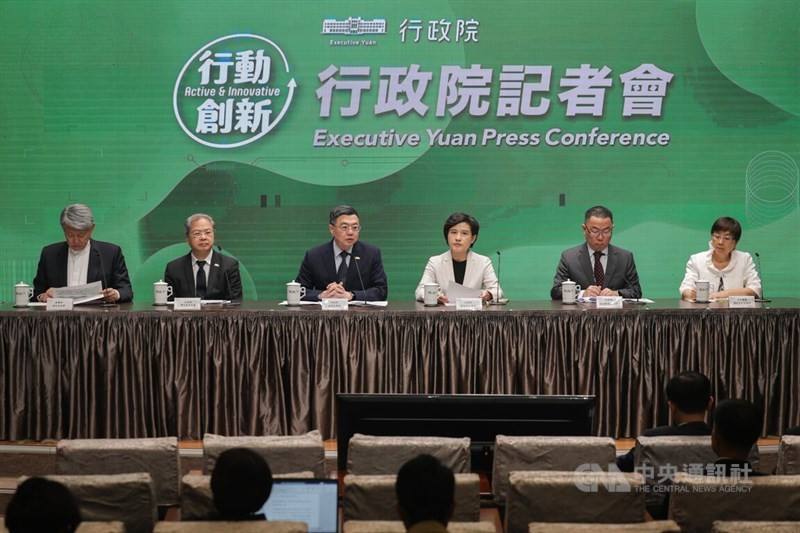
Taipei, April 24 (CNA) The Executive Yuan on Thursday approved a special budget proposal that would allow it to draw an additional funding of NT$410 billion (US$12.6 billion) in efforts to meet economic and security challenges facing Taiwan over the next two years, including its previously pledged measures to mitigate the impact of U.S. tariff shocks.
On April 21, the Cabinet launched a NT$88 billion support package designed to cushion the impact of U.S. tariffs on Taiwan's industrial and agricultural sectors and boost the local economy.
It said at the time it was expected to approve a special budget bill to finance the support plan during the Cabinet's meeting later this week and send it to the Legislature for approval.
However, the special budget proposal adopted on Thursday would allow the Cabinet to allocate NT$410 billion in addition to its annual general budgets over the next two years through the end of 2027.
At a news conference in Taipei, Premier Cho Jung-tai (卓榮泰) said the NT$410 billion proposal would include an allocation of NT$100 billion to Taiwan Power Co. (Taipower) to address its financial losses.
Taipower had accumulated deficits as much as NT$420 billion by the end of 2024 despite the Democratic Progressive Party (DPP) government's sustained efforts to inject funds into the state-run company from its annual budgets.
Taipower's losses stem from rising global oil prices and the government's reluctance to increase household utility rates -- a politically charged livelihood issue in Taiwan -- even after opposition lawmakers rejected the Cabinet's proposed NT$200 billion aid for the company for 2025-2026 earlier this year.
Cho said the latest attempt to fund Taipower would help stabilize consumer prices and shield Taiwanese industries and the broader economy from potential impacts of recent global economic shocks.
The NT$410 billion proposal would also include the Cabinet's support package, which, since its launch a few days ago, has been increased to NT$93 billion, with NT$150 billion earmarked to bolster Taiwan's security, Cho said.
Cabinet spokesperson Michelle Lee (李慧芝) said the NT$150 billion would be used to strengthen Coast Guard operations, develop unmanned aerial vehicle (UAV) infrastructure, and upgrade information and communications systems and facilities.
According to the Cabinet, the special budget will be funded primarily through fiscal surpluses, although the proposed bill would allow for borrowing if necessary.
The Cabinet's bill, titled the "Special Act for Strengthening Economic, Social, and National Security Resilience in Response to International Circumstances" (因應國際情勢強化經濟社會及國土安全韌性特別條例), requires legislative approval.
Even after the Legislature approves the proposed special act, the Cabinet will have to propose special budget plans and obtain the Legislature's permission to actually use the NT$410 billion in funds.