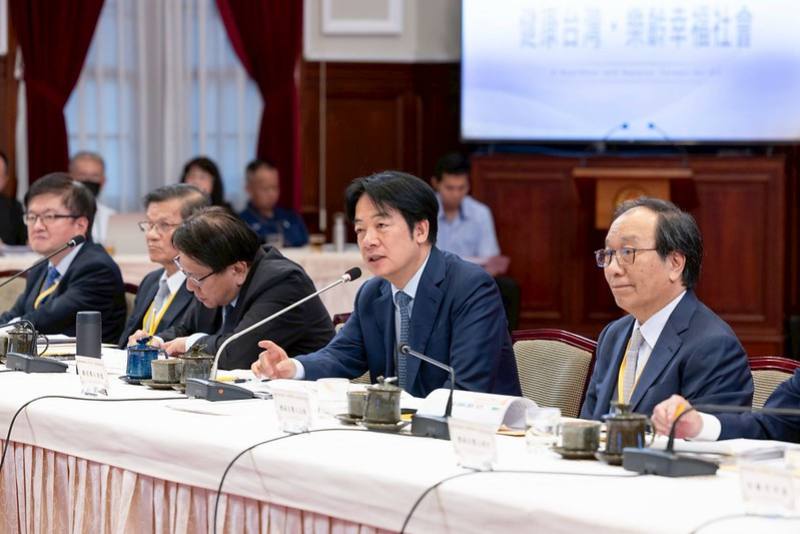
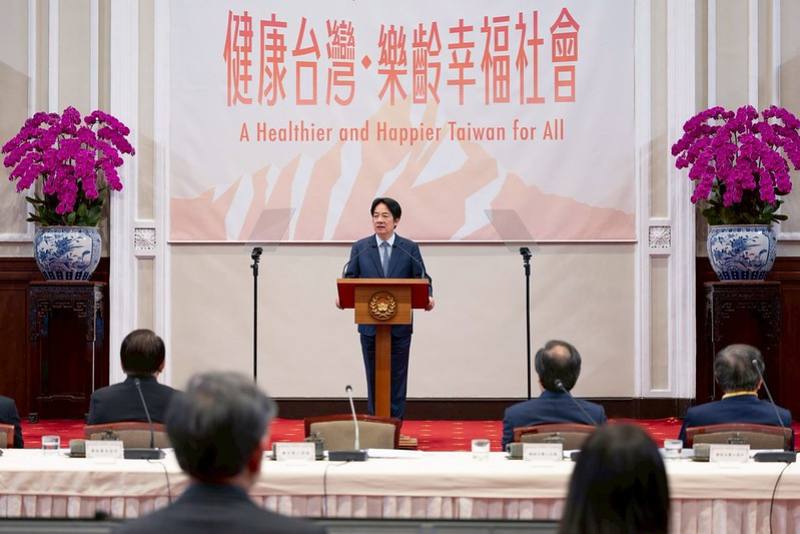
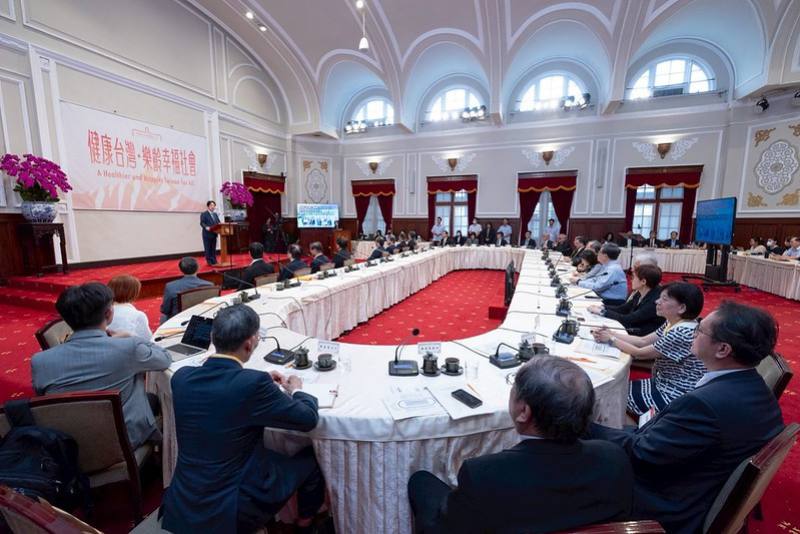
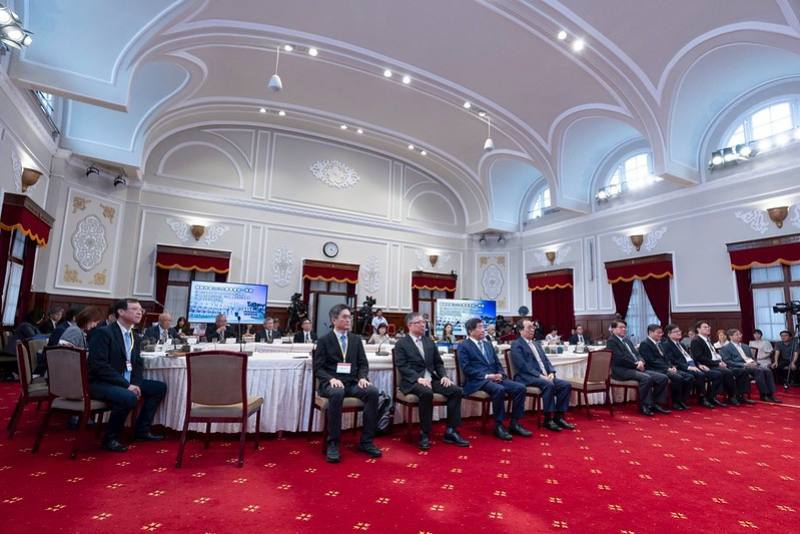
On the afternoon of May 22, President Lai Ching-te presided over the fourth meeting of the Healthy Taiwan Promotion Committee. In his opening statement, the president emphasized that building a Healthy Taiwan requires inter-ministerial collaboration and public-private cooperation, and that even more, it requires full public participation to keep people healthy and make the nation stronger so that the world embraces Taiwan.
President Lai indicated that promotional efforts for the government’s policies have already been elevated to a cooperative endeavor involving the entire government through a division of labor, continuously expanding whole-of-society participation, noting that the task for the next phase is to achieve public consensus. Looking ahead, he said, the government will promote sports and athletics among citizens through four main strategies: creating the right social climate, building a supportive physical environment, enhancing people’s awareness of self-health, and integrating information systems. The president stated that through inter-ministerial collaboration, we will create a comprehensive health education support system so that health is an everyday habit.
A translation of President Lai’s opening statement follows:
Today is the fourth meeting of the Healthy Taiwan Promotion Committee. The day before yesterday, Vice President Bi-khim Hsiao and I completed one year in office. I want to thank the three deputy conveners and all of our advisors and committee members for their efforts and dedication regarding various health policies since the committee’s first meeting last August.
On the 27th of last month, we also helped our friends in the medical community learn about the Healthy Taiwan Promotion Committee’s achievements, the government’s current policies, and our goals going forward at the 2025 Healthy Taiwan national forum.
I want everyone to know that whether it is today’s committee, the National Climate Change Committee, or the Whole-of-Society Defense Resilience Committee, over the past year, we have worked to implement the spirit of inter-departmental, cross-disciplinary, and public-private collaboration. Currently, the discussions and promotional efforts for various policies have shifted from individual departments performing their respective duties to a cooperative division of labor involving the entire government, continuously expanding whole-of-society participation. In the next phase, our task is to achieve public consensus.
We need to actively initiate campaigns that the public can participate in, promoting awareness and concepts that everyone should have, so that the ideas and practices that promote better health, respond to climate change, and boost whole-of-society defense resilience can be integrated into people’s lives. When policies have a palpable impact and public participation, working together, we can achieve the goals set by each committee.
For example, last year at the first meeting, we set a Healthy Taiwan goal to increase the average life expectancy of the public from 79 years to 82 years within 8 years, and reduce time spent living with illness or disability from 10 percent to 8 percent of the average life expectancy. To achieve that goal, we must integrate the strengths of various ministries and agencies, establish a comprehensive sports network, and promote regular exercise habits for people of all ages nationwide. By 2030, we aim to increase the number of physically active people by 15 percent compared to 2021, thereby extending the average healthy lifespan of our citizens.
The World Health Organization (WHO) has indicated that insufficient physical activity is one of the four main risk factors leading to non-communicable diseases, and that regular physical activity has significant benefits for both physical and mental health. But according to Taiwan’s 2021 National Health Interview Survey, more than half of the population does not meet the WHO’s recommendation of 150 minutes of moderate-intensity physical activity per week. We must implement various policies to enhance the willingness of people of all ages to engage in physical activity.
Therefore, at today’s meeting, in addition to hearing a report by the Ministry of Health and Welfare (MOHW) on the status of certain items listed in the third committee meeting, we have also specially invited the MOHW to deliver a report on promoting sports and athletics to drive citizen health, and the Ministry of Education (MOE) to deliver a report on courses and teaching activities regarding health promotion for schools at the high school level and below.
As I mentioned earlier, promotional efforts for our policies have already been elevated to a cooperative endeavor involving the entire government through a division of labor. Today’s report from the MOHW incorporates plans from the Ministry of Transportation, MOE, and Ministry of Labor, along with guidance from Committee Member Chien Wen-jen (簡文仁) and the Executive Yuan prior to the meeting. Looking ahead, the government will promote sports and athletics among citizens through four main strategies: creating the right social climate, building a supportive physical environment, enhancing people’s awareness of self-health, and integrating information systems.
In addition, education is the foundation and key to cultivating healthy citizens. By establishing correct health concepts from a young age, developing healthy behaviors that meet individual needs, and forming good habits, the likelihood of maintaining routine exercise in adulthood increases significantly.
In a few minutes, the MOE will deliver a report on helping children understand the importance of health through health-promotion courses and incorporating that understanding into their daily habits through practical and situational education.
In the future, through inter-ministerial collaboration and comprehensive campus health promotion policies, as well as close engagement with families and communities, we will create a comprehensive health education support system so that health is not just something people learn about from books, but an everyday habit.
I want to emphasize that building a Healthy Taiwan requires inter-ministerial collaboration and public-private cooperation. Even more, it requires full public participation to keep people healthy and make the nation stronger so that the world embraces Taiwan.
Taiwan’s various health policies and medical and public health experiences can help promote exchanges and cooperation with the world. As we meet today, Minister of Health and Welfare Chiu Tai-yuan (邱泰源) is leading a World Health Assembly action team to conduct professional medical and public health exchanges in Geneva. These exchanges not only demonstrate to the world Taiwan’s extensive soft power in the medical and public health fields, but also tell the international community that if Taiwan is permitted to participate in WHO-related activities, we can definitely contribute even more to the international medical and public health system.
Once again, I want to thank all the advisors and committee members for working together with the government. I also hope that after listening to the reports, you can provide expert opinions from the perspectives of your various fields for the reference of government agencies, so that together, we can raise health management awareness among the public and work together to achieve our vision of a Healthy Taiwan. Thank you.
Following his statement, President Lai heard a report on the progress of certain items listed in the third committee meeting from Deputy Executive Secretary and National Health Insurance Administration Director General Shih Chung-liang (石崇良), a report on promoting sports and athletics to drive citizen health from Deputy Minister of Health and Welfare Chou Jih-haw (周志浩), and a report on courses and teaching activities regarding health promotion for schools at the high school level and below from Political Deputy Minister of Education Chang Liao Wan-chien (張廖萬堅). Afterward, President Lai exchanged views with the committee members regarding the content of the reports.