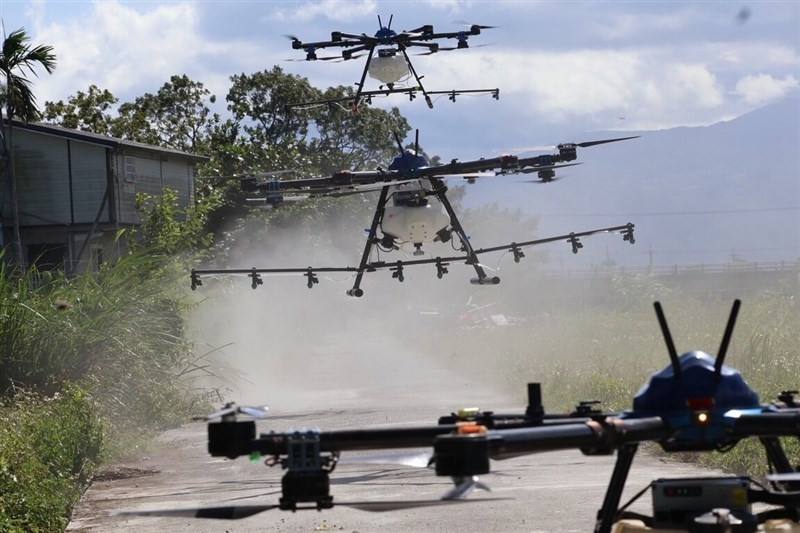
Taipei, Nov. 2 (CNA) The military's plan to create an unmanned aircraft system (UAS) group for each of the country's five theaters of operations (TOs) will help counter China's "gray-zone coercion" and surprise attacks disguised as exercises, a military expert said in a recent essay.
Army Chief of Staff Chen Chun-yi (陳俊義) told legislators on Oct. 23 that the Army will establish a UAS group in each TO to defend northern, central, southern and eastern Taiwan, as well as offshore Penghu County. The combat units are expected to be in place by July, Chen said.
Ko Yung-sen (柯永森), a researcher at the government-funded Institute for National Defense and Security Research (INDSR), wrote on Oct. 30 that drones' rapid deployability makes them well suited to respond when a military drill turns into an actual attack.
Compared with tanks, artillery or surface vessels, drones are more flexible, involve lower risk and are more cost-efficient, he said.
They can also be used for reconnaissance, intelligence sharing, denying or slowing access and breaking blockades, strengthening deterrence and defense, he said.
Ko added that the development of drone combat units will encourage industry collaboration -- for example, with National Chung-Shan Institute of Science and Technology -- to upgrade and domestically produce components such as optical sensors, bolstering supply chains and defense-industry resilience.
He recommended setting up an interim "experimental" drone unit before July to address operational challenges and stressed the need to train specialists in mission planning, image analysis, communications-link monitoring, maintenance and logistics.
Ko also noted that practical flight training is constrained under the Civil Aeronautics Administration's Regulations of Drone, especially near airports and densely populated areas.
Careful planning of garrisons, training sites, airspace and curricula is therefore essential to avoid training shortfalls that could weaken combat effectiveness, he said.
According to a Ministry of National Defense report to the Legislature in March 2024, the military plans to procure six drone types -- tactical short-range, land-based, shipborne, target-acquisition, surveillance/reconnaissance and micro models.
Ko said that, because these platforms will be fielded across the Army, Navy and Air Force, a unified data link and a joint operational picture are critical for streamlined command, reconnaissance and strike operations.
As nascent units, the drone groups should draw on foreign experience to develop standardized operating procedures, guidelines and doctrine to establish command chains and interoperability across service branches, he added.