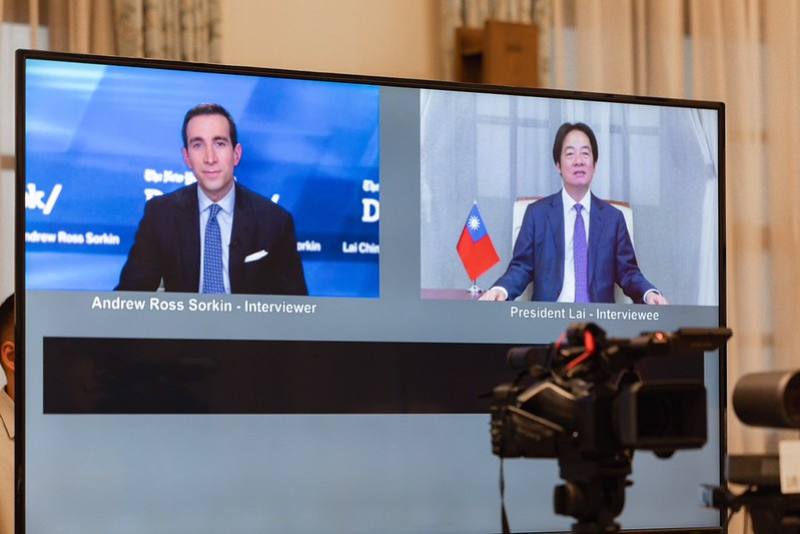
In a recent interview via videoconference with The New York Times for its DealBook Summit, President Lai Ching-te responded to questions from host Andrew Ross Sorkin on topics including Taiwan’s national defense, cross-strait relations, Taiwan-US relations, the Russia-Ukraine war, and the semiconductor industry. The interview was broadcast in the early morning of December 4.
The DealBook Summit is a major annual event held by The New York Times aimed at facilitating dialogue among leaders from various sectors and sharing their insights and analyses on international affairs. This year’s summit was held on December 3 (US EST) in New York, and included such speakers as Israeli Prime Minister Benjamin Netanyahu, United States Treasury Secretary Scott Bessent, California Governor Gavin Newsom, Palantir CEO Alex Karp, and Turning Point USA CEO and Chair of the Board Erika Kirk.
The following is the full text of the interview:
Q: Here’s where I want to start the conversation. You’ve just announced this past week that you’re introducing a US$40 billion special budget for military spending to buy more weapons from the US to try to deter China from invading Taiwan. What indicators, and perhaps new indicators, are you looking at that shows an increased threat to Taiwan?
President Lai: We can see that China’s military drills targeted at Taiwan are becoming increasingly frequent and intense. They have even moved beyond the first island chain into the second, affecting the wider Indo-Pacific region. At the same time, China’s united front influence campaigns against Taiwan are also becoming more serious. In order to safeguard national security and fulfill our responsibility to maintain peace and stability across the Taiwan Strait, we have announced this special defense budget.
We believe that peace is priceless, and war has no winners. While we aspire to peace, we cannot harbor illusions about it. Peace must be secured through strength. This is why we are increasing our defense budget and strengthening our national defense capabilities, while also cutting back our economic dependence on China. This includes improving our economic resilience. In 2010, 83.8 percent of Taiwan’s outbound investment went to China; last year, that figure had dropped to around 7 percent. We are also working side-by-side with other democracies to reinforce deterrence. Robust preparations are the best way to avoid war and achieve peace.
Q: Let me ask you this: President Xi has said that his goal for China’s military is to be capable of taking Taiwan by force by 2027. You said that Beijing is accelerating these preparations for an attempted invasion. So what do you think China’s timeline is now?
President Lai: We must ensure the best possible preparations for the worst-case scenarios. Whatever timeline the PLA may have, Taiwan’s fundamental principle is that we must be ready first – this is our basic principle.
I also want to use this opportunity to reiterate to the international community that Taiwan will do everything necessary to protect itself and to safeguard regional peace and stability. We are grateful to the international community, including the G7, the president of the United States, Japan’s political leaders, and many others for their interest in cross-strait peace and emphasizing that stability in the Taiwan Strait is essential to global security and prosperity. Their shared position greatly contributes to stability in Taiwan and peace in the region. We hope Taiwan can continue working with the international community to uphold the rules-based international order.
Q: Well, let me ask you about that because, Mr. President, last week you said the relationship between Taiwan and the US is rock-solid. How confident are you that the United States, and in particular President Trump, would come to the aid of Taiwan if China were to invade?
President Lai: Although Taiwan and the United States do not have official diplomatic relations, Taiwan is deeply grateful to the US Congress for passing the Taiwan Relations Act and to President Ronald Reagan for the Six Assurances. For decades, successive US administrations and both parties in Congress have strongly supported Taiwan based on this foundation. Our relationship truly is rock-solid. Since President Trump took office, cooperation with Taiwan has not only continued but even expanded. We look forward to working with the United States through tariff negotiations – not only to help address their trade deficit, but also to deepen bilateral economic relations and strengthen our friendship.
Q: We’ve all been watching what’s been happening play out in Ukraine between Ukraine and Russia. And there have been questions inside Ukraine about the support that the United States has provided or not in terms of how this ultimately gets settled. How do you view what’s happening in Ukraine right now and the role that the US is playing there?
President Lai: Taiwan stands with the people of Ukraine. We hope this irrational and illegitimate war will be over as soon as possible so that the Ukrainian people will no longer have to suffer. However, in ending this war, we also hope that Ukraine’s national dignity and the well-being of its people will be respected, and future conflict will be prevented.
Q: You talked about trade earlier. When you talk about the relationship between the US and Taiwan, one of the reasons that Taiwan is so valuable, such a strategic asset – and President Trump talks about it this way about Taiwan – is because of semiconductors. And one of the things that he says is that he hopes that the US is going to be manufacturing 40 to 50 percent of all semiconductors in the next couple of years with your help. Does that make Taiwan more valuable ultimately to the US or do you worry at all that it makes it less valuable to the US?
President Lai: Taiwan’s semiconductor industry plays a crucial role, especially as we enter the future AI era. But I want to emphasize, with humility, that Taiwan’s semiconductor sector is a global asset. The industry functions as an ecosystem: the US excels in R&D, design, and has the world’s largest market; Japan provides materials and equipment; the Netherlands makes advanced lithography systems; Taiwan specializes in logic chip manufacturing; and Korea leads in flash memory chips.
In other words, semiconductors are a global ecosystem – it requires worldwide cooperation to be effective. This is why our government supports TSMC and other Taiwanese semiconductor firms as they invest in the US, Japan, Europe, or wherever they believe is needed. This contributes to global progress and prosperity.
As a result, we remain supportive as President Trump seeks investments from Taiwanese semiconductor companies and suppliers in the US. We hope Taiwan can support the reindustrialization of the US. President Trump wants the US to become the world center for AI, and we are willing to assist in this.
As I said earlier, we hope Taiwan-US tariff negotiations will not only help reduce the US trade deficit, but also deepen bilateral economic cooperation, further integrate Taiwan’s industries with the American economic structure, and strengthen the Taiwan-US relationship. This will contribute to global prosperity and development.
Q: Do you think that President Trump’s timeline, this idea that 40 to 50 percent of all semiconductors could be manufactured in the United States in the next two or three years, is realistic?
President Lai: We understand President Trump’s sense of urgency; he wants the United States to maintain an edge in global competition. Whether this target of 40 to 50 percent can be achieved within this timeframe depends not only on Taiwan’s support but also on the US government’s ability to facilitate land acquisition, water and electricity supply, workforce and talent development, and investment incentives. If the US government manages to do this well and effectively, then this goal becomes much more achievable.
Q: There’s a big debate in the United States right now about whether companies like Nvidia should be allowed to sell their most advanced chips to China. And there has not been a real answer yet here in the US. I’m curious what you think about that. Do you think that the most advanced chips should be allowed to be exported to China?
President Lai: As Taiwan’s president, it would not be appropriate for me to comment on US domestic policy. But I can share an experience: Around the year 2000, Taiwan faced a similar debate about whether our advanced chip manufacturing capabilities should move to mainland China. There was an extensive and thorough discussion across society and among different political parties. The consensus was that it would be unwise and should not happen. Looking back, that decision was correct. Had Taiwan allowed its most advanced manufacturing to relocate to China, Taiwan would not be what it is today.
Q: Final question for you. Your economy is red hot right now, in large part because of the AI boom. It’s a two-part question. I wonder whether you’re worried about an AI boom being an AI bubble. And I’m also curious how you think about the Chinese economy today and how that relates to how President Xi even views Taiwan, and when and if it would consider either invading or, through using the gray zone, trying to effectively cut off or control Taiwan.
President Lai: There are many different views in the tech and economic communities. Some say AI could become a bubble; others say it may not. As a political leader, I believe the AI era will bring greater convenience to people’s lives, stimulate economic development, and contribute to global prosperity. That is why we must take steps to prevent AI from becoming a bubble.
In other words, leaders around the world – especially those from countries with AI-related industries – should work together and take necessary measures to ensure AI develops sustainably and has a soft landing, so that it can drive long-term global growth.
China’s economy is indeed struggling. Taiwan’s growth rate this year is projected to reach 7.37 percent, while international financial institutions estimate China’s growth to be only a little above 4 percent. We sincerely hope that as China faces economic pressures, President Xi Jinping will focus not on territorial expansion but on improving the well-being of the Chinese people. Taiwan is willing to help and to cooperate in addressing these economic challenges.