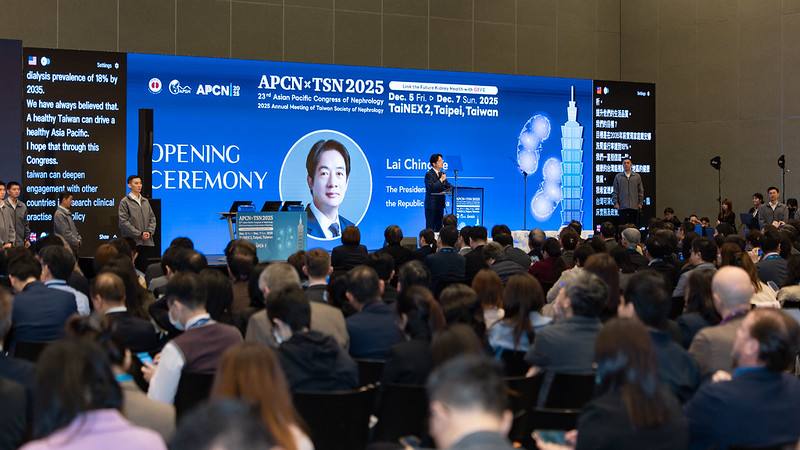
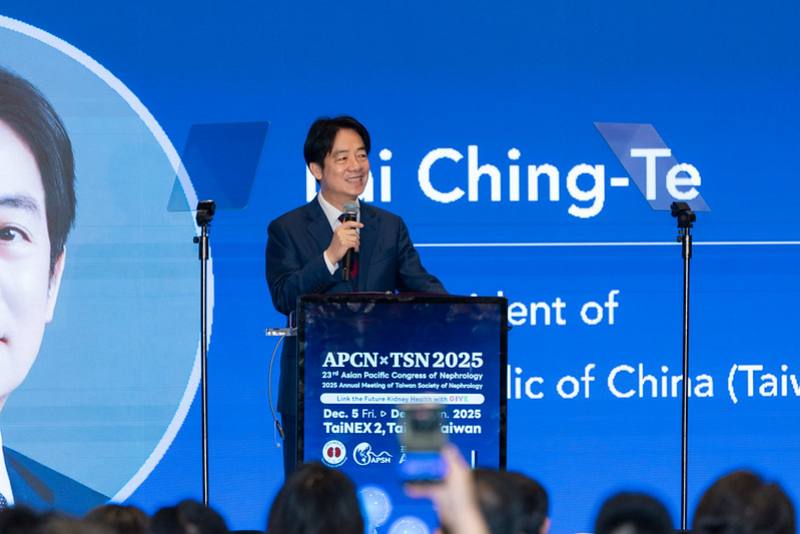
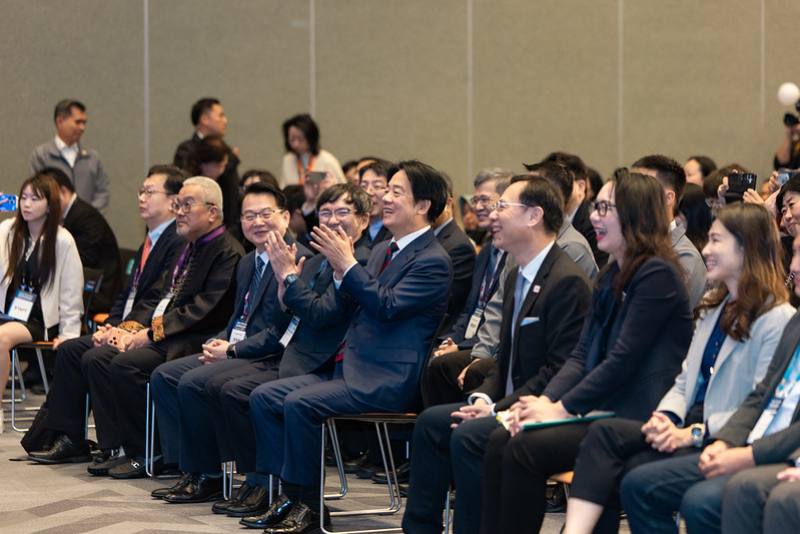
On the morning of December 5, President Lai Ching-te attended the opening of the 23rd Asian Pacific Congress of Nephrology held in conjunction with the Annual Meeting of the Taiwan Society of Nephrology. In remarks, President Lai stated that renal disease has become a major challenge for global public health and pointed out that Taiwan is taking active steps for comprehensive reform, from prevention, integrated care, and drug policy to the development of home dialysis content. He expressed hope that Taiwan can deepen engagement with other countries in research, clinical practice, and policy so that Taiwan can become a key force for promoting kidney health in the region and make greater contributions to global health.
A transcript of President Lai’s remarks follows:
The Asian Pacific Congress of Nephrology is the most influential international gathering in our specialty in the Asia-Pacific region. It is significant that Taiwan is hosting this congress again after 25 years. I extend a warm welcome to the many leaders in medicine from around the world joining us here in Taiwan. And I especially want to give sincere thanks to the APSN [Asian Pacific Society of Nephrology] and TSN [Taiwan Society of Nephrology] for organizing this meeting.
Renal disease has become a major challenge for global public health. In fact, the WHO [World Health Organization] recently adopted a global resolution that includes CKD [chronic kidney disease]. There are currently about 90,000 people who receive dialysis treatment in Taiwan, with related expenses estimated at 1.5 billion US Dollars for this year. This directly impacts the health, well-being, and quality of life of our citizens.
As a nephrologist myself, I know that kidney health is one of the pillars of health and happiness for our people. The theme of this year’s congress is “Link the Future Kidney Health with GIVE.” It calls for addressing kidney health issues from the perspectives of genetics, immunology, vast data analytics, metabolic science, and sustainability. And through the exchange of experiences, it aims for scientific results to be transformed into safeguards for people’s health.
Taiwan has had many significant clinical and research results in nephrology over the past several years. We have already shifted from a focus on treatment to prevention, and we are continuing to expand community screening and health education.
Here, I want to give special thanks to the nephrology community in Taiwan. Working closely and over many years with the APSN and ISN [International Society of Nephrology], they have shared Taiwan’s experience in dialysis quality, integrated care for CKD, and cooperation across specialties. This has helped to enhance the professional capabilities of medicine in Taiwan.
In addition to efforts in the private sector, Taiwan has also actively promoted prevention and treatment of renal disease on the policy side. This includes provision of free health exams for adults and encouragement for early screenings.
As we know, hypertension, hyperglycemia, and hyperlipidemia are risk factors for conditions such as renal disease. That is why last year we launched the 888 Program for the prevention and treatment of the three highs. The program helps people discover issues in the early stages and improve their health through management and intervention.
This March we also expanded coverage for SGLT-2 inhibitors in the treatment of CKD, in the hope that by attacking the problem from multiple angles, we can reduce the disease incidence rate and slow progression.
Taiwan’s age-standardized incidence rate of dialysis decreased from 318 per million in 2005 to 290 per million in 2022. Growth rates for patient visits and total medical expenses have also shown a downward trend. We will continue our efforts to ensure that renal disease prevention and treatment strategies achieve better and better results.
I am also honored to share with everyone today the newly released Taiwan Home Dialysis White Paper for 2026 to 2035. Special thanks go to the TSN, our Ministry of Health and Welfare, and the ISPD [International Society for Peritoneal Dialysis] for their professional contributions. This publication signifies that Taiwan has moved beyond hospital-only treatment, and is integrating medical care into homes and communities. We are making progress toward our goals of human-centered care, healthy aging, and sustainable healthcare.
We will do our utmost to realize the vision put forth in the white paper, working with international healthcare organizations like the ISPD and the International Home Dialysis Consortium to enable even more patients to safely receive dialysis at home, enhancing their quality of life. Our goal is to achieve a home dialysis prevalence of 18 percent by 2035.
We have always believed that a healthier Taiwan can drive a healthier Asia-Pacific. I hope that through this congress, Taiwan can deepen engagement with other countries in research, clinical practice, and policy. I also hope that Taiwan can become a key force for promoting kidney health in the region, and that we can all work together to make greater contributions to global health. Thank you once again to the organizers. I wish this conference great success. Thank you all.
Also in attendance at the event were International Society of Nephrology President Marcello Tonelli, International Society for Peritoneal Dialysis President Rajnish Mehrotra, and Asian Pacific Society of Nephrology President-elect Hyeong Cheon Park.