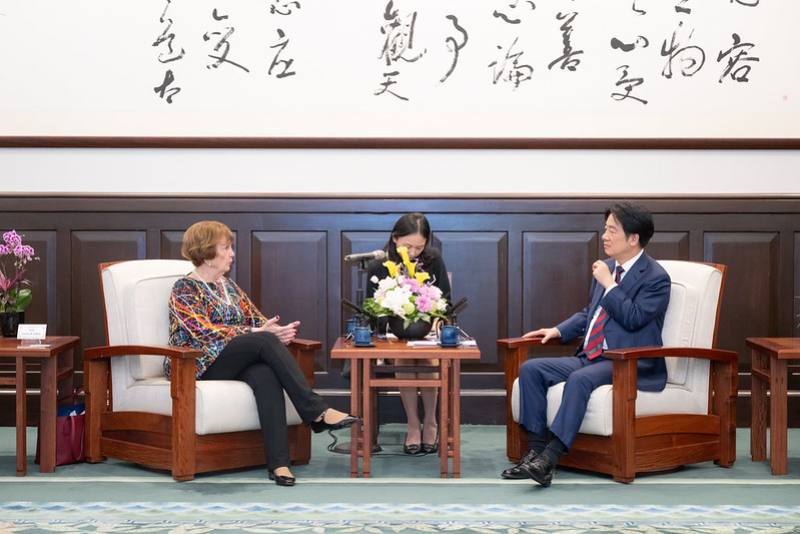
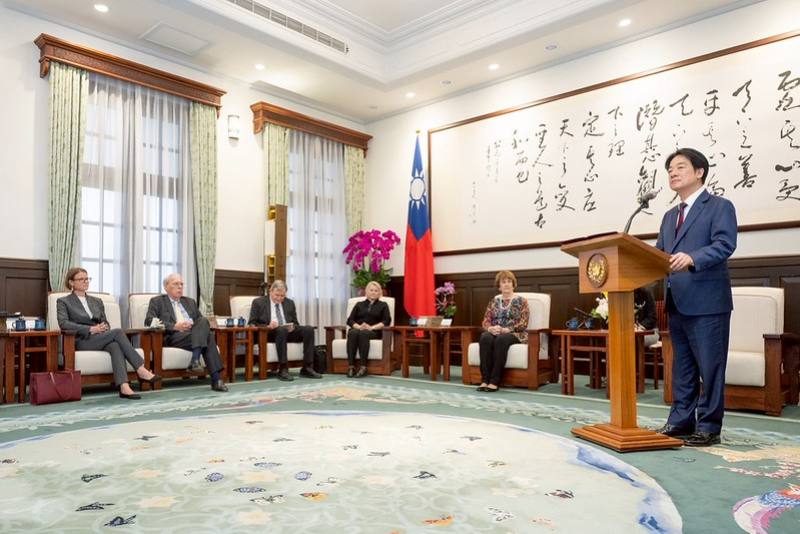
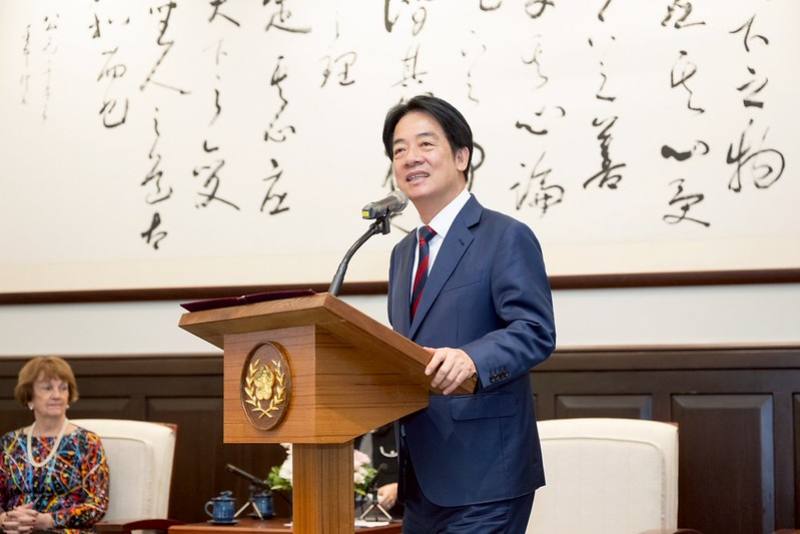
On the morning of December 5, President Lai Ching-te met with a delegation from the National Committee on American Foreign Policy (NCAFP). In remarks, the president stated that Taiwan and the United States are important strategic and trade partners, share ideals and values, and are deepening exchanges and collaboration. He emphasized that last week, Taiwan proposed an eight-year, US$40 billion supplementary defense budget for significant military procurement from the US, indigenous defense, and substantial reinforcement of Taiwan’s asymmetric capabilities. The president said that Taiwan will continue to reform national defense and actively enhance whole-of-society defense and resilience, and will also support Taiwan-US industrial engagement and deepen cooperation with the US and other like-minded democracies, upholding the values of freedom and democracy and our way of life.
A translation of President Lai’s remarks follows:
I warmly welcome Ambassador Susan M. Elliott as she leads another delegation to Taiwan. Ambassador Elliott has a doctorate in nursing science, while I started out as a physician. I am delighted that we have this opportunity to discuss the health and sustainable development of democracy. The NCAFP has always been highly valued internationally as a think tank and platform for exchanges. And over many years, through symposiums and research reports drawing attention to the Taiwan Strait situation, the committee has advanced international understanding of Taiwan. Many members of the delegation with us today have deep connections to Taiwan. I would like to thank you for affirming and supporting Taiwan’s determination to uphold democratic values.
Situated on the Indo-Pacific’s first island chain, Taiwan is a mature democracy, a responsible security partner, and an important part of global governance. Maintaining peace and stability in the Indo-Pacific and advancing prosperous global development are Taiwan’s unwavering goals. Recently, however, China has continued to threaten Taiwan and other countries in the region through such tactics as military intimidation, gray-zone oppression, economic coercion, and diplomatic suppression. It aims to alter the cross-strait status quo and challenge Indo-Pacific security and the global order.
In the face of expanding authoritarianism, we understand very clearly that only unity can help us weather these challenges, and only strength can bring peace. For this reason, Taiwan is committed to acting responsibly by continuing to bolster our national defense capabilities and demonstrating our resolve to defend ourselves. Just last week, we proposed an eight-year, US$40 billion supplementary defense budget for significant military procurement from the US, indigenous defense, and substantial reinforcement of Taiwan’s asymmetric capabilities. Meanwhile, defense spending, as it is defined by NATO, will exceed 3 percent of GDP next year, and is expected to reach 5 percent of GDP by 2030. Taiwan will continue to reform national defense and actively enhance whole-of-society defense and resilience. We will support Taiwan-US industrial engagement and deepen cooperation with the US and other like-minded democracies, upholding the values of freedom and democracy and our way of life.
I would like to thank successive US administrations for supporting and fulfilling their commitment to Taiwan in accordance with the Taiwan Relations Act and the Six Assurances. I also thank the US Congress for long demonstrating bipartisan support for Taiwan. The recent passage in the Senate and House of the Taiwan Assurance Implementation Act – just signed into law by President Donald Trump – is a prime example of this.
Taiwan and the US are important strategic and trade partners. Through our shared ideals and values, deepening exchanges and collaboration, and expanding mutual benefits and interests, we are the best of partners. In closing, I once again welcome you all to Taiwan and thank you for sharing your insights into deepening Taiwan-US relations.
Ambassador Elliott then delivered remarks, thanking President Lai for his warm welcome and hospitality. She noted that the NCAFP has visited Taiwan many times over the past two decades as part of their annual visit to Asia. While the delegation is in Taiwan, she said, they hope to discuss issues of common interest between both countries, including regional security, prosperity, and the relationship between Taiwan and the American people. Ambassador Elliott concluded her remarks by saying that the delegation looks forward to productive discussions and to spending the next few days in the beautiful city of Taipei.
The delegation also included NCAFP Director of the Forum on Asia-Pacific Security Susan A. Thornton, Distinguished Fellow at the Stimson Center Karl Winfrid Eikenberry, and President of the Pacific Century Institute Raymond F. Burghardt.