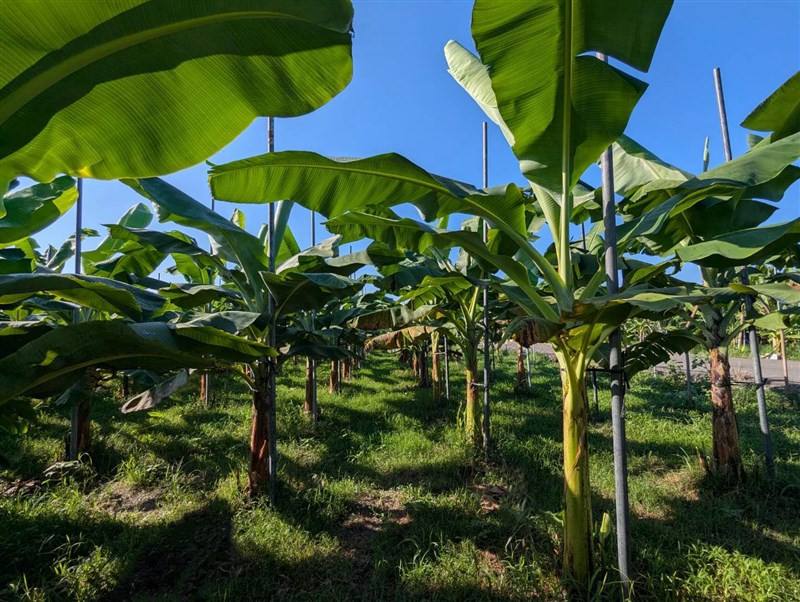
When the banana-killing Panama disease was detected in September 2025 in Ecuador, the world's largest banana exporter, it sent chills through the global industry.
The "Panama disease," a destructive wilt caused by a fungus whose most aggressive strain is known as TR4, is particularly feared because it attacks the "Cavendish" banana variety, which accounts for roughly half of global production and more than 90 percent of banana exports.
There is no known cure, and the TR4's symptoms are usually not visible until after the fungus has established itself in the soil, when it is too late to take action, leading to worries that the Cavendish variety could one day become extinct.
Taiwan, however, has managed to at least co-exist with the fungus since it first attacked nearly 60 years ago and recently cracked the code behind TR4 resistance that could give the world renewed hope that the fungus can be beaten.
CNA spoke with agricultural scientists to see how Taiwan's fight against the disease has evolved and what it has been able to achieve.
TR4 strikes
Taiwan's banana plantations were first struck by TR4 in 1967, when infected banana plants were discovered in Pingtung County, said Su Yu-yen (蘇育彥), a Taiwan Banana Research Institute (TBRI) assistant research fellow who has studied bananas for over 15 years.
Infected banana plants usually show yellowing along the leaf edges before wilting, and the fruit becomes small, misshapen, and inedible, Su told CNA.
Without knowing much about the disease, farmers cut down infected trees, disposed of them randomly and replanted lateral buds from infected plants, unintentionally spreading the fungus further.
"Over 80 percent of banana farms [in Taiwan] are still infected with TR4 today," Su said.
To address the problem, the TBRI collected the lateral buds from banana trees that seemed less affected by the disease and cultivated new infected buds in labs to create thousands of small plantlets.
Planlets appearing to the naked eye to be disease resistant in the lab were then planted in contaminated soil to determine, which, if any, could survive the fungus on the farm.
It was through that process that the first disease-resistant Giant Cavendish strain, the Taiwan Banana No. 1, was identified, and it was first planted for harvesting in 1992.
Eventually seven variants, including the Tai-Chiao No. 1 (80-90 percent resistant to TR4), No. 4, No. 5 (80 percent resistant to TR4), and No. 7, were identified as showing resistance while co-existing with Panama disease.
In 2025, the TBRI successfully used the "Williams" banana variety, also vulnerable to the TR4 fungus, to create a new disease-resistant variant, with 70 percent resistance to Panama disease.
Secret lies in gene loss
These many advances have been made through trial and error, relying on veteran TBRI farmers having "eyes as sharp as eagles" in spotting TR4-resistant banana variants, said Academia Sinica scientist Chen Ho-ming (陳荷名).
But Chen wanted to understand what was happening at a genetic level.
After years of research, she and her team published a study in the journal Proceedings of the National Academy of Sciences in November 2025 showing that TR4-resistant variants are protected not by extra genes but by missing chunks of DNA.
Chen said she did not realize how challenging banana research would be, calling it "so complicated."
Standard genetic analysis was impossible, Chen said, because bananas cannot produce seeds. With no local banana gene database and little prior research, her team spent years comparing and analyzing different variants to build a research foundation.
Four to five years into the process, Chen's team was finally able to use genomic analysis to find that disease-resistant varieties shared the same missing DNA segments.
They found that certain genes normally suppress the banana plant's immune response, and not having them meant TR4-resistant variants could mount a stronger defense against the fungal infection.
"One thing I'm proud of is that all the data points and research materials are local," Chen said, "Figuring out how the [TBRI farmers] had the insight to select and breed these plants has been amazing."
Chen said her research could be applied to support the development of new disease-resistant banana varieties in the future.
Taiwan's bananas on the international stage
Given the global threat posed by the TR4 fungus, one might think there would be interest in how Taiwan has coped with the disease.
Early on, when some foreign businesses sought to import TR4-resistant plantlets from Taiwan, however, their agriculture authorities tended to reject the requests over concerns the fungus could spread, said Su, the TBRI assistant research fellow.
Yet now, more countries, including the Philippines, the largest buyer of the TR-4 resistant strain, are welcoming the disease-resistant plantlets.
Since 2015, the Taiwan Banana Research Institute has exported about 2.8 million plantlets worldwide, Su said.
Local varieties
The most prevalent banana species in the Taiwan market, Oolong banana, is actually a cultivar of Tai-Chiao No. 1.
The variant is known for its golden appearance after induced ripening and accounts for 60-70 percent of local market share.
"You can find it at 7-11, PX Mart, and other supermarkets," Su said.
Tai-Chiao No. 5 has a 30 percent market share and tastes the same as the "Bei-qiao," the original banana of Taiwan with over 280 years of history.
It is widely welcomed by consumers in Japan, Su said.