Taipei, Feb. 24 (CNA) The recent ruling declaring President Donald Trump's "reciprocal" tariffs unconstitutional will not affect key favorable terms Taiwan obtained in a trade deal recently signed with the United States, Vice Premier Cheng Li-chiun (鄭麗君) said Tuesday.
Cheng was referring to provisions in a Taiwan-U.S. investment memorandum of understanding (MOU) signed on Jan. 15 that gave Taiwan preferential treatment on potential tariffs imposed based on Section 232 investigations under the U.S. Trade Expansion Act.
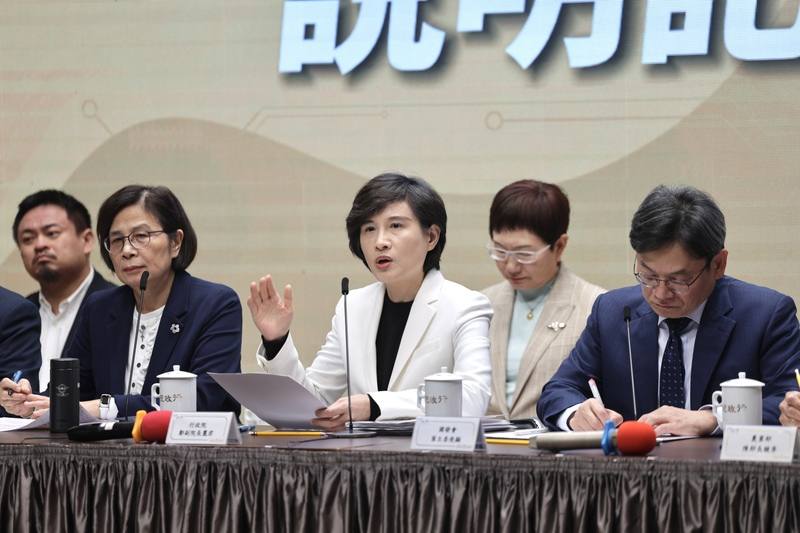
Speaking at a press conference Tuesday, Cheng said the Section 232 provisions will not be adjusted because the Supreme Court ruling did not involve those measures.
The "preferential conditions" Taiwan has already secured related to Section 232, Cheng said, included "exemptions within quotas and most-favored nation treatment beyond quotas," and those "will not change."
Cheng was responding to questions about the impact of the U.S. Supreme Court ruling on Feb. 20 that invalidated tariffs imposed under the International Emergency Economic Powers Act (IEEPA).
Those included the 15 percent baseline tariff, negotiated down from an original 20 percent, found in the agreement on reciprocal trade (ART) signed by Taiwan and the U.S. on Feb. 12.
Several countries are facing the same predicament of having agreed to trade frameworks based on U.S. tariffs that have now been ruled illegal, but as of Tuesday, those countries were generally waiting for clarification from the U.S. before deciding whether to stick with the deals negotiated.
Trump reacted angrily to the Supreme Court ruling, immediately invoking Section 122 of the Trade Act of 1974 to first impose a global 10 percent tariff and then adjusting that to a global 15 percent tariff a day later.
His administration also threatened possible use of Sections 301 and 232 to further impose punitive tariffs.
Cheng said Taiwan would wait for confirmation from the U.S. on final details related to the MOU and ART before submitting them along with an impact assessment to the Legislative Yuan for review and approval.
Taiwan has been in contact with the U.S. side since the Supreme Court ruling was handed down and was told that the U.S. is still studying potential responses and will inform Taipei and other trading partners with deals in place once a final decision is made, she said.
Meanwhile, in response to an inquiry from CNA, a White House spokesperson confirmed that the 15 percent to be assessed under Section 122 authority was "temporary" as the Trump administration pursues alternatives.
Trump still "expects all countries to continue abiding by their trade deal commitments on reducing trade barriers and other concessions, which have not changed," the spokesperson said.