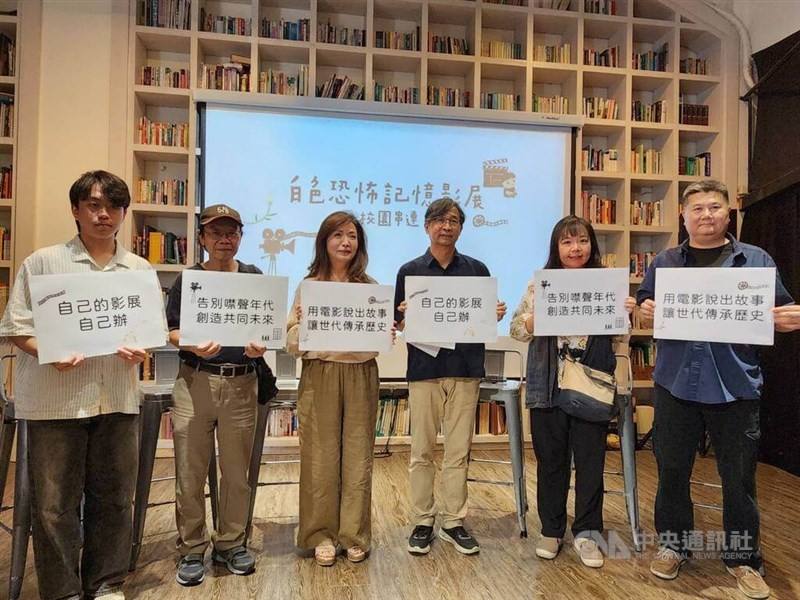
Taipei, April 27 (CNA) A cross-campus initiative was launched Monday aimed at screening and discussing films depicting the White Terror era at schools across Taiwan to deepen public engagement with the country's authoritarian past.
The initiative, co-organized by the Modern Culture Foundation and the New Taiwan Peace Foundation, seeks to link universities and other educational institutions through independently organized screenings, allowing campuses to curate and host their own events.
Student councils from more than 50 universities have joined the effort so far.
At a press conference in Taipei on Monday, organizers said the move builds on a White Terror film festival held in 2024 but shifts its focus toward a decentralized, grassroots model to overcome the limited impact of centralized screenings.
Chen Chun-hung (陳俊宏), a political science professor at Soochow University, said film can serve as a powerful medium for transitional justice by fostering dialogue and empathy.
"Through cinema, we can expand moral imagination and invite society to reflect on difficult histories," Chen said, specifically referring to the White Terror period.
The White Terror refers to a decades-long period of political repression under martial law in Taiwan, beginning in 1949 and lasting until 1992, during which tens of thousands of people were imprisoned, executed or otherwise persecuted for alleged political dissent.
The initiative, Chen said, emphasizes a bottom-up approach in which local organizers take the lead in curating programs.
Documentary director Kevin Lee (李惠仁) called for greater government support, including the creation of a publicly accessible database of films on the White Terror, noting that copyright and administrative barriers often hinder campus screenings.
In launching the initiative, the foundations are trying to overcome those barriers and put together a bank of films available for the activity.
Meanwhile, student representative Cheng Yu-lun (鄭宇倫) of the National Students' Union of Taiwan said the initiative would help bring historical memories back onto campuses.
"Memory is not a burden; forgetting is," he said.
The program will include a diverse lineup of films and encourage post-screening discussions, with plans to extend participation beyond universities to high schools and community venues, the organizers said.