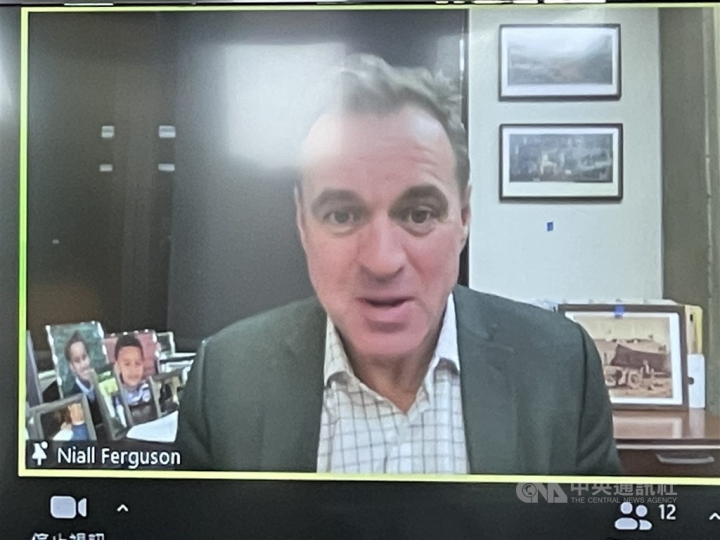
Taipei, Jan. 15 (CNA) British historian Niall Ferguson said Saturday China would likely ramp up pressure on Taiwan next year, stressing the key to warding off Beijing's threats against the island would be deterrence.
The British historian, known best for his television work and pop-history books, was speaking during a talk organized by the Taipei School of Economics and Political Science Foundation.
Attending the talk in Taipei virtually, Ferguson, the current Milbank Family Senior Fellow at the Hoover Institution of Stanford University, predicted that Beijing would likely increase its pressure on Taiwan next year after wrapping up the Communist Party's 20th party congress this autumn, at which Xi Jinping (習近平) is likely to secure a third term as leader.
Ferguson stated that Xi viewed taking Taiwan under China's control as the ultimate goal of his leadership and that the various internal problems in China, such as a slowing economy and a growing debt problem, had threatened the legitimacy of the Chinese Communist Party's (CCP) rule.
In the meantime, China has been facing a "backlash" by the international community over accusations it covered up the initial outbreak of the COVID-19 pandemic in Wuhan in late 2019 as well as its practice of "Wolf Warrior" diplomacy, he added.
Ferguson went on to say that the U.S. and its allies should be committed to a credible deterrence strategy that could prevent "China from acting recklessly with respect to Taiwan."
"Deterrence is key here," Ferguson said. "And it's not just the United States that can deter China. It's the United States and [its] allies," he said, alluding to countries such as Japan, which has openly expressed concern for the security and stability of the Taiwan Strait.
Ferguson contended that a "Cold War II" was happening between Washington and Beijing and that if such a war "turns hot" Taiwan would be a hotspot.
According to Ferguson, if Washington pursues a policy of verbal commitment to Taiwan while continuing its confrontational strategy in its dealings with Beijing, then a conflict could be triggered in which the island would be a battlefield.
In that case, it would be a "nightmare scenario" for Taiwan as the island would end up "being a battlefield in a battle that the United States is not actually properly prepared to fight," he added.
"Ultimately in a Cold War, there are two superpowers and your relationship with those superpowers is the most important decision you have to make in terms of a foreign policy," Ferguson said, adding he believed that "Taiwan has an easy choice" to make on this issue.
While commending Taiwan's efforts to fight off China's information warfare campaign, the scholar noted that Taiwan "does not really have a particularly compelling self-defense strategy at this point" to counter growing military threats from China, citing his recent discussions at the Hoover Institution with Taiwanese military experts.
"It [Taiwan] is far from being a porcupine," he commented, a clear reference to reports by Western media last year that U.S. and Taiwanese policymakers had been pursuing a "porcupine strategy" of increased coastal defenses and cruise missiles in the hopes of making the island a pricklier target.