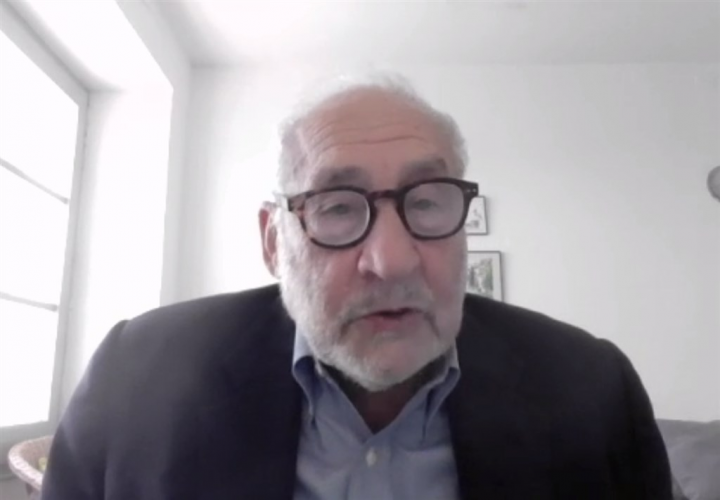
Taipei, May 7 (CNA) Nobel Prize-winning economist Joseph E. Stiglitz has called for greater international cooperation to address the "seismic" changes brought on by COVID-19 and the Russian invasion of Ukraine.
Stiglitz made the remarks during a talk given virtually to the Taipei School of Economics and Political Science Foundation Friday.
The former World Bank chief economist said that the pandemic and Russia's commencement of military operations in Ukraine on Feb. 24 would be marked by future historians as "cataclysmic" turning points of the 21st century.
Such challenges, Stiglitz said, had also underscored the need for collective action and international cooperation.
"None of us individually would have been able to combat the disease [COVID-19] or combat the economic effects of the disease," Stiglitz said.
Stiglitz argued that the economic toll of COVID-19 would have been considerably higher had it not been for the collective action of governments around the world.
The Columbia University professor offered the ratification of a 750 billion euro stimulus fund by all 27 EU member states in May 2021, as one example of a successful collective intervention.
However, Stiglitz warned that the fact that the world was more divided and moving toward "a new Cold War" could jeopardize the coordination of future international collaboration.
A world of liberal democracies and free-market economies envisioned by some economists in the past has not played out, and instead, the world is now overshadowed by the rise of authoritarianism in China and Russia, Stiglitz said.
"So the challenge that we are going to be facing is how do we wage this new Cold War and at the same time, cooperate in solving common global problems," Stiglitz said, adding that global problems such as climate change and pandemics could only be addressed by cooperative action by all the countries of the world.
Stiglitz also highlighted the importance of social cohesion and trust to tackle global challenges.
"Those societies that responded [to COVID-19] best, like New Zealand, were those where they trusted the government, they trusted science, and they showed respect for each other. There was a high level of social cohesion," Stiglitz said.
Regarding the rising price of goods worldwide, Stiglitz said he did not agree with the argument made by some U.S. politicians that such inflation had been caused by COVID-19 stimulus expenditure.
"The underlying problem is the supply chain problem," Stiglitz said.
As a result, Stiglitz argued that interest rate hikes, such as the 0.5 percent rise rolled out by the United States Federal Reserve this week, would not only fail to dampen inflationary pressure but could exacerbate it.
"In fact, an increase in interest rates may have adverse effects, because what we need to respond to a supply-side problem is investment," Stiglitz noted, adding that raising the interest rates would make investment more difficult.