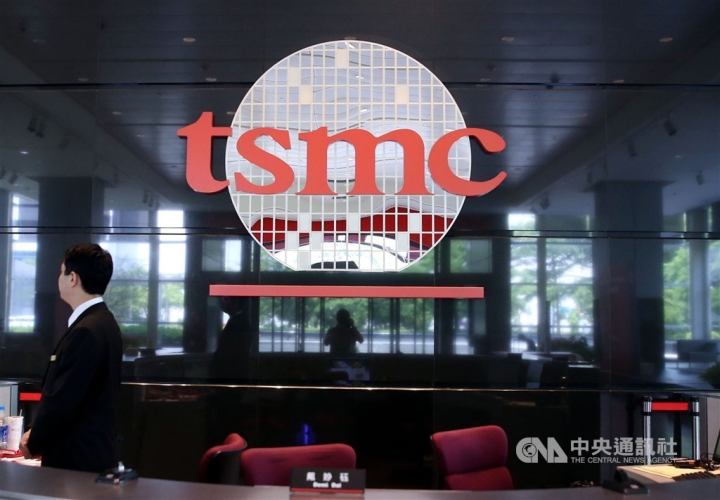
Taipei, Oct. 22 (CNA) Taiwan Semiconductor Manufacturing Co., the world's largest contract chipmaker, is expected to drive growth in the global pure-play wafer foundry industry in 2023, according to Taipei-based market information advisory firm TrendFroce Corp.
At a technology forum held by TrendForce earlier this week, Joanne Chiao (喬安), a senior semiconductor analyst at the advisory firm, said TSMC is expected to benefit from its efforts to develop the advanced 3 nanometer process, which is scheduled to start mass production later this year. Chips made using the process will command a higher profit margin.
Although the global pure-play wafer foundry industry has been undertaking inventory adjustments due to weakening demand, Chiao said, TSMC is expected to weather the headwinds on the back of a hike in product prices with the 3nm process expected to make a significant contribution to the chipmaker's sales in 2023, when the Taiwanese manufacturer is estimated to see its revenue rise 7-9 percent from 2022.
A trial run of the 3nm process started last year, with the 5nm process the latest technology for which TSMC launched mass production, accounting for 21 percent of the chipmaker's total sales in the second quarter of this year. An upgraded version, known as 3nm enhanced (N3E), is expected to begin commercial production in a year.
TSMC's 3nm family uses FinField-effect-transistor (FinFET) technology, a 3D transistor structure that allows a chip to run faster using the same amount of power or to run at the same speed on reduced power, according to the chipmaker.
On the back of TSMC's growth, the global wafer foundry industry is expected to grow in 2023 by about 2.7 percent, although the growth will moderate from an expected 28 percent year-on-year increase in 2022, when wafer foundry operators enjoyed high growth resulting from emerging technologies such as 5G applications, and COVID-19 and geopolitical tension driven demand earlier this year.
According to Chiao, the global wafer foundry industry had entered a cyclical peak since 2020, when sales grew 24 percent from a year earlier, and year-on-year growth even hit 26.1 percent in 2021.
The current demand weakness in the global wafer foundry business is a result of fast growing inflation worldwide and China's zero tolerance COVID-19 policy, while U.S. sanctions on the export of IC and related production equipment to China amid escalating trade tensions between Washington and Beijing are expected to have an adversary impact on the global semiconductor industry, Chiao said.
Although many countries are pushing for projects to build their own wafer fabs, Taiwan's lead over its peers in sophisticated process development will ensure it continues to dominate the global market, Chiao said.
However, as more and more wafer fabs will roll out chips, an increase in supply is expected to present semiconductor producers with new challenges, she said.
In the same forum, H.P. Chang (張小彪), COO of TrendForce Research Operations Center, said he remains cautious about the business outlook for the global manufacturing sector in 2023.
There is no sign that inflation in the United States and Europe will be brought under control anytime soon and China's economy has been slowing amid the COVID-19 pandemic, which has created uncertainties over the global economy, Chang said.