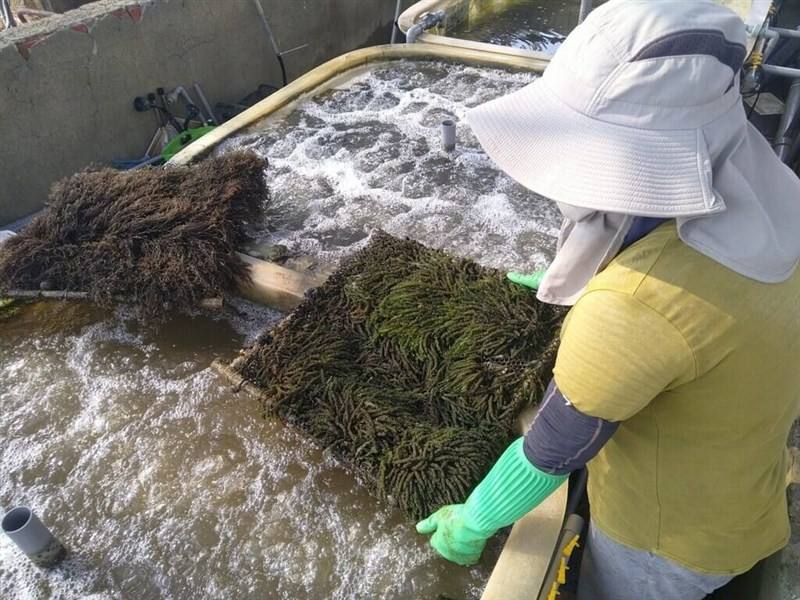
A seaweed breeding program in Taiwan has successfully cultivated two types of native giant seaweeds, or marine algae, enabling the restoration of marine habitats, the National Academy of Marine Research (NAMR) said on Monday.
The success in cultivation of the macroalgae species would also enable a stable supply of seedlings and enhance ocean carbon sinks, it added.
The NAMR under the Ocean Affairs Council collaborated with the Ministry of Agriculture's Fisheries Research Institute to build a farm for cultivation of large seaweeds at the institute's Mariculture Research Center earlier this year and developed techniques for mass culture of native giant seaweed species, the NAMR said in a statement.
As part of the project, researchers collected 48 native species of large seaweeds in waters off southern Taiwan and moved the fresh algae to land-based tanks for cultivation in large amounts, the NAMR indicated.
The research team designed land-based water tanks and improved the algae production and cultivation model, including regulating natural light sources, using flowing water for cultivation without fertilization, and reducing the labor cost of harvesting algae, to provide a stable source of algae for high-value recycling utilization, according to the statement.
The center said after cultivating large seaweeds by the team, two types of native large seaweeds, namely Caulerpa lentillifera, commonly known as "sea grapes," and Gracilaria firma were found to be suitable for mass production.
During the cultivation and mass production process, these algae species were found to be able to survive in unfavorable conditions such as high water temperatures in summer and large changes in salinity, according to the center
It added that after one month of cultivation, the biomass changed, and the growth rate of sea grapes increased by as much as nine times, while Gracilaria firma grew three times.
The NAMR on July 13 delivered the mass-produced giant algae to the Fisheries Research Institute which then shipped the large seaweeds using its research ship to the artificial algal field facilities in the Taiwan Strait for cultivation and testing.
These macroalgae cultivated in large amounts in warm water temperatures this summer will be used in research related to marine carbon sinks in the future as they possess excellent carbon-absorption properties and can help control pollution, the center said.
The macroalgae can be used in high-value industries, such as food, biomedicine, energy and environmental protection in the future and will help promote the government's policy of transitioning to a net zero energy system by 2050 to enhance the function of ocean carbon sinks and benefit marine ecosystems, the NAMR said in the statement.