In order to make organic light-emitting diodes (OLEDs) brighter and more colorful in the display fields of mobile phones, computers and TVs, with the sup-port of the National Science and Technology Council (NSTC), Professors Ken-Tsung Wong and Pi-Tai Chou of the Department of Chemistry, National Taiwan University developed a new supramolecule, providing a new vision for realizing low-cost, high-efficiency OLED devices in the future. This research result has been published in the international high-impact academic journal "Nature Chemistry" in January (2024), and has been attracting widespread attention in the academic community.
Today, the popularity of OLEDs is limited, in part because of the higher pro-duction costs of using light-emitting materials containing precious metals such as iridium. To further enhance the advantages of OLED displays, current research is using a technology called "thermally activated delayed fluorescence" (TADF) that can convert electrical energy into light energy more efficiently. However, a key challenge is to understand the interrelationship between the design of organic ma-terials, their structure and photophysical properties. Only in this way can we achieve the goal of OLED to reduce costs and improve efficiency.
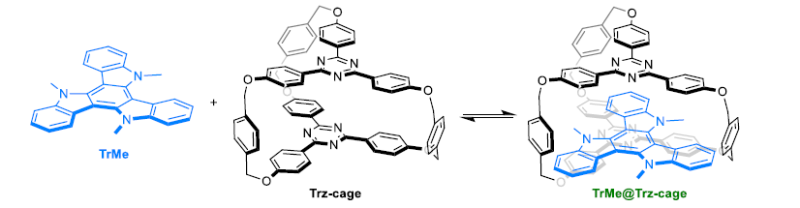
The NTU-chemistry team adopted an innovative strategy to design and syn-thesize a highly symmetric cage-like host molecule with electron-accepting prop-erties (black building blocks), and a guest molecule with electron-donating proper-ties (blue building blocks) that can be placed into the host cage, successfully creat-ing a new supramolecule capable of exhibiting TADF.
Detailed X-ray analysis of the grown single crystal confirmed that the blue blocks are inside the cage created by the black blocks. The team also found that the assembly of this supramolecule is an entropy-driven process, elegantly demonstrating that scientists are able to utilize chemistry principles to access a new technology. In addition, blue blocks (guest molecules) with different electron-ic and structural properties can be placed in the cage to regulate the emission col-or of the supramolecule, rendering versatility and flexibility of this new framework for the lighting application.
Overall, the new system reported by the NTU-chemistry team gains a new understanding on the formation thermodynamics of exciplexes. This breakthrough liberates exciplexes from previous constraints on understanding the interactions between molecules, laying an important foundation for the future application of exciplexes in OLEDs.