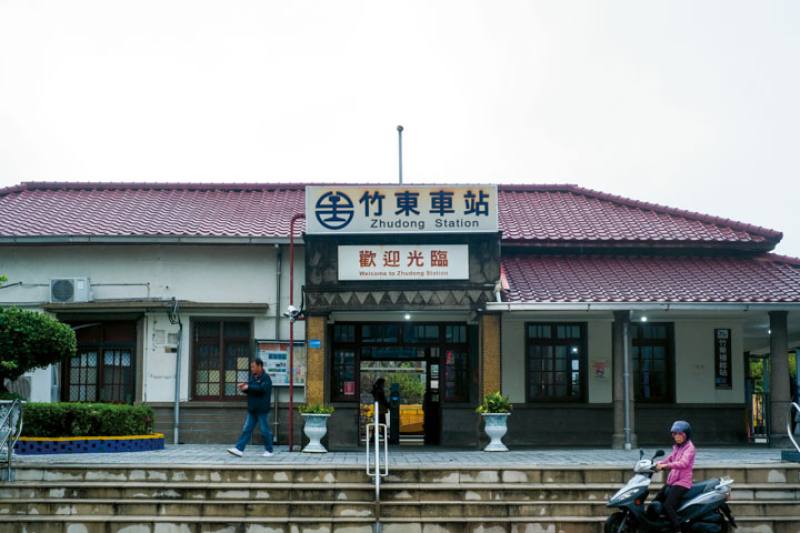
When the name of Hsinchu County’s Zhudong Township is mentioned, the first thing many people think of is the delicious Hakka rice-based foods sold in its Zhongyang Market. However, Zhudong is not just some unsophisticated agricultural settlement, but was the starting point of Taiwan’s high-tech industry. More than 90 years ago, a huge fire that broke out during oil exploration operations sparked this town’s industrial development.
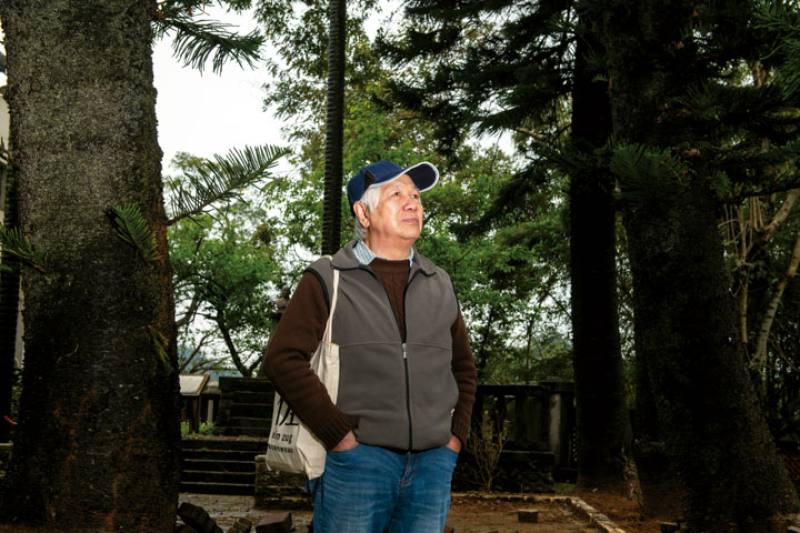
Local historian Li Xuchuan tells us the story of Zhudong. Lying at the heart of Hsinchu County’s mountain communities, it was in its earliest days a distribution point for agricultural products. But a shocking event that occurred in 1934, during the Japanese colonial era, caused Zhudong to transform. Opening a book of historic photographs of Zhudong, Li points to one showing a raging fire, and explains: The Taiwan Governor-General’s Office had commissioned the Taiwan Mining Company to explore for oil at Mt. Yuandongzi in Zhudong, and the plan called for a test well to be bored 1,000 meters deep. But at only 300 meters down a large amount of natural gas spurted out, and when it came into contact with the fires heating the boilers of the steam-driven machinery it exploded, creating an uncontainable inferno.
Big fire sparks a new future
“The flames reached seven stories high and it was impossible to approach to within 100 meters of the conflagration, which burned for more than 30 days before exhausting itself.” Li relates that the fire caused huge losses, with costs totaling more than ¥300 million. But the fire also made Zhudong famous as the site of oil and gas fields, attracting people with an interest in these resources to settle there. From that point on, the town began to transition from agriculture and small trading businesses to a period of industrialization.
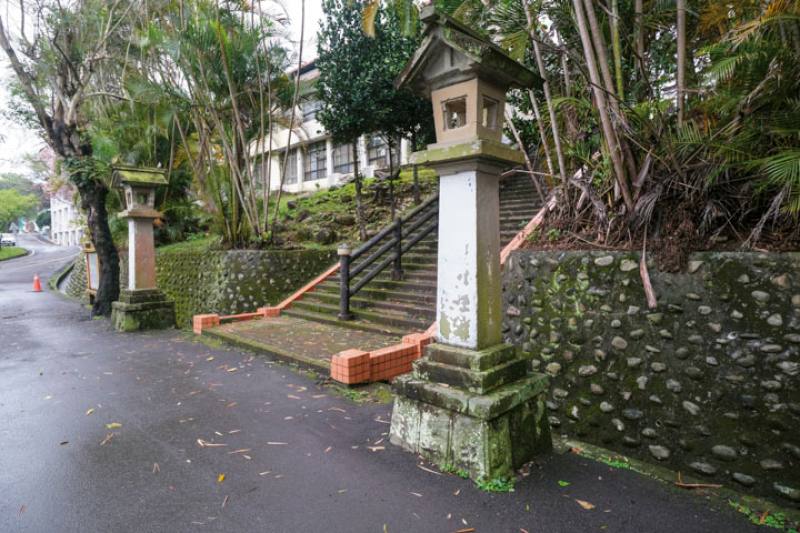
Exploring the traces of Zhudong’s industrial past with the help of Li’s collection of old photographs, we arrive at the remains of Yuandongshan Shinto Shrine, located on the grounds of Yuandong Elementary School. The fire provided evidence of Zhudong’s potential for development, and the area’s oil and natural gas industry came into being. In order to ensure the safety of those engaged in exploration and extraction, in 1935 a leading family in the town donated land and citizens contributed money to build the shrine, which is dedicated to the guardian deity of the petroleum industry, Ame no Kagoyama no Mikoto.
Gas research gives birth to high tech
From behind Yuandong Elementary School we hike up a small slope and see the stairway leading to the shrine, with intact stone lanterns on each side. Climbing the stairs, we come to a hilltop, where we see the well-preserved foundations of the Shinto shrine. Surrounded by Japanese cedars and acacia trees, the remains evoke a tranquil atmosphere, and we can’t help but imagine scenes of people worshiping here back in the day.
Li Xuchuan states that the Taiwan Mining Company extracted a great deal of natural gas here. Besides supplying the emerging petrochemical industry in Zhudong, enough gas was produced to prompt the Governor-General’s Office to found a natural gas research institute in 1936. Renamed the Joint Industrial Research Institute in 1954, it undertook a broad range of industrial technology research. In 1973 the Joint Institute was one of three organizations that merged to form the Industrial Technology Research Institute, which gradually built semiconductor R&D into a major focus of its work. Li suggests that if you want to really go into detail, Taiwan’s current status as the center of international semiconductor production can be traced back to Zhudong’s natural gas resources.
Preserving the memories of an era
To enable their employees to work in Zhudong with peace of mind, the Taiwan Mining Company built a residential compound at the foot of the hill where the Yuandongshan Shinto Shrine is located. In park-like surroundings they built living quarters for more than 200 households, with comprehensive communal infrastructure including a kindergarten, a clinic, a club, a hair salon, public baths, and an auditorium. “It had all the services and facilities one could need from birth to death, so that people might live their whole lives without setting foot outside the walls” says Li with humor.
After World War II and the arrival of the Nationalist government in Taiwan, the residential compound was rechristened “Ziyuan Village,” but retained its communal facilities and remained a symbol of local prosperity. Li says that when he studied at Yuandong Elementary School, many of the students came from Ziyuan Village. While children like him from poor farming families came to school barefoot with shaved heads, if he saw a classmate with shoes and a full head of hair, he knew they must come from Ziyuan Village.
The walled compound was not closed to the outside world, and many people from Zhudong share memories of eating shaved ice in its cold drinks bar. Sadly, the entire swath of Japanese buildings was torn down in the 1980s, leaving behind only the auditorium and the employee welfare center. Still, memories of life in Ziyuan Village back in the day are not only engraved in the memories of Zhudong people, there are also many old photographs on display in the auditorium, where they are accessible to the general public.
The welfare center originally included a general store and hot and cold drinks bars, but later only the cold drinks bar remained. Selling frozen ice treats to outsiders, it was a great place for Zhudong folks to beat the summer heat. In May of 2024, there was a fire at the welfare center which left many Zhudong natives heartbroken. Fortunately, thanks to efforts by Li Xuchuan and other local historians, China Petroleum Corporation followed suggestions to relocate the cold drinks bar to the auditorium, where it once again is up and running.
Li states that the origins of the ice treats from Ziyuan Village can be traced back to formulas and techniques handed down from the Japanese era. The main raw material is clean, fresh tap water from the Yuandong waterworks. It is brought to a boil and then sugar and fruit juice are added, and the mixture is frozen to make the final product. “The first ice treat I ever ate in my life was a mung-bean popsicle from Ziyuan Village.” Li describes the taste as putting him into a state of ecstasy. In addition, the banana-flavored popsicles from Ziyuan Village had a special sweet flavor of their own. Connoisseurs would sprinkle a little salt on them, which not only did not clash with the taste of the ice, it made it even sweeter!
Fine Hakka craftsmanship
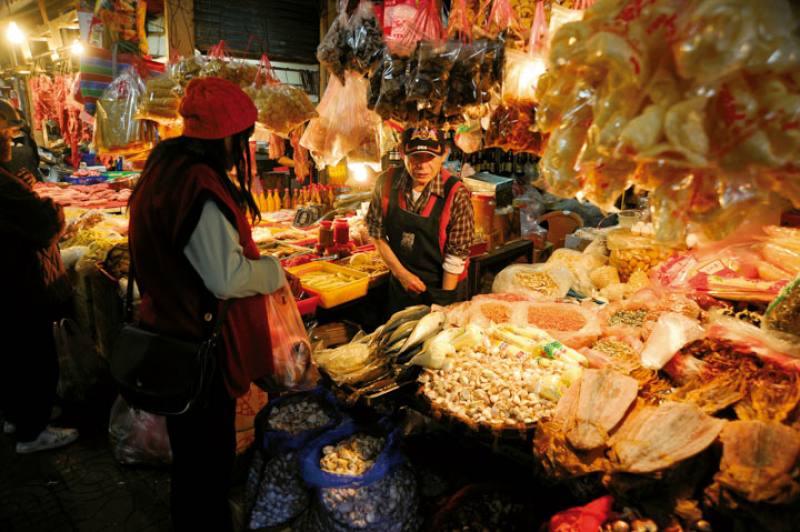
Industry flourished in Zhudong, bringing waves of people to the area, and the town’s traditional market expanded in turn, eventually becoming today’s bustling Zhongyang Market, also known as Zhudong Market.
At one o’clock in the morning, the day has already begun at the market. Workers set out movable shelters and vendors open their booths or put out their wares on their stalls. Local elders bring vegetables that they have grown themselves and set up little stalls in the market to sell them. Li teaches us how to identify these small farmers who are selling their own produce: They usually have only a few types of fruits and vegetables to sell and they are not as beautiful to the eye as those bought from wholesalers, but each of their offerings is set out with care. These elders are not doing it for the income, but just to give them something to do and to chat in passing with their regular customers. It’s a phenomenon that is rarely seen at traditional markets in urban areas.
Zhongyang Market brings together more than 700 vendors, of which quite a number sell Hakka products made with skills passed down through many generations. One example is various types of traditional Hakka ban, which are rice-based foods. According to Li Xuchuan, these date back over 200 years. Passed down from generation to generation among Hakka people, they are indispensable for religious offerings at the Lunar New Year and as snacks in daily life.
As for authentic Hakka cuisine, the seasonings used by Hakka women play a critical role. “Jiepo” (“Granny”) fried shallots, sold at a stall in Zhongyang Market called “Granny’s Fried Garlic,” are an example of fine craftsmanship passed down through a family. The stall’s name refers to the fact that stallholder Peng Li-chen inherited her recipe from her mother and her maternal grandmother. The family has always insisted on using high-quality lard from black pigs, and fresh shallots that are chopped just before they are used. The glossy, golden-yellow fried shallots are very fragrant, and when you try a bite they have the crispy texture of Prince noodles (a popular snack food that brings back childhood memories for many Taiwanese). They go well with noodles and blanched green vegetables.
The frugality for which Hakka are famous is manifested in their knowledge of food preservation. In Zhongyang Market one can find many classic Hakka preserved foods including suancai, fucai, and meigancai, all tracing their origins back to the way Hakkas treasure food ingredients. Suancai is made by pickling fresh mustard greens, which are fermented for one to two weeks. Fucai is made by drying suancai in the sun and wind until it is half dry, then tightly packing it in jars to ferment further. Meigancai is made by fully drying suancai in the elements, then tying it into bundles and storing it indoors for at least six months. All of these are made from mustard greens, but have markedly different flavors. Such practical knowledge passed down from generation to generation has become the soul of Hakka cuisine.
If you grow tired while roaming the market, you can stop at its service center to rest your feet. There you will find a tea dispenser with tea prepared daily by Hu Kunlong, director of the Zhudong Hakka Traditional Market Promotion Association. Hu is carrying on the memory of his grandaunt, who would carry a teapot and set it up under a tree to enable passersby to quench their thirst, just out of kindness and hospitality. Today this tradition has become a heartwarming feature of Zhudong Market.
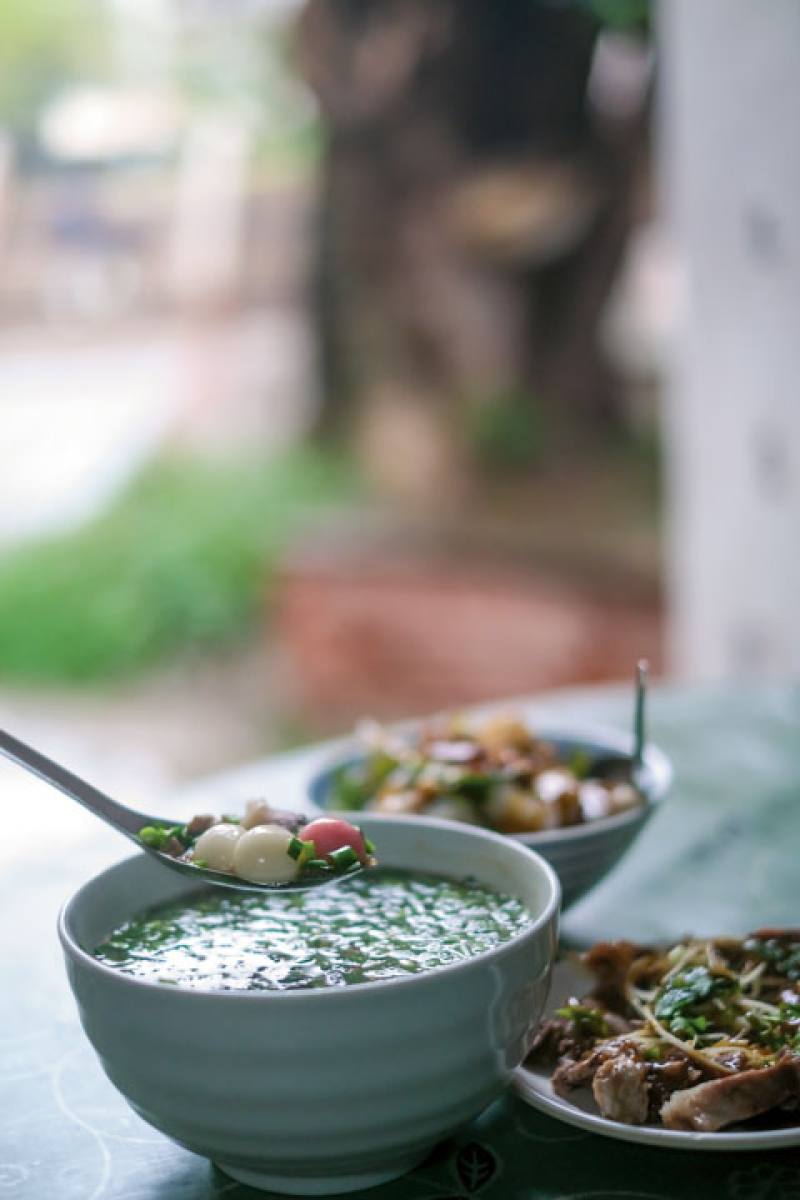
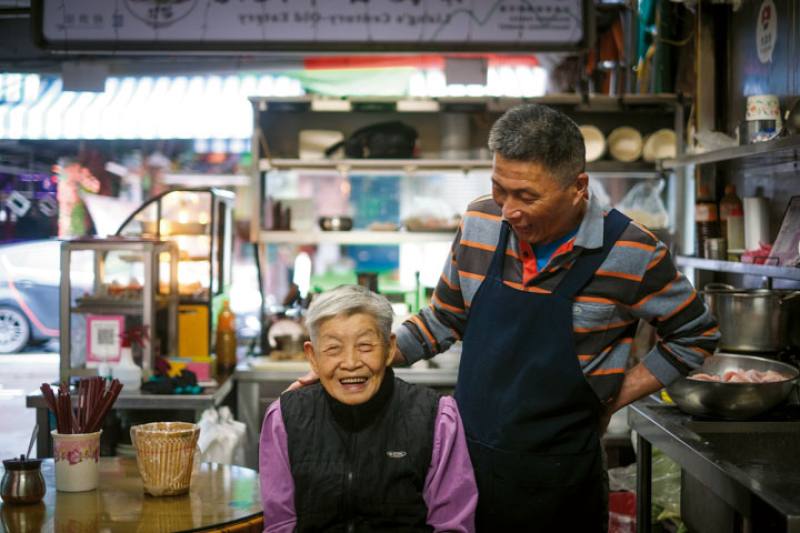
When you have finished strolling around the shops and stalls, why not stop at Liang’s Century-Old Eatery in the market to enjoy freshly made Hakka flat rice noodles or a bowl of steaming hot Hakka tangyuan (filled glutinous rice balls). The refreshing broth, made each day by the eatery’s owner and served with generous amounts of Chinese chives and shallots, is both warming and comforting. Or you can order a plate of Hakka pocai, which is made with vegetables such as sweet potatoes, yams, and carrots that are dipped in a flour batter and deep fried to make breaded veggies which retain their sweetness without being oily; they are both tasty and filling.
Traces of history everywhere
If you look closely at the older houses in Zhudong, you will see that many of them retain decorative metal window lattices or walls faced with washed aggregate, symbols of the area’s past prosperity. As we stroll through the street, our attention is suddenly seized by a sign in Japanese reading “Zhudong Sales Center for Products of the Teikoku Seiyaku Company [Imperial Pharmaceuticals Company]” along with the name of a Japanese specialty medicine “Senkintan,” indicating that this is a shop dating back to the era of Japanese rule.
It is only after entering the shop that we learn that it is a pharmacy called Dashengtang that was founded in the late Qing Dynasty. For the first two generations, it sold Traditional Chinese Medicine, but began to incorporate Western pharmaceuticals in the third generation. Today the shop is in the hands of the founding family’s fifth generation.
Fifth-generation owner Liu Shufen says that the sign outside the pharmacy was one of 12 sent by Teikoku Seiyaku to Taiwan during the era of Japanese rule, and it is the only remaining one in all of Taiwan. Many years ago, Teikoku Seiyaku wanted to acquire the sign for its museum and hoped that the pharmacy would be willing to part with it. “Even the signs in Japan were all destroyed, so this might be the only one of its kind left anywhere in the world,” says Liu Shufen’s mother, Li Meihui, the fourth-generation proprietor.
In the end, Li Meihui declined the Japanese request and kept the sign at the pharmacy. She did so because it is a part of Dashengtang and a witness to history, and so mother and daughter decided to keep this precious historical artifact in Taiwan. This is an example of how traces of Zhudong’s former prosperity can still be found hidden in the most unexpected of places.