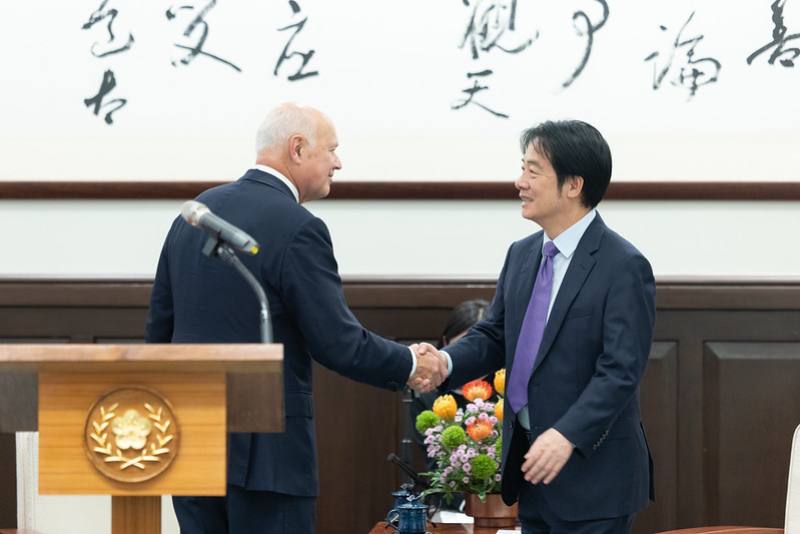
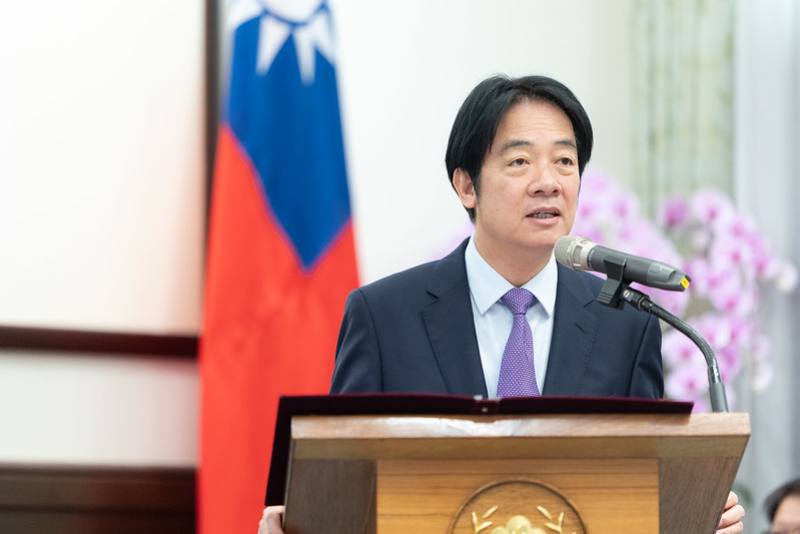
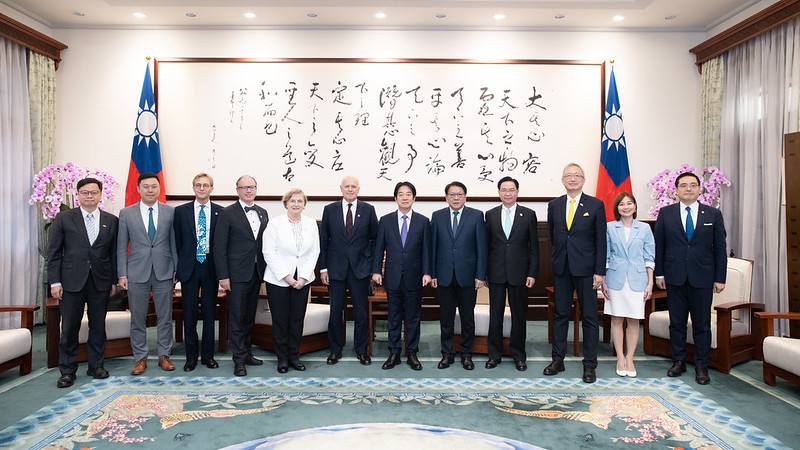
On the afternoon of August 27, President Lai Ching-te met with a delegation from the Inter-Parliamentary Alliance on China (IPAC). In remarks, President Lai thanked IPAC for continuing to support Taiwan through concrete actions. President Lai emphasized that Taiwan will continue to bolster its national defense capabilities and deepen collaboration with democratic partners to enhance deterrence. The president expressed hope that IPAC, through its inter-parliamentary network, will be able to bring together even more like-minded partners to stand side by side in protecting democracy, peace, and prosperity in the region and around the world.
A translation of President Lai’s remarks follows:
I thank our dear friends from IPAC for visiting and for demonstrating staunch support for democratic Taiwan. In July last year, the largest ever multinational delegation of lawmakers visited Taiwan to attend IPAC’s annual summit in Taipei. The summit adopted an IPAC model resolution on United Nations General Assembly Resolution 2758 to help Taiwan counter China’s lawfare. Because of IPAC’s principled actions, the national parliaments of countries including the United Kingdom, the Netherlands, and the Czech Republic, as well as the European Parliament, have passed Taiwan-friendly resolutions or motions. The executive branches of numerous countries have also openly expressed support for Taiwan. We look forward to seeing even more countries join this effort.
I also want to thank IPAC for continuing to support Taiwan through concrete actions this year. It expressed concern over China’s military exercises around Taiwan this April and condemned China for planning a collision with then-Vice President-elect Bi-khim Hsiao’s car during her visit to the Czech Republic last March. IPAC also arranged events to engage with Taiwan’s high-level delegation during the Copenhagen Democracy Summit held in Denmark.
In recent years, China has continued its political and military intimidation against Taiwan and neighboring countries. These actions have severely disrupted regional peace and stability. And as China, Russia, and other authoritarian regimes continue to converge, democracies must foster more comprehensive cooperation so as to safeguard peace, freedom, and democracy.
Moving ahead, Taiwan will continue to bolster its national defense capabilities and deepen collaboration with democratic partners to enhance deterrence. Our defense spending, as defined by NATO, will reach 3.32 percent of GDP in 2026. And our goal is to increase that number to five percent of GDP by 2030. This will help Taiwan enhance its self-defense capabilities and further contribute to the maintenance of regional peace and stability.
Taiwan will also work alongside other democracies in such fields as energy, AI, and high tech to build more resilient industrial structures and democratic supply chains, demonstrating greater unity, spurring greater economic prosperity, and further consolidating our democracy. Looking ahead, I hope that IPAC, through its inter-parliamentary network, will be able to bring together even more like-minded partners to stand side by side in protecting democracy, peace, and prosperity in the region and around the world.
IPAC Co-founder and Member of the Parliament of the United Kingdom Iain Duncan Smith then delivered remarks, first thanking President Lai for taking the time to meet with them. He said that their visit here the last few days has been incredibly helpful to chart the course for IPAC over the next year.
MP Smith said that IPAC will be holding a much bigger meeting in Belgium in November to discuss the rising challenge we face today. We see this challenge manifested in Ukraine, he pointed out, with Russia’s brutal invasion of that country, and the coming together of a threatening group of authoritarian states such as Iran, North Korea, and China, to support Russia in that endeavor. He said that this obviously has an impact on a variety of different areas, and particularly, what is happening there has an impact on the treatment of Taiwan in the future. What they wish, he underlined, is to draw the attention of all the governments that are part of IPAC to this issue and to stop authoritarian states from doing something similar here.
MP Smith said that IPAC now has members from various parties in the parliaments of 53 countries who, whether on the left or right, cooperate together against the threat of the autocracy in China. They wish, he said, to bring together all of the freedom-loving states of the world to recognize the threat that is now posed to our democracies and freedoms, and to group together to protect those here in Taiwan.
The delegation also included former Foreign Minister of Poland Anna Fotyga, Member of the Swedish Riksdag (parliament) Magnus Berntsson, and IPAC Co-founder and Executive Director Luke de Pulford.